1614
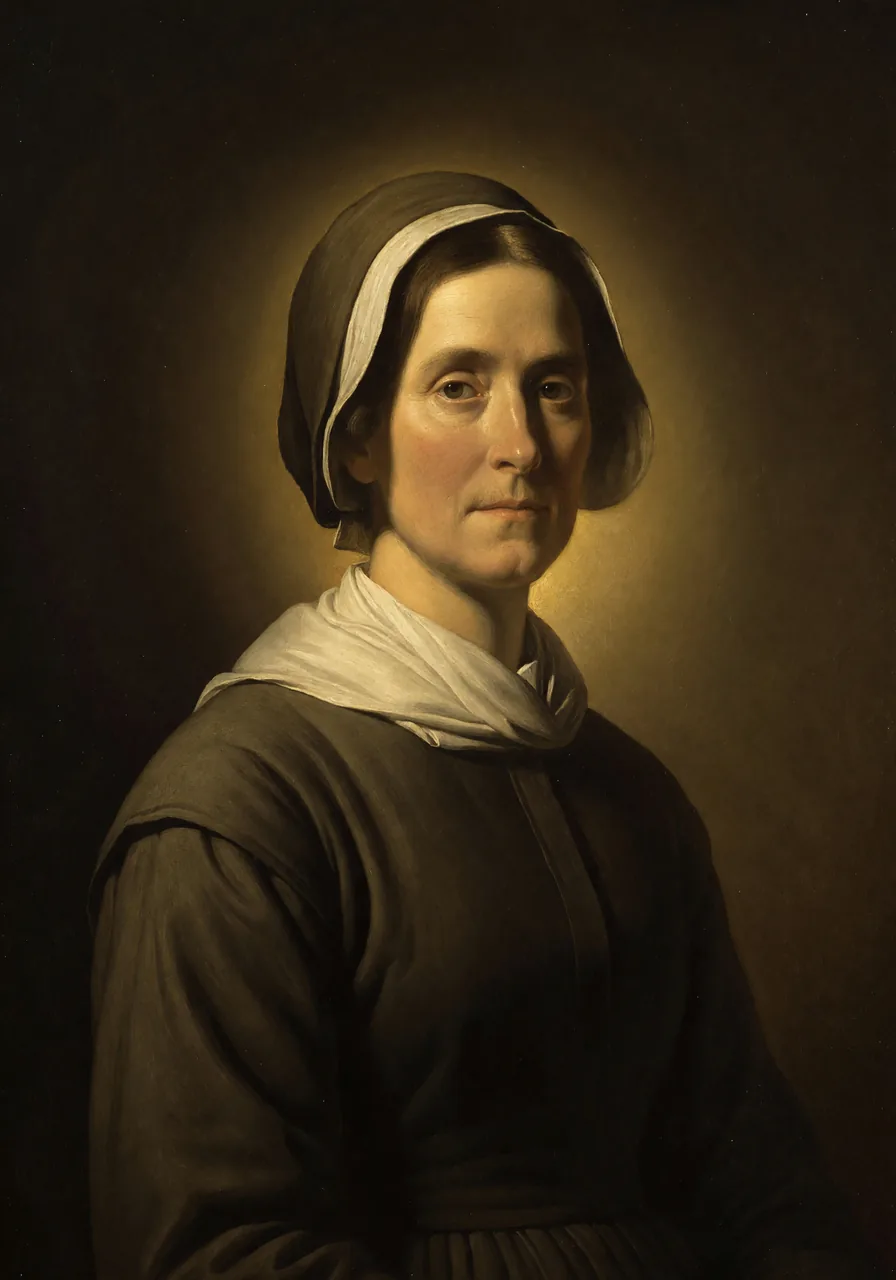
Margaret Fell Born
BirthBorn Margaret Askew at Marsh Grange, Lancashire, into a landed gentry family with Puritan sympathies.
From the religious upheaval of the English Civil War to the establishment of religious toleration, follow the journey of the First Friends.
1614–1646: Seeds of Upheaval
England is torn apart by civil war. Traditional religious authority collapses. New spiritual movements begin to emerge.
Born Margaret Askew at Marsh Grange, Lancashire, into a landed gentry family with Puritan sympathies.
Son of Isaac Penington, Lord Mayor of London and Master of the Mint. The Peningtons were wealthy, educated, and powerful.
Born at Hemswell, Lincolnshire. Little is known of his early life — he appears to have been a farmer or artisan.
Born at Todthorne, Westmorland. Before his convincement he served as an Independent (Congregationalist) minister.
Born in England. He would become one of the four Quaker martyrs executed in Massachusetts, his final epistle from prison among the most powerful documents in Quaker literature.
Born in Drayton-in-the-Clay (now Fenny Drayton), Leicestershire, son of a weaver known as 'Righteous Christer.'
Born at Colchester, Essex. Crisp would pass through Baptist and Independent congregations before finding Quakerism.
Born in Cornwall. As an adult he would become George Fox's most trusted London operative — a skilled negotiator who secured legal protections for Friends from Charles II and James II.
Born at Underbarrow, Westmorland — a remote region where underground Seekers flourished and traditional religious structures were weak.
Born in the north of England. He would settle in Sussex and endure some of the most brutal persecutions of any first-generation Friend.
Born at Sunbiggin, Westmorland. Convinced at just 16, he would become the longest-lived of the First Publishers of Truth.
Born in Berkshire. An early seeker, he would endure repeated imprisonment and suffering for his Quaker convictions, leaving a vivid persecution narrative.
Born at Crowell, Oxfordshire, into a respectable gentry family with Puritan leanings.
King Charles I raises his standard at Nottingham. Religious censorship weakens as Parliament and King divide the nation. Sects and dissenting groups multiply.
Son of Admiral William Penn, the most powerful naval commander of Cromwell's era. His mother was Dutch, giving him cosmopolitan connections.
Parliamentary forces defeat the King. Religious censorship and control from the Established Church weakens. Sects and dissenting groups multiply.
After years of seeking, Fox hears a voice: 'There is one, even Christ Jesus, that can speak to thy condition.' He declares: 'Then did my heart leap for joy.'
“I saw that all flesh must in silence wait upon God for His guidance.”
— George Fox, Journal
Born at Gordonstown, Morayshire, into a Scottish family with aristocratic connections. His uncle was General John Barclay.
Fox imprisoned at Derby for blasphemy. Justice Gervase Bennet mocked him as a 'quaker' — one who trembles at the Word — and the name stuck.
Fox's Yorkshire ministry wins over Richard Farnworth, James Nayler, and William Dewsbury — three powerful preachers who carry the Quaker message across England.
Fox preaches for three hours on a rock near Firbank Chapel to over a thousand Seekers. Francis Howgill, John Audland, and John Camm are convinced — experienced preachers who immediately begin their own ministries.
“The Lord opened my mouth, and the everlasting Truth was declared amongst them, and the power of the Lord was over all.”
— George Fox, Journal
Margaret Fell, wife of Judge Thomas Fell, hears Fox preach at Ulverston Church. She is struck to the heart. Swarthmore Hall becomes Quakerism's administrative headquarters.
The 18-year-old Burrough hears Fox preach at a Baptist chapel in Sedbergh. His convincement is immediate and complete. He begins traveling with Francis Howgill.
At just 16, Whitehead is convinced by Nayler's preaching in Westmorland. He becomes one of the youngest First Publishers of Truth.
Fox spends seven months in Carlisle prison under harsh conditions. His famous letter 'Friends, be valiant for the truth' is written here.
Mary Fisher, a former servant girl, and Elizabeth Williams travel to Cambridge to preach to university students. The mayor has them publicly stripped to the waist and whipped through the streets — one of the earliest and most shocking acts of persecution against Quaker women.
Howgill and Burrough arrive in London as inseparable partners. Within three years they convert thousands and establish Quaker meetings throughout the capital.
Fox meets Oliver Cromwell at Whitehall. The Lord Protector receives him warmly. Cromwell says of Fox: 'He is not a fool.'
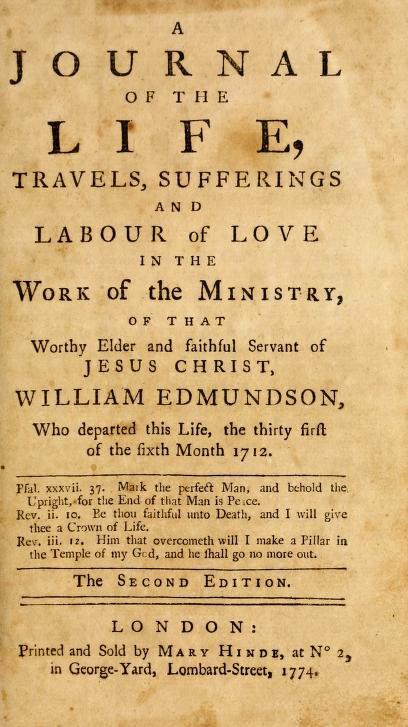
William Edmundson, a former Cromwellian soldier settled in County Armagh, establishes the first Quaker meeting in Ireland at Lurgan. He becomes the 'father of Irish Quakerism,' planting meetings across the island despite persistent persecution from both Anglicans and Catholics.
After passing through Baptist and Independent congregations, Crisp encounters Quakers at Colchester and is convinced. He becomes the movement's foremost Continental missionary.
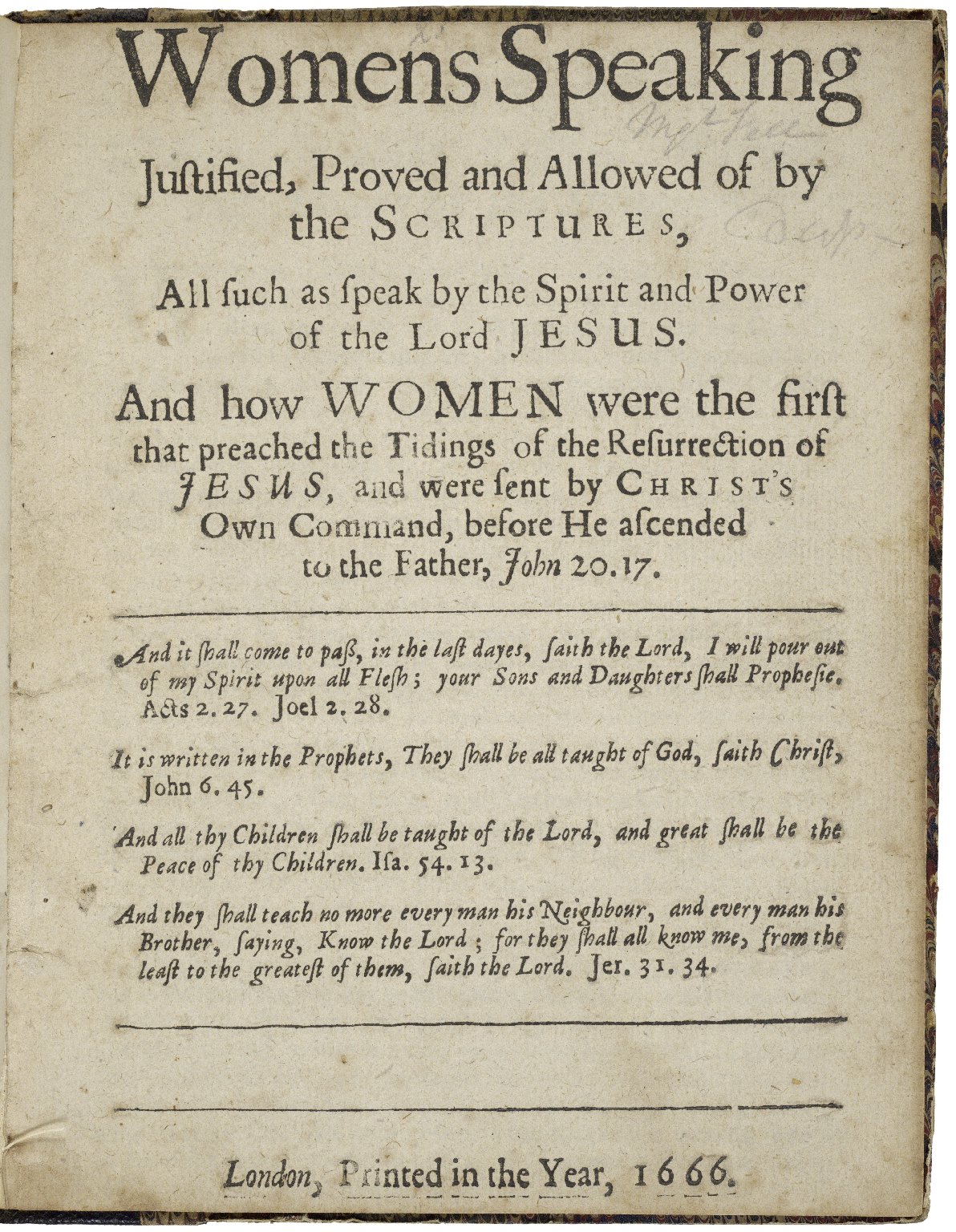
Margaret Fell publishes her most important theological work, defending women's ministry from Scripture. It becomes foundational for Quaker theology and proto-feminist thought.
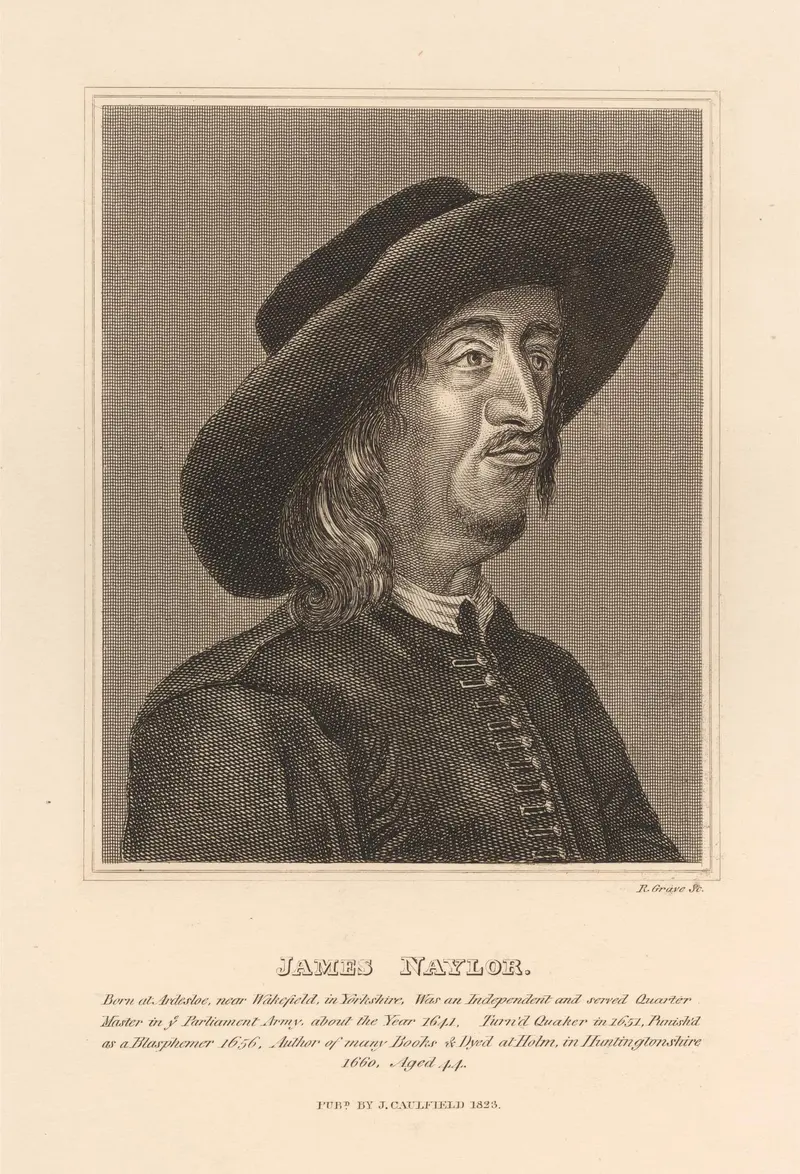
James Nayler enters Bristol on horseback, acclaimed by followers in a reenactment of Christ's entry into Jerusalem. Parliament punishes him brutally — whipped, branded, bored through the tongue. The movement faces schism.
“The Lord of heaven and earth was come to reign, and I did witness Him the same day.”
— James Nayler's defense
James Parnell, the youngest of the First Publishers of Truth, dies in Colchester Castle at just nineteen. Forced to climb a rope to reach his cell high in the castle wall, he falls and sustains injuries from which he never recovers. He is remembered as Quakerism's first martyr.
After years of reading Fox's writings and attending meetings, the wealthy Penington declares himself convinced. His transition is intellectual and mystical — theology meets experience.
Mary Fisher, a former servant girl from Yorkshire, travels alone across the Mediterranean to deliver her Quaker message to Sultan Mehmed IV at Adrianople. The Sultan receives her with full diplomatic courtesy and listens through interpreters — more respect than any Christian magistrate ever showed her.
A young poet named Thomas Ellwood meets George Fox, fresh from prison. An enduring friendship begins — Ellwood will become Fox's trusted friend and scribe.
Oliver Sansom, a Berkshire tradesman, encounters Quakers and is convinced. He would endure years of imprisonment and financial ruin for his faith, becoming one of the most vivid chroniclers of first-generation suffering.
Charles II is restored to the throne. Quakers are persecuted as 'dangerous radicals.' The Quaker Act makes meetings illegal. Thousands are imprisoned.
Nayler, reconciled with Fox, is set upon by robbers on a journey and dies of his injuries. His last words become among the most famous in Quaker literature: 'There is a spirit which I feel that delights to do no evil...'
“There is a spirit which I feel that delights to do no evil, nor to return evil for evil, but delights to endure all things, in hope to enjoy its own in the end.”
— James Nayler's dying words
William Dewsbury, one of the most powerful early Quaker preachers, is imprisoned at York Castle with the Restoration. He will spend nearly twenty of the next twenty-eight years behind bars, writing influential epistles on church discipline and spiritual faithfulness from his cell.
Samuel Fisher, a Cambridge-trained Baptist minister turned Quaker, publishes Rusticos ad Academicos — a 900-page work of biblical criticism that anticipates modern textual scholarship by two centuries, arguing that Scripture has been altered by copyists and translators.
William Leddra becomes the last of four Quaker martyrs hanged on Boston Common, following William Robinson, Marmaduke Stephenson, and Mary Dyer. His epistle from prison, written the night before his execution, is among the most powerful documents in Quaker literature. The executions provoke outrage in England; Charles II intervenes to halt further hangings.
“In the love and life of God I commit my outward being into your hands, counting it of less value than my testimony.”
— William Leddra, epistle from Boston prison
Parliament passes the Quaker Act, making it illegal for five or more Quakers to meet for worship. Thousands are imprisoned. The 'great persecution' begins.
Burrough, weakened by previous imprisonments, dies in Newgate prison at age 29. His collected works would exceed 2,000 pages.
Returning from the Scots College in Paris, Barclay encounters Scottish Quakers and is convinced. His theological training immediately distinguishes him from every other Quaker writer.
At a Friends meeting in Cork, Ireland, the young gentleman William Penn hears Thomas Loe preach and is definitively convinced. His father disowns him.
“There is a faith which overcomes the world, and there is a faith which is overcome by the world.”
— Thomas Loe, preaching at Cork
Penington publishes his most comprehensive work — a guide to distinguishing false spirituality from true, written with remarkable psychological insight.
Imprisoned in the Tower of London, Penn composes his masterwork on Christian self-denial. Thomas Ellwood visits and transcribes the text from Penn's dictation.
“No pain, no palm; no thorns, no throne; no gall, no glory; no cross, no crown.”
— William Penn, No Cross, No Crown
The two great leaders of Quakerism are united at Bristol. They continue their partnership until Fox's death in 1691.
Howgill dies in Appleby gaol after five years of imprisonment for refusing to take the oath of allegiance. He had written to his daughter from prison: 'Be faithful to God.'
Penn and William Mead are tried for preaching outdoors. When the jury refuses to convict, the judge imprisons the jurors. Edward Bushell's habeas corpus case establishes jury independence — a landmark in English legal history.
“My liberty is not in your hands, for you have not a prisoner here but of your own making.”
— William Penn, to the court
Fox visits Barbados, Jamaica, and the American colonies. He establishes Quaker meetings, confronts slavery, and converts thousands.
Gilbert Latey, Fox's most trusted London operative, begins his decades-long campaign of petitioning Charles II and later James II for Quaker relief. His skilled negotiations with the Crown secure the release of hundreds of imprisoned Friends and establish legal precedents for toleration.
Ambrose Rigge endures prolonged imprisonment at Horsham, Sussex — one of many incarcerations he suffered over decades. His Sussex persecutions were among the most severe experienced by any first-generation Friend.
Barclay composes Theologiae Vere Christianae Apologia — the most systematic defense of Quakerism ever written. Designed in Latin to convince scholars directly.
Fox, Penn, and Barclay travel together to Holland and Germany, visiting sympathetic communities and debating local theologians.
The English translation of the Apology appears, transforming Quakerism's intellectual standing. Fifteen propositions defending the Inward Light become the standard reference for Quaker doctrine.
Penington dies at his home in Chalfont, having suffered imprisonment and financial ruin for his faith. His letters remain treasured for their pastoral wisdom.
Charles II grants Penn 45,000 square miles west of the Delaware — an area larger than England — in settlement of a debt owed to Penn's father. The 'holy experiment' begins.
Ellwood writes The History of the Life of Thomas Ellwood — featuring portraits of Fox, Penn, and his neighbor John Milton. It becomes a masterpiece of 17th-century English prose.
By the mid-1680s Crisp has made over a dozen journeys to Holland and Germany, establishing Quaker meetings across the Continent. He preaches in English, Dutch, and German.
Parliament passes the Toleration Act, allowing Quakers and other dissenters to worship legally in licensed meeting houses. Decades of persecution end.
Barclay dies at Ury at only 42. His Apology had given Quakerism its definitive theological statement. His grandson would later found the banking house that bears the family name.
Fox dies in London at 67, having established a movement stretching from Barbados to New England. Ellwood will edit and publish his Journal.
Crisp dies at Colchester after decades of Continental missionary work. His allegorical autobiography A Short History of a Long Travel becomes a Quaker classic.
Thomas Ellwood completes his careful editing of Fox's Journal and sees it into print. It becomes the foundational text of Quakerism.
George Whitehead's decades of lobbying Parliament bear fruit: the Affirmation Act allows Quakers to affirm rather than swear oaths, removing a key source of persecution.
The 'Mother of Quakerism' dies at Swarthmore Hall at age 88, surrounded by family and Friends. Her funeral draws thousands.
Latey dies in London, having spent decades securing legal protections for Friends through personal appeals to Charles II, James II, and William III. His patient diplomacy helped end the great persecution.
Rigge dies in Sussex after a lifetime of suffering for his Quaker convictions. His journals and tracts document some of the most brutal persecutions endured by any early Friend.
The poet and autobiographer dies at 74 in Chalfont St. Peter, having shaped Quaker literature more than any writer except Fox himself.
Sansom dies in Berkshire after decades of faithful ministry, having endured repeated imprisonments and financial loss. His life account preserves a vivid record of first-generation Quaker suffering.
Penn dies in England at 73. His colony thrives, his writings endure. Voltaire calls him the only statesman who ever governed by conscience.
William Sewel, a Dutch-English Quaker born in Amsterdam, publishes The History of the Rise, Increase, and Progress of the Christian People Called Quakers in English — the first comprehensive history of the movement, based on decades of original research and correspondence with eyewitnesses.
The last of the First Publishers of Truth dies at 87, having bridged early Quakerism's revolutionary fervor and its establishment as a tolerated religious society.
Whitehead's autobiography, published posthumously, provides the longest first-person account of the Quaker movement — from the 1650s convincements through the age of toleration.
John Woolman, a New Jersey tailor and shopkeeper, publishes Some Considerations on the Keeping of Negroes — a quiet, devastating appeal to conscience that marks the beginning of organized Quaker antislavery witness. He travels by foot and horseback through the southern colonies, refusing to eat food prepared by slaves.
“Placing on men the ignominious title SLAVE, dressing them in uncomely garments, keeping them to servile labour... tends gradually to fix a notion in the mind, that they are a sort of people below us in nature.”
— John Woolman, Some Considerations on the Keeping of Negroes
After years of patient persuasion by John Woolman and Anthony Benezet, Philadelphia Yearly Meeting rules that Quakers who buy or sell slaves will be disciplined. It is the first institutional stand against slavery in America — preceding the Revolution by nearly two decades.
Benezet, the Huguenot-born Quaker who spent decades teaching African American children and organizing against slavery, dies in Philadelphia. Hundreds of Black Philadelphians walk in his funeral procession — a testament to a life spent in service to the enslaved and the free.
Thomas Scattergood, a Philadelphia minister of extraordinary spiritual depth, begins an extensive period of ministry in England and Ireland. His journal records some of the most penetrating spiritual observations in Quaker literature.
Martha Routh, one of the most widely-traveled women ministers in Quaker history, visits meetings across America and Europe. Her extensive journal documents decades of faithful itinerant ministry.
Thomas Shillitoe, in his sixties, undertakes remarkable diplomatic missions to European royalty — visiting kings, princes, and the Pope himself to urge peace and religious toleration. His vivid, readable journal records these extraordinary encounters.
See when each author lived, wrote, and died within the context of Quaker history.