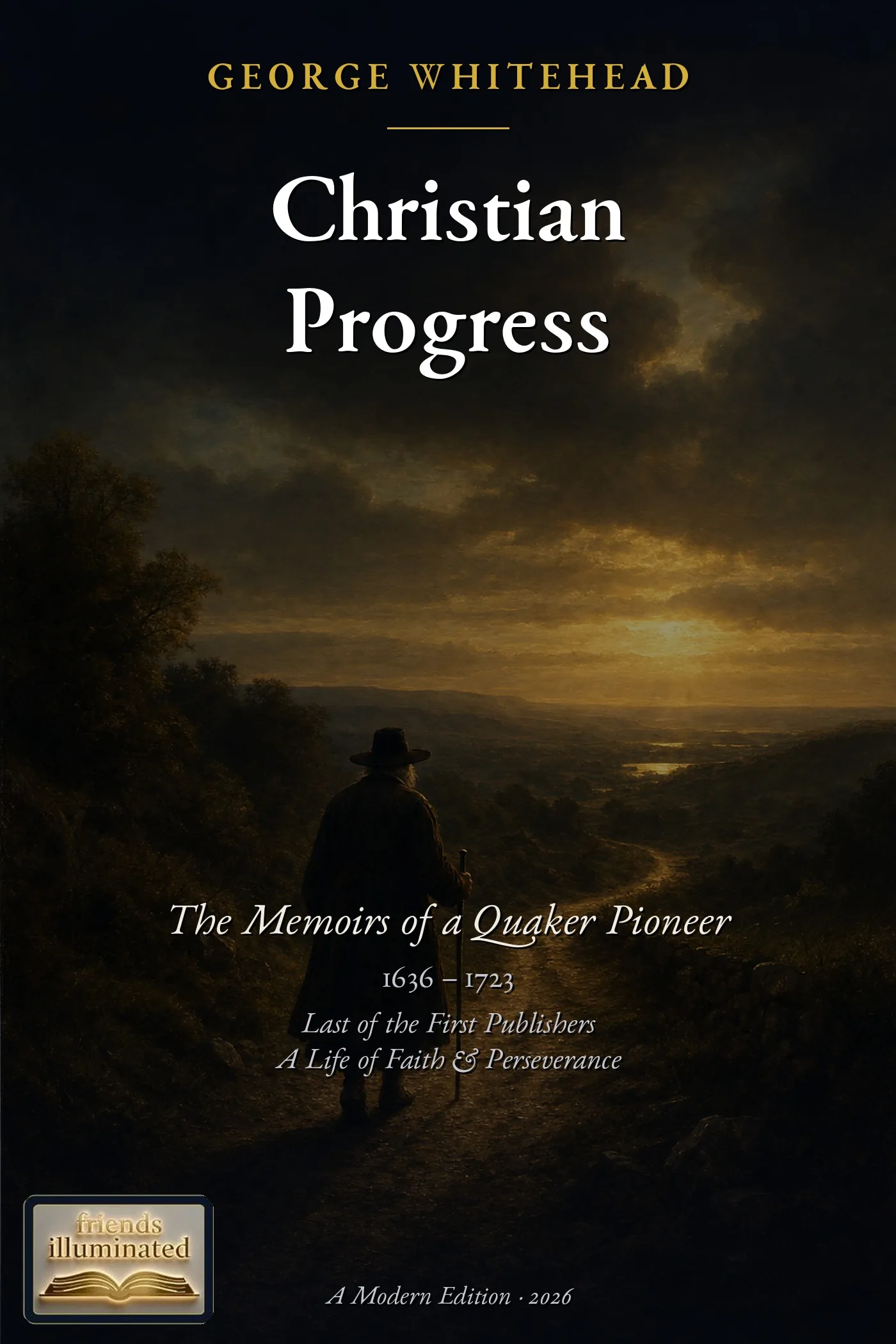
The Christian Progress of George Whitehead
George Whitehead's spiritual autobiography — the life and sufferings of the last of the early Quaker Publishers of Truth, who pleaded the cause of Friends before four English monarchs — in a modern English edition with linked scripture references.
- First published 1725
- 600+ pages
- EPUB format
This edition
Read itE-book · EPUB
- Time to read15.1 hours
- Length215,461 words
- Files1 EPUB, DRM-free
How we get 15.1 hours
This figure is here so you can compare one book against another. Every title on the site is timed from its own word count at the same reading speed — nothing is adjusted book by book — so if this edition says 15.1 hours and another says half that, the second one really is about half the reading. It is a measure of size, in the way a page count is. Your own pace is your own: at the speeds typical adult readers actually manage, this edition runs anywhere from 12 hours to 20.5 hours.
What is in this edition
| Modernized text | 211,225 words |
|---|---|
| Introduction, chapter summaries and notes written for this edition | 4,236 words |
| Total | 215,461 words |
The introduction, the chapter summaries and the notes on people, places and unfamiliar terms were written for this edition. They are 4,236 of the 215,461 words above, and they are part of what you are buying.
Counted from the text of the EPUB you receive. Navigation, the title page, the table of contents and the licence page are excluded — they are packaging, not reading.
The reading rate
238 words per minute, for adult silent reading of non-fiction, applied unchanged to every title on the site. We did not pick the number; it is the pooled result of a published meta-analysis. Nothing is adjusted book by book — that consistency is what makes two of these figures worth comparing.
Brysbaert, M. (2019). How many words do we read per minute? A review and meta-analysis of reading rate. Journal of Memory and Language, 109, 104047. doi:10.1016/j.jml.2019.104047
190 studies, 18,573 participants.
The same paper puts most adult readers between 175 and
300 words per minute, and those two speeds give the
12 hours and 20.5 hours above.
Because time is words divided by speed, an even range of speeds produces an
uneven range of times, so 15.1 hours sits nearer the fast end of that
range than the middle of it.
If it were a paperback
Roughly 616–862 pages.
Words per printed page is a typesetting convention, not a measurement — it moves with trim size, type size and leading. The range above assumes 250–350 words a page. Friends Illuminated publishes no print edition of this book; the figure is here only because pages are a more familiar size than words.
- Secure checkout by Stripe
- Instant download
- 7-day money-back guarantee
About This Edition
George Whitehead (1636–1723) outlived nearly every one of the first generation of Friends. Convinced as a teenager in the north of England in the early 1650s, he became one of the “Valiant Sixty” — the itinerant ministers who carried the Quaker message across the country — and went on to spend seventy years in the work. By the time he died, he was the last surviving link to the founding era of the movement, the elder statesman who had known George Fox, Edward Burrough, James Nayler, and the rest when the Truth was young.
The Christian Progress, first published in 1725 from papers Whitehead gathered near the end of his life, is the record of that long service. It begins with his boyhood in Westmorland and his first meeting with the Quakers, traces his convincement and early ministry, and follows him through the decades of imprisonment, public disputation, and tireless petitioning that defined his career. Whitehead was beaten, jailed, and prosecuted again and again under the penal laws against Dissenters — yet he repeatedly found his way into the presence of those in power, pleading the cause of the suffering Friends before Charles II, James II, William III, and finally Queen Anne. More than any other Friend, he is remembered as the man who argued Quakerism’s case before the throne and helped secure the toleration the next generation enjoyed.
The book is at once a personal memoir and a documentary history of early Quaker suffering. Whitehead preserves the texts of petitions, addresses to Parliament, and accounts of the great public controversies in which he defended Friends’ principles — the inward Light, spiritual worship, the refusal of oaths and tithes — against Presbyterian, Baptist, and Anglican opponents. Through it all runs the steady first-person voice of a man wholly persuaded that the hand of the Lord was with him.
This edition modernizes Whitehead’s seventeenth- and eighteenth-century prose into clear contemporary English while preserving his distinctive voice, his Quaker vocabulary, and the verbatim text of the letters and documents he quotes. Every scripture reference has been identified and hyperlinked, and the full navigational structure makes it easy to follow Whitehead’s long life from his youth on the barren mountains of fruitless profession to his final testimony as the ancient servant of a now-established people.