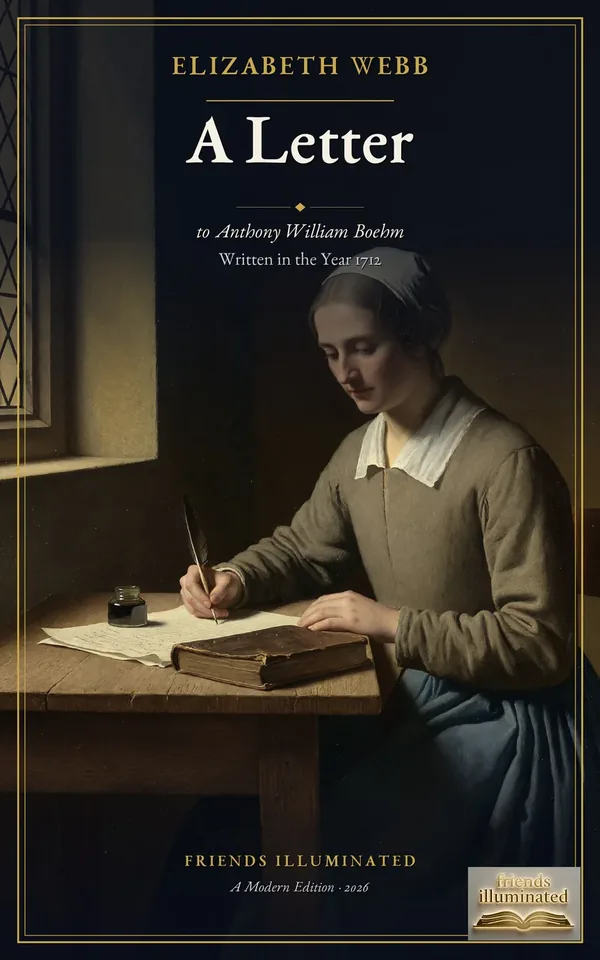
A Letter from Elizabeth Webb to A. W. Boehm
In 1712 Elizabeth Webb (1663–1727), an acknowledged minister among the people called Quakers, wrote from London to Anthony William Boehm, the German-born chaplain to Prince George of Denmark. What she sent him was not a tract but the history of her own soul: a schoolgirl's uneasy reverence for the clergy she was raised among, her reading of the Scriptures and her convincement that the Quakers held the principles of Truth, the years in which she let go of the daily cross, and the fiery trial that followed. She describes her call to the ministry, the trials it cost her at home, and the concern that came on her in a meeting at Gloucester in 1697 and carried her across the ocean to Virginia and Maryland. A modern English edition with linked scripture and historical references.
- A complete spiritual autobiography in a single letter, written 1712
- Her convincement among Friends, and the fiery trial that followed
- The 1697 concern at Gloucester that carried her to America
- With Anthony William Boehm's reply, and the 1781 publisher's preface
- EPUB format
This edition
Read itE-book · EPUB
- Time to read51 minutes
- Length12,127 words
- Files1 EPUB, DRM-free
How we get 51 minutes
This figure is here so you can compare one book against another. Every title on the site is timed from its own word count at the same reading speed — nothing is adjusted book by book — so if this edition says 51 minutes and another says half that, the second one really is about half the reading. It is a measure of size, in the way a page count is. Your own pace is your own: at the speeds typical adult readers actually manage, this edition runs anywhere from 40 minutes to 1.2 hours.
What is in this edition
| Modernized text | 10,743 words |
|---|---|
| Introduction, chapter summaries and notes written for this edition | 1,384 words |
| Total | 12,127 words |
The introduction, the chapter summaries and the notes on people, places and unfamiliar terms were written for this edition. They are 1,384 of the 12,127 words above, and they are part of what you are buying.
Counted from the text of the EPUB you receive. Navigation, the title page, the table of contents and the licence page are excluded — they are packaging, not reading.
The reading rate
238 words per minute, for adult silent reading of non-fiction, applied unchanged to every title on the site. We did not pick the number; it is the pooled result of a published meta-analysis. Nothing is adjusted book by book — that consistency is what makes two of these figures worth comparing.
Brysbaert, M. (2019). How many words do we read per minute? A review and meta-analysis of reading rate. Journal of Memory and Language, 109, 104047. doi:10.1016/j.jml.2019.104047
190 studies, 18,573 participants.
The same paper puts most adult readers between 175 and
300 words per minute, and those two speeds give the
40 minutes and 1.2 hours above.
Because time is words divided by speed, an even range of speeds produces an
uneven range of times, so 51 minutes sits nearer the fast end of that
range than the middle of it.
If it were a paperback
Roughly 35–49 pages.
Words per printed page is a typesetting convention, not a measurement — it moves with trim size, type size and leading. The range above assumes 250–350 words a page. Friends Illuminated publishes no print edition of this book; the figure is here only because pages are a more familiar size than words.
- Secure checkout by Stripe
- Instant download
- 7-day money-back guarantee
About This Edition
Elizabeth Webb wrote this letter in 1712, in London, to a man she had met only a little while before. Anthony William Boehm was German by birth, chaplain to Prince George of Denmark — the consort of Anne, Queen of England — and a writer of serious devotional books. He had shown her some kindness; they had exchanged letters; and he had asked her, in effect, who she was. The answer took her the length of a small book.
What she gave him is one of the clearest accounts in Quaker literature of a soul finding its way, written at a remove of forty years by a woman who could still remember exactly how each stage felt. She was baptized and brought up in the Church of England, and as a girl she loved the ministers she sat under and thought of them as angels bringing glad tidings. Then she went to live in a knight’s household with a chaplain whose conduct she watched closely, and the thought would not leave her that it ought not to be so. She began to search the Scriptures for herself, which is where the trouble started.
She had been to a Quaker meeting or two as a child of twelve, and the voice of one man who preached there stayed in her mind the way a tune does. Reading confirmed it. By sixteen she was convinced that the Quakers held the principles of Truth — and did nothing about it. This is the part of the book that readers tend to remember. She knew, and she drew back; flesh and blood grew uneasy under the yoke, and she reasoned with herself that she was young, that she might take a little more pleasure, and that she could serve God when she was older. The sweet, meek Spirit withdrew. She went on going to meetings and found herself a dry stick, to which rain and sunshine, summer and winter, were all alike.
Then the wilderness. She describes it without any softening: darkness that might be felt, months in which she wished for morning when it was night and for evening when it was morning, a heart she could compare to nothing but a coal of fire, and no tear that would come. Satan, she says, was very unwilling to lose his subject, and raised all his forces, pressing her to look with the eye of carnal reason into mysteries that belong to salvation, until she questioned whether anything in the Scriptures were true at all. She came through it, but she never once suggests it was brief or that it was easy.
The call to the ministry cost her more. There were outward trials at home, a husband to be reconciled to a travelling wife, and the ordinary dread of standing up among people. Then, in the sixth month of 1697, sitting in the meeting at Gloucester where she then lived, her mind was gathered into stillness and her spirit was as if it had been carried away into America. The concern never left her, day or night, until she went. She sailed from Bristol that ninth month with Mary Rogers, and reached Virginia in the twelfth month of 1697.
What she found there produced the passage this letter is best known for. Travelling through Virginia and Maryland she saw great numbers of black people held in slavery — a strange people to me, she writes — and she wanted to know whether God’s visitation reached their souls, and watched them to see whether she could discern any good. In a house in Maryland she dreamed she was a servant drawing water at a well to wash the uppermost rooms of a great house, and was told to call the other servants to help her. She was satisfied, she says, that the call of the Lord was to the black people as well as to the white. The dream is recorded plainly, without argument, by a woman working out in 1697 what the people around her would not think through for another seventy years.
Boehm’s answer closes the volume, and is worth reading beside hers: a learned Lutheran court chaplain replying, with evident warmth, to an unlettered Quaker woman who had just told him the whole history of her inward life. The letter circulated in manuscript for decades afterwards and was printed at Philadelphia in 1781, partly because copies had been handed about in a corrupted state and the publisher wanted an accurate one in the world.
This Friends Illuminated edition presents the complete letter in clear modern English, with the 1781 publisher’s preface, the editorial footnotes of the Friends’ Library text, and Boehm’s reply — with scripture references and historical links throughout.