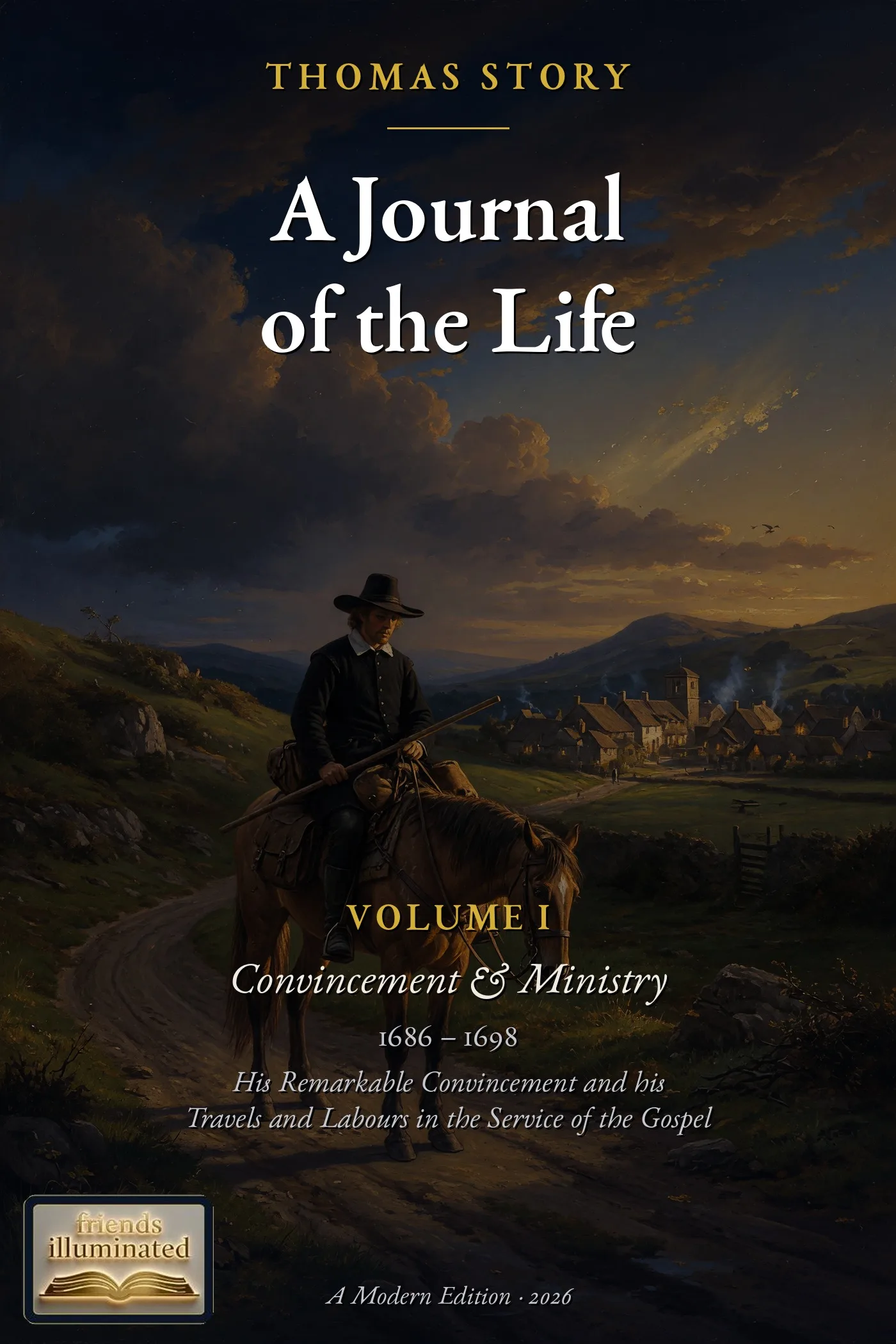
A Journal of the Life of Thomas Story, Volume I: Convincement & Ministry
The first volume of the Journal of Thomas Story (c. 1670–1742), the Cumberland lawyer who became one of the great Quaker ministers: his dream of five lights, his convincement at Carlisle and famous dispute on the sacraments with Dr. Richard Gilpin, his fearless travels through Scotland, and his great doctrinal letter on perfection — a modern English edition with linked scripture and historical references.
- The opening years of a great Quaker journal (1686–1698)
- A trained lawyer's account of his convincement and call to ministry
- EPUB format
This edition
Read itE-book · EPUB
- Time to read6.2 hours
- Length88,406 words
- Files1 EPUB, DRM-free
How we get 6.2 hours
This figure is here so you can compare one book against another. Every title on the site is timed from its own word count at the same reading speed — nothing is adjusted book by book — so if this edition says 6.2 hours and another says half that, the second one really is about half the reading. It is a measure of size, in the way a page count is. Your own pace is your own: at the speeds typical adult readers actually manage, this edition runs anywhere from 4.9 hours to 8.4 hours.
What is in this edition
| Modernized text | 82,648 words |
|---|---|
| Introduction, chapter summaries and notes written for this edition | 5,758 words |
| Total | 88,406 words |
The introduction, the chapter summaries and the notes on people, places and unfamiliar terms were written for this edition. They are 5,758 of the 88,406 words above, and they are part of what you are buying.
Counted from the text of the EPUB you receive. Navigation, the title page, the table of contents and the licence page are excluded — they are packaging, not reading.
The reading rate
238 words per minute, for adult silent reading of non-fiction, applied unchanged to every title on the site. We did not pick the number; it is the pooled result of a published meta-analysis. Nothing is adjusted book by book — that consistency is what makes two of these figures worth comparing.
Brysbaert, M. (2019). How many words do we read per minute? A review and meta-analysis of reading rate. Journal of Memory and Language, 109, 104047. doi:10.1016/j.jml.2019.104047
190 studies, 18,573 participants.
The same paper puts most adult readers between 175 and
300 words per minute, and those two speeds give the
4.9 hours and 8.4 hours above.
Because time is words divided by speed, an even range of speeds produces an
uneven range of times, so 6.2 hours sits nearer the fast end of that
range than the middle of it.
If it were a paperback
Roughly 253–354 pages.
Words per printed page is a typesetting convention, not a measurement — it moves with trim size, type size and leading. The range above assumes 250–350 words a page. Friends Illuminated publishes no print edition of this book; the figure is here only because pages are a more familiar size than words.
- Secure checkout by Stripe
- Instant download
- 7-day money-back guarantee
About This Edition
Thomas Story (c. 1670–1742) was born near Carlisle in Cumberland, in the far north of England, to a family of some means and Presbyterian convictions. His parents gave him a good education and intended him for the law; he was a bright, serious young man, drawn to books and to argument, and by every outward measure his path was set. The inward Light had other plans. Among the distinguished company of early Quaker autobiographers — George Fox, Thomas Ellwood, William Penn — Story holds a place all his own: a trained legal mind turned wholly to the service of the inward Light, a man who could argue sacramental theology with learned divines, stand before a czar without flinching, and cross the Scottish Highlands when no Friend had ventured there in years.
This first volume of Story’s Journal covers the years from roughly 1686 to 1698 — from his youth and education through the beginning of his Irish ministry. It is the story of a calling discovered, tested, and accepted, and it moves through a series of episodes that rank among the most vivid in early Quaker literature.
The narrative opens with Story’s early life and the famous dream of five lights — an experience so powerful and so strange that he sets it down with the care of a lawyer presenting evidence. The dream unsettled him and set him searching, and the chapters that follow trace the long, often painful process of his convincement among the people called Quakers. His public confession at Carlisle is a set piece of quiet drama, culminating in a remarkable theological confrontation with Dr. Richard Gilpin, a learned Presbyterian divine, on the subject of the sacraments. Story argues, with lawyerly precision and scriptural depth, that water baptism and the outward supper are types and shadows belonging to the old dispensation, fulfilled and superseded by the coming of Christ. It is one of the most sustained and closely reasoned doctrinal passages in the Quaker journals.
The call to ministry, once answered, sends Story north. His journeys through Scotland — to Edinburgh, Aberdeen, Elgin, and as far as Inverness — are among the most gripping passages in the book; he traveled farther into the Scottish north than any Friend had ventured in years, through country where hostility to Quakers was fierce and the roads were dangerous. Returning south, he labored across the western and southern counties of England before settling for a time in London, where he practiced conveyancing and wrestled honestly with the tension between the demands of business and the demands of the Spirit. The volume closes with his great doctrinal letter on the sacraments and Christian perfection, his audience with the Czar of Muscovy, and the voyage that carried him toward his Irish ministry.
This Friends Illuminated edition modernizes Story’s seventeenth-century spelling and the long, winding sentences of the period, so that his voice may reach a modern reader without hindrance, while preserving the cadence and diction of the original and the distinctive plain language of Friends — the “thee” and “thou” he retained as a testimony. Quoted letters and doctrinal writings are presented verbatim in set-off blockquotes. Scripture references have been linked and made visible, and the people and places of his story annotated, so that his account may be both read and explored.