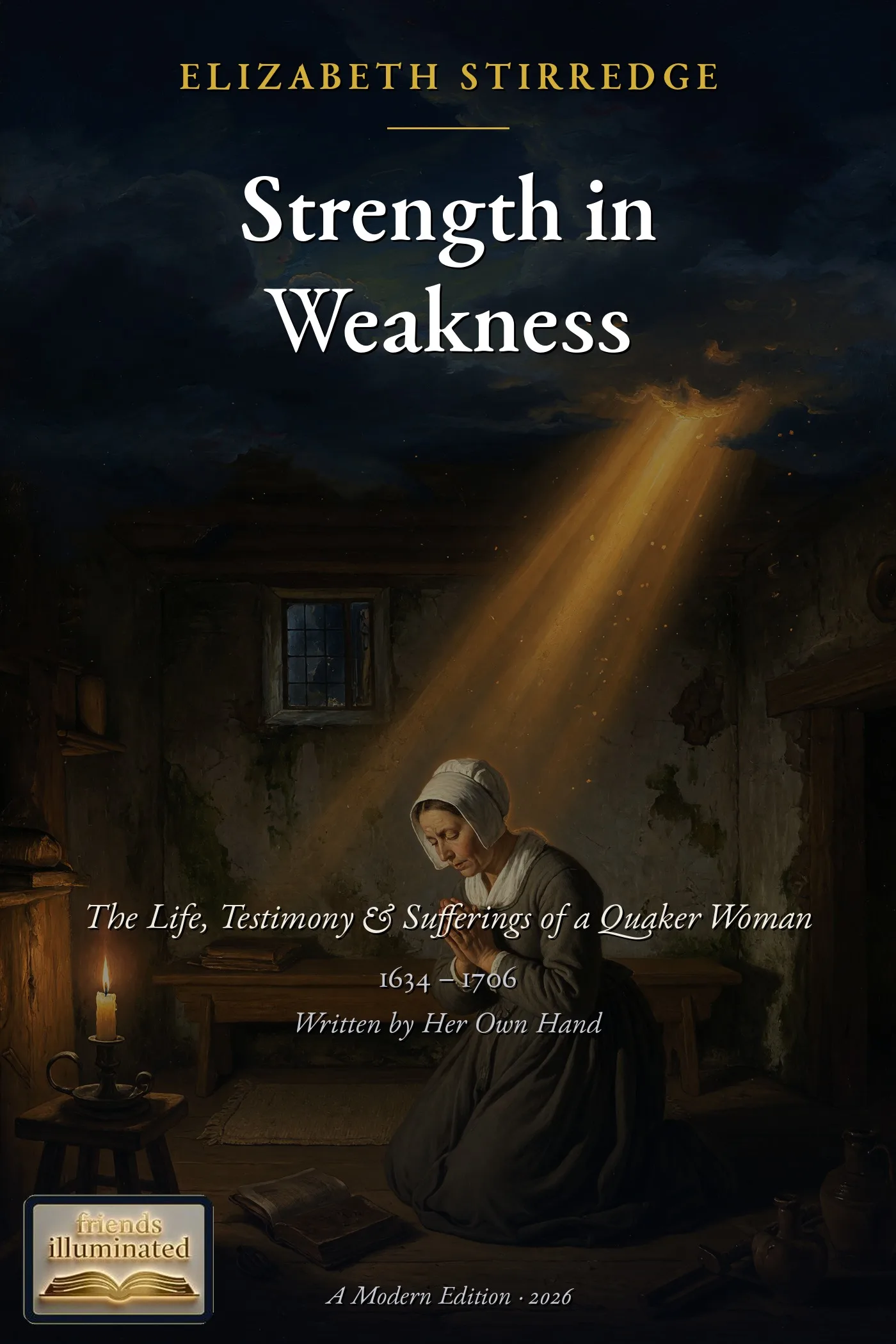
Strength in Weakness Manifest: The Life, Testimony & Sufferings of a Quaker Woman
The spiritual autobiography of Elizabeth Stirredge (1634–1706), a Quaker woman of Gloucestershire: her convincement under the Valiant Sixty, her divinely-appointed journey to warn King Charles II, the distraint and imprisonment she endured for her faith, and her closing counsel to her children — a modern English edition with linked scripture and historical references.
- A complete spiritual autobiography (1634–1706)
- One of the great women's voices of early Quakerism
- EPUB format
This edition
Read itE-book · EPUB
- Time to read2.6 hours
- Length37,099 words
- Files1 EPUB, DRM-free
How we get 2.6 hours
This figure is here so you can compare one book against another. Every title on the site is timed from its own word count at the same reading speed — nothing is adjusted book by book — so if this edition says 2.6 hours and another says half that, the second one really is about half the reading. It is a measure of size, in the way a page count is. Your own pace is your own: at the speeds typical adult readers actually manage, this edition runs anywhere from 2.1 hours to 3.5 hours.
What is in this edition
| Modernized text | 31,915 words |
|---|---|
| Introduction, chapter summaries and notes written for this edition | 5,184 words |
| Total | 37,099 words |
The introduction, the chapter summaries and the notes on people, places and unfamiliar terms were written for this edition. They are 5,184 of the 37,099 words above, and they are part of what you are buying.
Counted from the text of the EPUB you receive. Navigation, the title page, the table of contents and the licence page are excluded — they are packaging, not reading.
The reading rate
238 words per minute, for adult silent reading of non-fiction, applied unchanged to every title on the site. We did not pick the number; it is the pooled result of a published meta-analysis. Nothing is adjusted book by book — that consistency is what makes two of these figures worth comparing.
Brysbaert, M. (2019). How many words do we read per minute? A review and meta-analysis of reading rate. Journal of Memory and Language, 109, 104047. doi:10.1016/j.jml.2019.104047
190 studies, 18,573 participants.
The same paper puts most adult readers between 175 and
300 words per minute, and those two speeds give the
2.1 hours and 3.5 hours above.
Because time is words divided by speed, an even range of speeds produces an
uneven range of times, so 2.6 hours sits nearer the fast end of that
range than the middle of it.
If it were a paperback
Roughly 106–148 pages.
Words per printed page is a typesetting convention, not a measurement — it moves with trim size, type size and leading. The range above assumes 250–350 words a page. Friends Illuminated publishes no print edition of this book; the figure is here only because pages are a more familiar size than words.
- Secure checkout by Stripe
- Instant download
- 7-day money-back guarantee
About This Edition
Elizabeth Stirredge (1634–1706) was born at Thornbury in Gloucestershire, the daughter of a devout Puritan who told his family that a day was coming when Truth would break forth more gloriously than at any time since the apostles. He died in that hope, seven years before the first Quaker preachers reached the west of England; his daughter lived to see what he only foretold. By her own account she was, from her earliest years, a child of a tender and fearful heart — terrified by thunder, haunted by the question of her soul, and unable to find rest in the religion of her neighbors. Then, in 1654, two of the Valiant Sixty, John Audland and John Camm, came preaching into her country, and Audland’s voice pierced her. From that day she was a convinced Friend.
What follows in this little book is one of the most moving spiritual autobiographies the early Quaker movement produced — the testimony of a woman who never thought herself fit for any public service, who trembled at the cost of obedience, and who was nonetheless sent on errands that would have daunted far bolder hearts. The book’s title is taken from the Apostle Paul: that the Lord’s strength is made perfect in weakness. Stirredge offers herself as living proof of it.
The narrative carries her from her convincement into the ministry, and then to the great trial of her life: a journey to London to deliver a warning, laid upon her by the Lord, to King Charles II himself. She records the distraint of her family’s goods for the crime of worshiping as Friends, the downfall of the persecutors who had harried them, and the bitter internal conflict of the Wilkinson–Story separation, in which she stood firmly for the order of the church against those who would have unraveled it. The book reaches its climax in her arrest at Chew Magna and her imprisonment in Ilchester gaol in 1683, where, in the worst of conditions, she found the day of her deliverance.
To these memoirs are joined her closing counsel to her children, finished in 1692, and two printed prophetic addresses — a salutation and warning to the city of Bristol, and a faithful warning to the inhabitants of England — in which the trembling girl of Thornbury speaks with the authority of a prophet, calling whole cities and a whole nation to repentance. The work was first published in 1711, and again in the second edition of 1746 from which this text is drawn, with a preface by the Quaker editor and historian John Whiting and the collected testimony of Friends who had known her.
This Friends Illuminated edition modernizes her seventeenth-century spelling and the long, winding sentences of the period, so that her voice may reach a modern reader without hindrance, while preserving the fervency of her devotion, the boldness of her prophetic speech, and the distinctive plain language of Friends — the “thee” and “thou” she retained as a testimony. Scripture references have been linked and made visible, and the people and places of her story annotated, so that her account may be both read and explored.