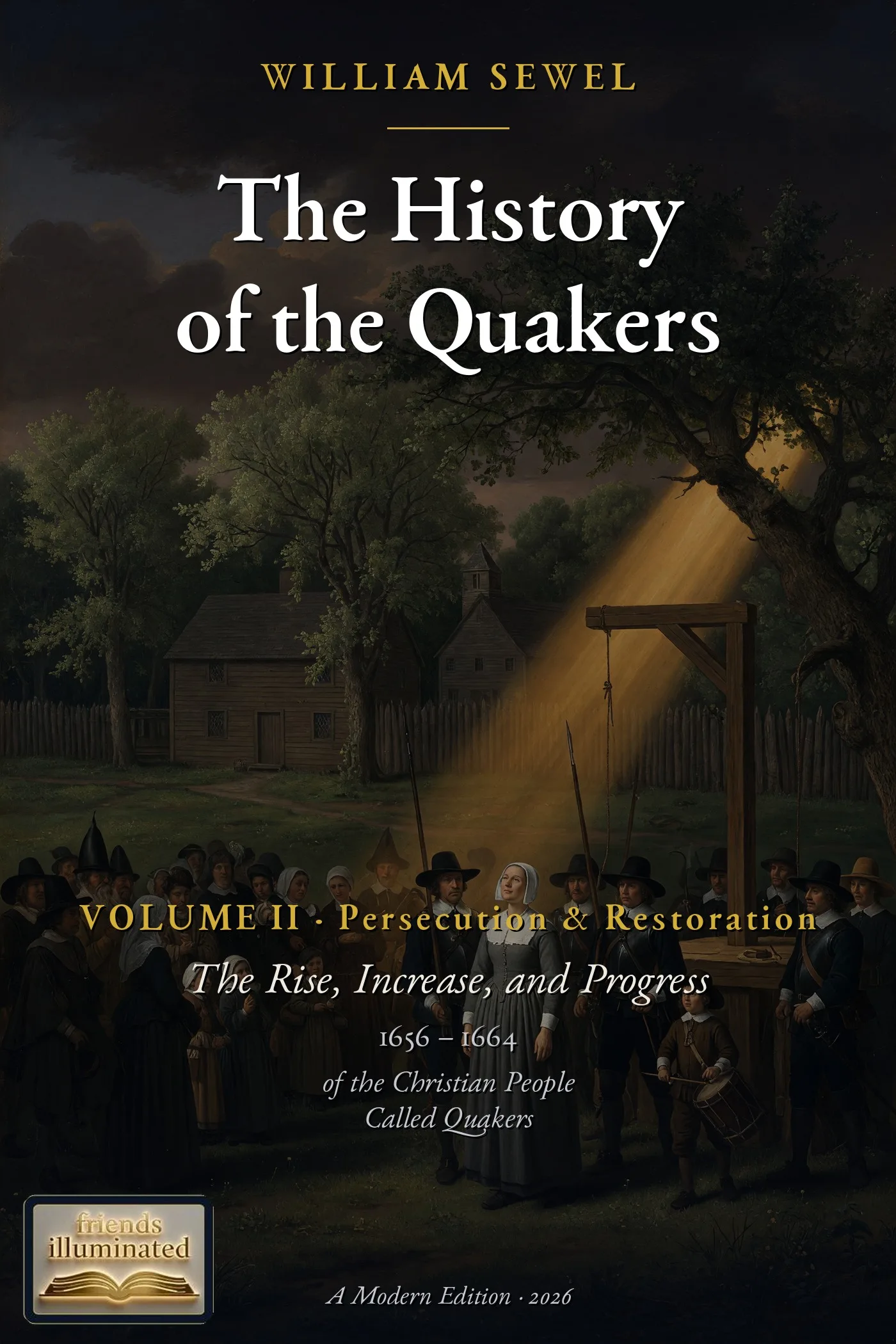
The History of the Quakers, Volume II: Persecution & Restoration
The second volume of William Sewel's classic History of the Rise, Increase, and Progress of the Christian People Called Quakers carries the story through the hardest decade the early Friends ever knew — from the fall and repentance of James Nayler in 1656, through the hangings on Boston Common and the fall of the Protectorate, to the Restoration of Charles II and the Quaker Act of 1662 — in a modern English edition with linked scripture references.
- Books 4–6, covering 1656–1664
- The Nayler tragedy, the Boston martyrs, and the Malta inquisition
- EPUB format
This edition
Read itE-book · EPUB
- Time to read10.4 hours
- Length148,669 words
- Files1 EPUB, DRM-free
How we get 10.4 hours
This figure is here so you can compare one book against another. Every title on the site is timed from its own word count at the same reading speed — nothing is adjusted book by book — so if this edition says 10.4 hours and another says half that, the second one really is about half the reading. It is a measure of size, in the way a page count is. Your own pace is your own: at the speeds typical adult readers actually manage, this edition runs anywhere from 8.3 hours to 14.2 hours.
What is in this edition
| Modernized text | 139,625 words |
|---|---|
| Introduction, chapter summaries and notes written for this edition | 9,044 words |
| Total | 148,669 words |
The introduction, the chapter summaries and the notes on people, places and unfamiliar terms were written for this edition. They are 9,044 of the 148,669 words above, and they are part of what you are buying.
Counted from the text of the EPUB you receive. Navigation, the title page, the table of contents and the licence page are excluded — they are packaging, not reading.
The reading rate
238 words per minute, for adult silent reading of non-fiction, applied unchanged to every title on the site. We did not pick the number; it is the pooled result of a published meta-analysis. Nothing is adjusted book by book — that consistency is what makes two of these figures worth comparing.
Brysbaert, M. (2019). How many words do we read per minute? A review and meta-analysis of reading rate. Journal of Memory and Language, 109, 104047. doi:10.1016/j.jml.2019.104047
190 studies, 18,573 participants.
The same paper puts most adult readers between 175 and
300 words per minute, and those two speeds give the
8.3 hours and 14.2 hours above.
Because time is words divided by speed, an even range of speeds produces an
uneven range of times, so 10.4 hours sits nearer the fast end of that
range than the middle of it.
If it were a paperback
Roughly 425–595 pages.
Words per printed page is a typesetting convention, not a measurement — it moves with trim size, type size and leading. The range above assumes 250–350 words a page. Friends Illuminated publishes no print edition of this book; the figure is here only because pages are a more familiar size than words.
- Secure checkout by Stripe
- Instant download
- 7-day money-back guarantee
About This Edition
Volume I of William Sewel’s great History told the story of a beginning — George Fox’s years of seeking, the great convincement of the North, and the raising up of the Valiant Sixty. This second volume takes up the thread exactly where the first laid it down, and carries the reader into the hardest and most dramatic decade the early Friends ever knew. The years covered here run from 1656 to 1664, and they hold together three of Sewel’s twelve “Books” — the fourth, fifth, and sixth. We have called the volume Persecution and Restoration, because those two words name the double weight the Friends carried through these years: at home, a monarchy fell and rose again, and each new government found fresh reasons to fear and to fine a people who would not swear, would not fight, and would not take off their hats; abroad, the message ran to Boston, to Rome, to Malta, and even to the court of the Turkish Sultan — and wherever it went, it was met with prisons, ropes, and branding-irons, and it did not stop.
No story shadows this volume as the tragedy of James Nayler does. Once among the ablest and most admired of the early preachers, Nayler was led on horseback into Bristol in the autumn of 1656 by a company of over-zealous followers, in a sign that his enemies read as blasphemy. Parliament seized on the case and voted a punishment of shocking cruelty — the pillory, the lash, the boring of the tongue, the branding of the forehead. Sewel, who never excuses Nayler’s error, tells the whole story with a historian’s honesty and a Friend’s compassion: the fall, the terrible sentence patiently borne, and the slow, genuine repentance that ended in one of the most moving passages of confession in the English language.
Alongside Nayler’s fall runs the darkest chapter of Quaker history in the New World. In these pages the reader will watch the Massachusetts Bay colony pass its escalating laws against the Quakers — fines, whippings, the cutting of ears, and finally death — and will stand on Boston Common as William Robinson, Marmaduke Stevenson, Mary Dyer, and William Leddra go to the gallows rather than promise to stay away. Here too are the stories that carried the Quaker name across the world: Mary Fisher’s journey to the camp of the Turkish Sultan, who received her with more courtesy than the magistrates of Boston ever showed; and Katharine Evans and Sarah Cheevers, held for years by the Inquisition at Malta, whose steadfastness under examination Sewel recounts at length from their own letters.
Behind it all, England itself is overturning. Oliver Cromwell dies and his Protectorate crumbles; the army and the Parliament wrestle for power while Edward Burrough delivers his prophetic warnings to each government in turn; General Monk marches south, and Charles II returns amid the bells and bonfires of the Restoration — bringing first a promise of liberty of conscience, and then the Quaker Act of 1662, under which thousands of Friends filled the jails of England. The volume closes at the end of Sewel’s sixth Book, with Edward Burrough dead in Newgate prison at thirty and the movement he helped build refusing, still, to meet in secret.
This edition is drawn from Sewel’s own English translation and gently modernized for contemporary readers: spelling and punctuation brought into present-day usage, the most archaic verb forms lightened, and the longest run-on sentences divided for clarity — while Sewel’s voice, his vocabulary, and the plain testimony of the Friends he quotes are kept intact. Scripture references have been added and linked to the King James text, and the names of persons, places, and events linked to encyclopedic articles, so that any reader may turn at once from Sewel’s narrative to the Scripture and history behind it.