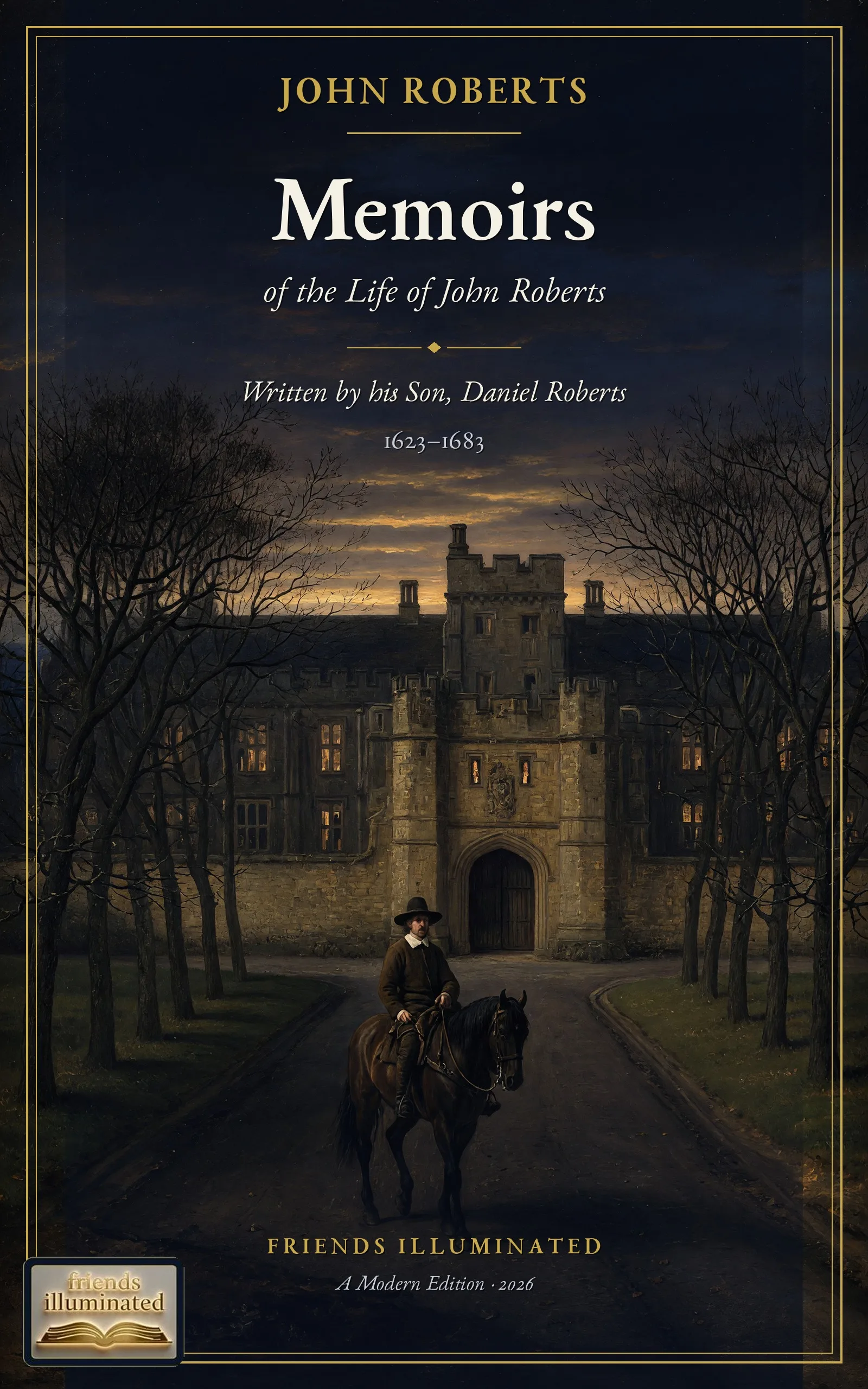
Memoirs of the Life of John Roberts
John Roberts of Siddington in Gloucestershire (1623–1684) — Parliamentary soldier, yeoman farmer, and from 1665 a Quaker who spent his last eighteen years fined, distrained, and imprisoned. He is remembered not for what he suffered but for what he said. Written by his son Daniel in 1725 and first printed in 1746, these Memoirs are made almost entirely of remembered conversation: his confrontations with parish priests, justices, bailiffs, and above all with William Nicholson, Bishop of Gloucester, who came in the end to like him. A modern English edition with linked scripture and historical references.
- The plain-spoken yeoman who bested a bishop in argument — repeatedly
- A son's record of his father's best exchanges, written from memory in 1725
- EPUB format
This edition
Read itE-book · EPUB
- Time to read1.7 hours
- Length24,219 words
- Files1 EPUB, DRM-free
How we get 1.7 hours
This figure is here so you can compare one book against another. Every title on the site is timed from its own word count at the same reading speed — nothing is adjusted book by book — so if this edition says 1.7 hours and another says half that, the second one really is about half the reading. It is a measure of size, in the way a page count is. Your own pace is your own: at the speeds typical adult readers actually manage, this edition runs anywhere from 1.3 hours to 2.3 hours.
What is in this edition
| Modernized text | 20,616 words |
|---|---|
| Introduction, chapter summaries and notes written for this edition | 3,603 words |
| Total | 24,219 words |
The introduction, the chapter summaries and the notes on people, places and unfamiliar terms were written for this edition. They are 3,603 of the 24,219 words above, and they are part of what you are buying.
Counted from the text of the EPUB you receive. Navigation, the title page, the table of contents and the licence page are excluded — they are packaging, not reading.
The reading rate
238 words per minute, for adult silent reading of non-fiction, applied unchanged to every title on the site. We did not pick the number; it is the pooled result of a published meta-analysis. Nothing is adjusted book by book — that consistency is what makes two of these figures worth comparing.
Brysbaert, M. (2019). How many words do we read per minute? A review and meta-analysis of reading rate. Journal of Memory and Language, 109, 104047. doi:10.1016/j.jml.2019.104047
190 studies, 18,573 participants.
The same paper puts most adult readers between 175 and
300 words per minute, and those two speeds give the
1.3 hours and 2.3 hours above.
Because time is words divided by speed, an even range of speeds produces an
uneven range of times, so 1.7 hours sits nearer the fast end of that
range than the middle of it.
If it were a paperback
Roughly 69–97 pages.
Words per printed page is a typesetting convention, not a measurement — it moves with trim size, type size and leading. The range above assumes 250–350 words a page. Friends Illuminated publishes no print edition of this book; the figure is here only because pages are a more familiar size than words.
- Secure checkout by Stripe
- Instant download
- 7-day money-back guarantee
About This Edition
John Roberts was born at Siddington, near Cirencester, in 1623, of a family also known by the name Hayward. He served as a soldier in the Parliamentary army during the Civil War, came home, married, farmed, and lived as an ordinary man of his parish until 1665, when two travelling women Friends came into the country and he went to hear them. He was convinced, and the ordinary part of his life was over.
From that time he refused tithes, refused to swear an oath, refused to remove his hat to a magistrate, and refused to pay the gaoler’s fees that would have shortened his imprisonments — on the ground that a man wrongly imprisoned should not pay for the privilege. He was in gaol at Cirencester, at Gloucester, and at Tetbury. His cattle, his corn, and at one point very nearly his bed were carried off.
What makes this little book unlike any other in the Friends’ Library is that it is not a journal of the inward life. It is a book of scenes, and its characteristic movement is: an official arrives with power; John Roberts asks him a question; the official leaves. He was a plain man who read few books and quoted one, and he lost none of his arguments. He argued the image of Nebuchadnezzar with the Bishop of Gloucester, answered the charge that Quakerism was an upstart religion, burned a mittimus at Tetbury, expounded the key of David, and turned a threat back upon Justice George. Stranger still, and what gives the book its peculiar warmth: the bishop came to like him, and arrived one day at his door.
Daniel Roberts wrote the account for his own children, forty years after the events, from what he had seen as a boy and what his father had told him. It is a son’s book, and it has a son’s memory for the exact words of a father’s best exchanges.
This edition modernizes spelling and punctuation, lightens archaic verb forms, and divides the longest sentences for clarity. What has not been touched is the substance of the conversations, which are the whole value of the book. The Quaker vocabulary and calendar remain as written. Scripture references have been supplied and linked to the King James text that Roberts knew by heart and used as a weapon, and the persons and places named have been linked to encyclopedic articles.