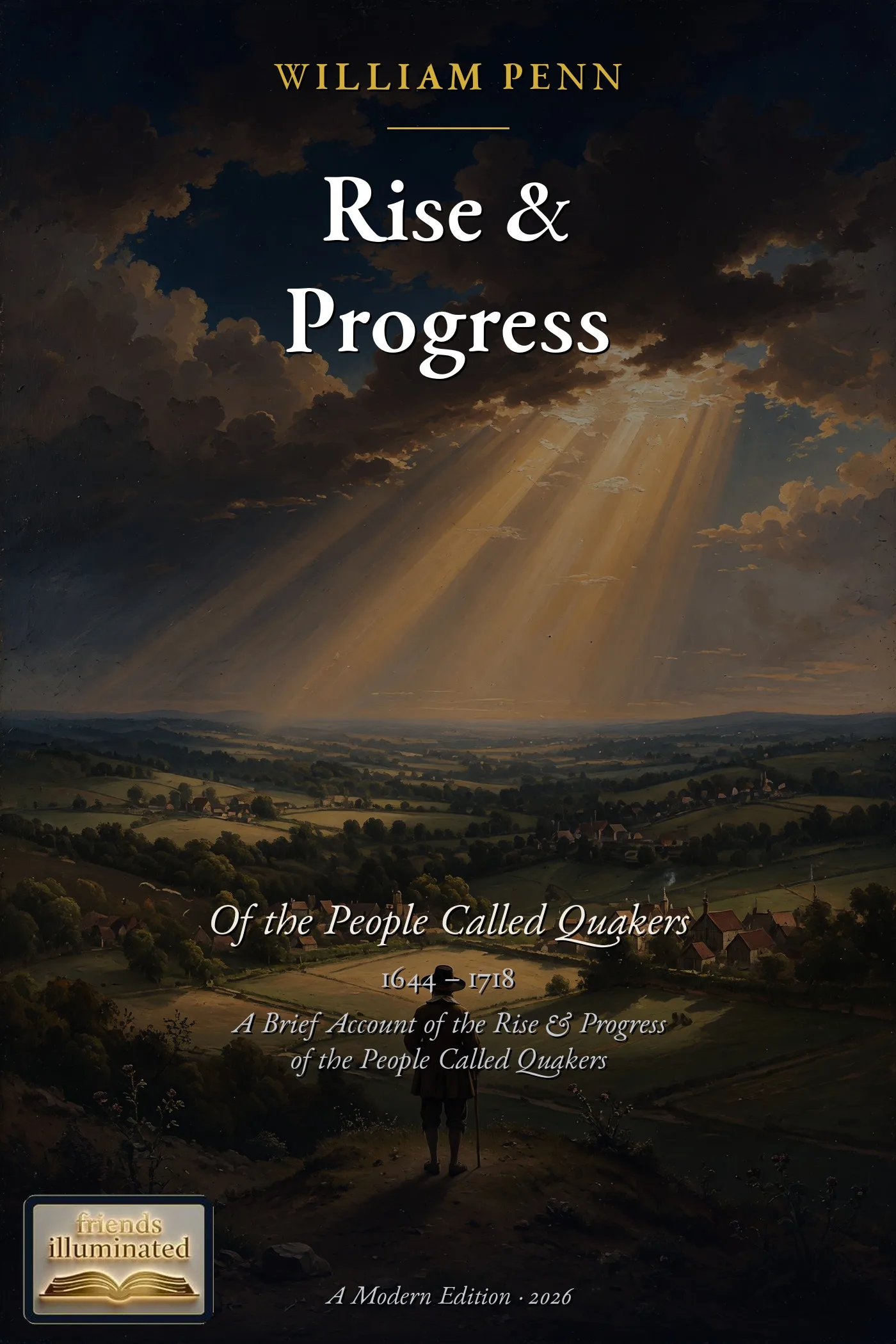
A Brief Account of the Rise and Progress of the People Called Quakers
William Penn's classic account of the Quaker movement — from creation through apostasy to the rise of Friends — written as a preface to George Fox's Journal and still the finest introduction to early Quakerism by someone who lived it.
- Complete & unabridged
- Modernized English
- EPUB format
This edition
Read itE-book · EPUB
- Time to read1.9 hours
- Length27,328 words
- Files1 EPUB, DRM-free
How we get 1.9 hours
This figure is here so you can compare one book against another. Every title on the site is timed from its own word count at the same reading speed — nothing is adjusted book by book — so if this edition says 1.9 hours and another says half that, the second one really is about half the reading. It is a measure of size, in the way a page count is. Your own pace is your own: at the speeds typical adult readers actually manage, this edition runs anywhere from 1.5 hours to 2.6 hours.
What is in this edition
| Modernized text | 25,661 words |
|---|---|
| Introduction, chapter summaries and notes written for this edition | 1,667 words |
| Total | 27,328 words |
The introduction, the chapter summaries and the notes on people, places and unfamiliar terms were written for this edition. They are 1,667 of the 27,328 words above, and they are part of what you are buying.
Counted from the text of the EPUB you receive. Navigation, the title page, the table of contents and the licence page are excluded — they are packaging, not reading.
The reading rate
238 words per minute, for adult silent reading of non-fiction, applied unchanged to every title on the site. We did not pick the number; it is the pooled result of a published meta-analysis. Nothing is adjusted book by book — that consistency is what makes two of these figures worth comparing.
Brysbaert, M. (2019). How many words do we read per minute? A review and meta-analysis of reading rate. Journal of Memory and Language, 109, 104047. doi:10.1016/j.jml.2019.104047
190 studies, 18,573 participants.
The same paper puts most adult readers between 175 and
300 words per minute, and those two speeds give the
1.5 hours and 2.6 hours above.
Because time is words divided by speed, an even range of speeds produces an
uneven range of times, so 1.9 hours sits nearer the fast end of that
range than the middle of it.
If it were a paperback
Roughly 78–109 pages.
Words per printed page is a typesetting convention, not a measurement — it moves with trim size, type size and leading. The range above assumes 250–350 words a page. Friends Illuminated publishes no print edition of this book; the figure is here only because pages are a more familiar size than words.
- Secure checkout by Stripe
- Instant download
- 7-day money-back guarantee
About This Edition
In 1694, William Penn sat down to write a preface for the posthumous journal of his friend George Fox, the founder of the Quaker movement. What emerged was far more than a preface. It was a sweeping history of God’s dealings with humanity, an explanation of Quaker beliefs and practices, a tribute to Fox’s extraordinary character, and a passionate appeal to the world — all in six tightly argued chapters that became one of the most widely read Quaker texts of the eighteenth century.
Penn traces the story from creation itself through the patriarchs, the prophets, Christ and the apostles, and the long corruption of medieval Christendom, arguing that the true church went into hiding during centuries of spiritual decline. The Protestant reformers made progress but remained incomplete. Into this gap, God raised up a despised people who recovered what had been lost: worship in the Spirit, ministry from divine life rather than human learning, and the revolutionary conviction that Christ himself — the Inner Light — is present in every human heart as teacher, guide, and savior.
Whether you come to this book as a student of history, a seeker after spiritual truth, or simply a reader curious about one of the most remarkable religious movements in Western civilization, Penn has something to offer. His closing cry — “Turn in, turn in, I urge you” — has rung through three centuries as one of the great invitations in Christian literature.