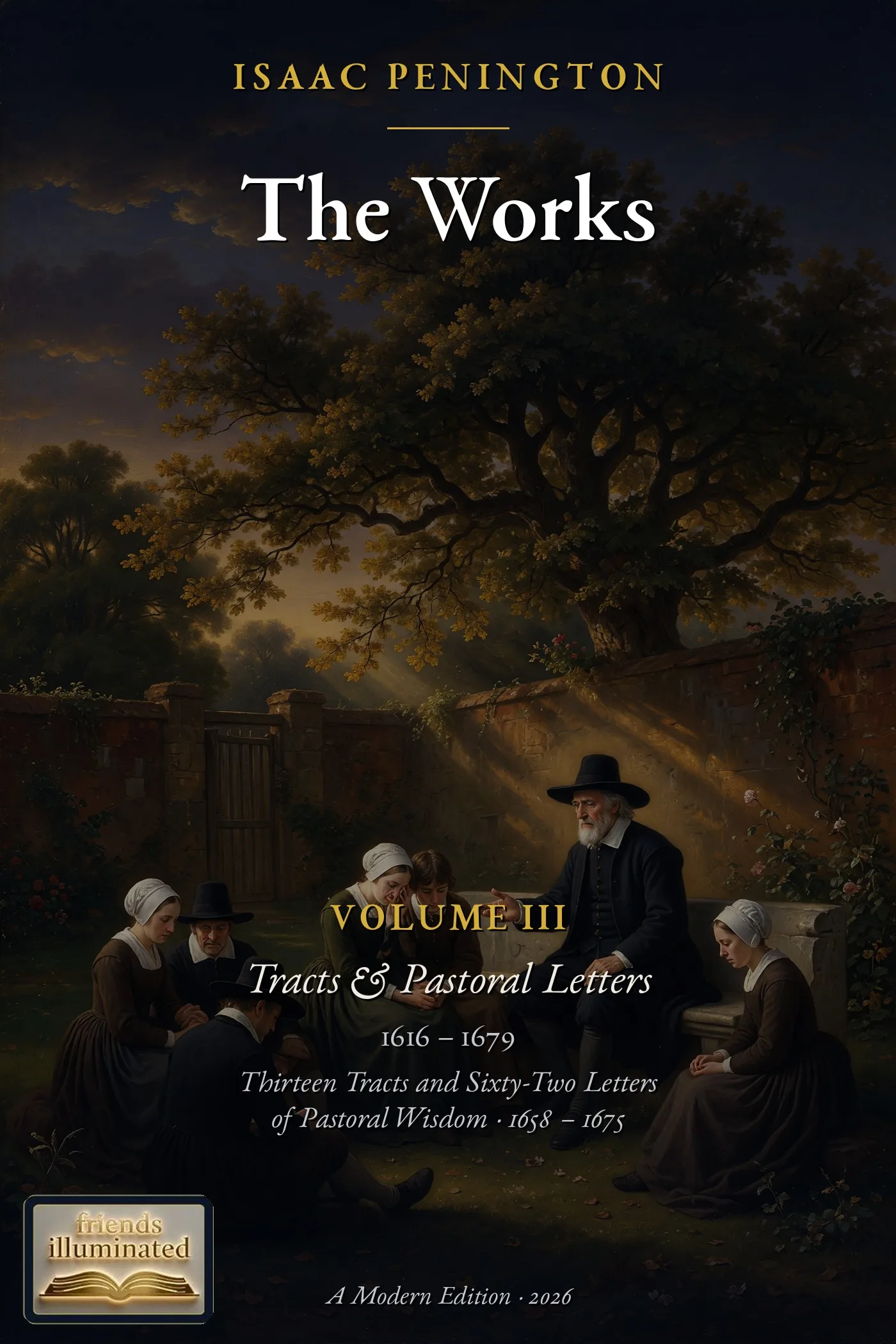
The Works of Isaac Penington, Volume III
The third volume of Penington's collected works — thirteen theological tracts and sixty-two letters, the most personal and pastorally rich volume in the set.
- Volume 3 of 4
- 500+ pages
- EPUB format
This edition
Read itE-book · EPUB
- Time to read16.2 hours
- Length230,880 words
- Files1 EPUB, DRM-free
How we get 16.2 hours
This figure is here so you can compare one book against another. Every title on the site is timed from its own word count at the same reading speed — nothing is adjusted book by book — so if this edition says 16.2 hours and another says half that, the second one really is about half the reading. It is a measure of size, in the way a page count is. Your own pace is your own: at the speeds typical adult readers actually manage, this edition runs anywhere from 12.8 hours to 22 hours.
What is in this edition
| Modernized text | 227,915 words |
|---|---|
| Introduction, chapter summaries and notes written for this edition | 2,965 words |
| Total | 230,880 words |
The introduction, the chapter summaries and the notes on people, places and unfamiliar terms were written for this edition. They are 2,965 of the 230,880 words above, and they are part of what you are buying.
Counted from the text of the EPUB you receive. Navigation, the title page, the table of contents and the licence page are excluded — they are packaging, not reading.
The reading rate
238 words per minute, for adult silent reading of non-fiction, applied unchanged to every title on the site. We did not pick the number; it is the pooled result of a published meta-analysis. Nothing is adjusted book by book — that consistency is what makes two of these figures worth comparing.
Brysbaert, M. (2019). How many words do we read per minute? A review and meta-analysis of reading rate. Journal of Memory and Language, 109, 104047. doi:10.1016/j.jml.2019.104047
190 studies, 18,573 participants.
The same paper puts most adult readers between 175 and
300 words per minute, and those two speeds give the
12.8 hours and 22 hours above.
Because time is words divided by speed, an even range of speeds produces an
uneven range of times, so 16.2 hours sits nearer the fast end of that
range than the middle of it.
If it were a paperback
Roughly 660–924 pages.
Words per printed page is a typesetting convention, not a measurement — it moves with trim size, type size and leading. The range above assumes 250–350 words a page. Friends Illuminated publishes no print edition of this book; the figure is here only because pages are a more familiar size than words.
- Secure checkout by Stripe
- Instant download
- 7-day money-back guarantee
About This Edition
Volume III of The Works of Isaac Penington contains the most personal and pastorally rich material in the entire collection. Here we find thirteen major theological tracts — including Some Things of Great Weight and Concernment, The Way of Life and Death, and The Ancient Principle of Truth — alongside sixty-two letters addressed to individuals in every imaginable spiritual condition: seekers who cannot find peace, established Friends who have grown cold, prisoners in damp cells, widows in grief, young people afraid of their own doubts.
Penington’s letters are unlike anything else in early Quaker literature. Where George Fox declared and Edward Burrough argued, Penington listened. He wrote to people he knew, often in direct response to letters they had sent him, and his replies breathe with an intimate knowledge of the inner life that no other Quaker writer possessed. The letters in this volume were written between 1658 and 1675, during the years of Penington’s deepest spiritual maturity — after he had passed through his own long wilderness of seeking, after he had found what he sought among the Quakers, and after he had learned through suffering what his faith actually meant.
The tracts collected here represent Penington’s major published work. The Way of Life and Death is perhaps his most comprehensive single piece — a guide to distinguishing true from false spirituality that draws on his own decades of searching and finds in Quaker principles the answer he had sought. The Ancient Principle of Truth defends Quaker doctrine against Presbyterian and Independent critics with a patience and theological depth that surprised even hostile readers. Throughout these writings, Penington returns to the same themes: the light of Christ within as the only reliable guide, the cross of Christ as the only true power against sin, and the gathered meeting as the authentic expression of the church Christ intended.
This modernized edition preserves Penington’s distinctive voice — its gentleness, its precision, its willingness to acknowledge what it does not fully understand — while rendering archaic constructions in clear contemporary English. Scripture quotations are identified and linked, and the full table of contents allows readers to locate any letter or tract with ease. For Quakers, this volume is essential spiritual reading. For anyone interested in the inner life, it is one of the most remarkable collections of spiritual correspondence in the English language.