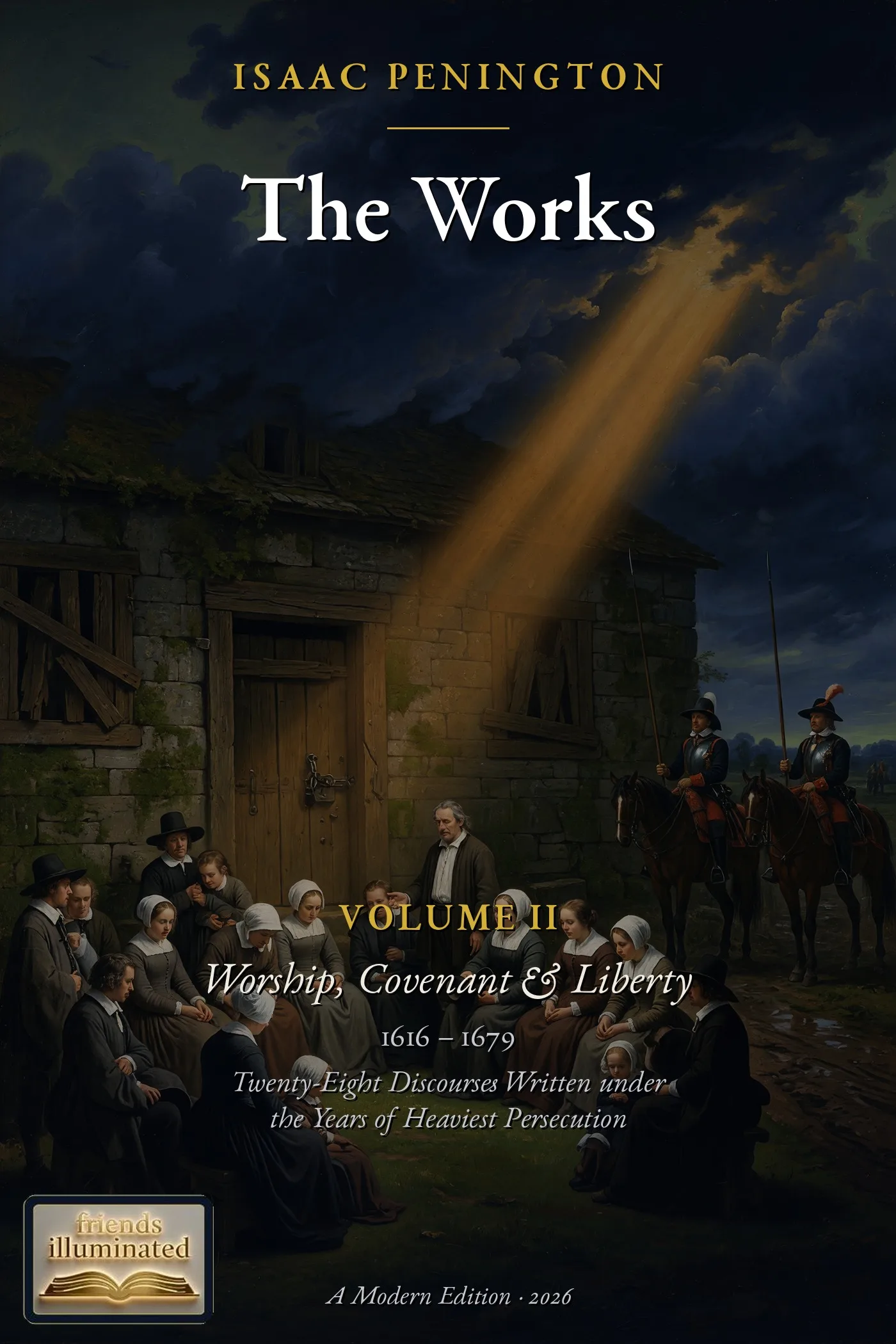
The Works of Isaac Penington, Volume II
The heart of Penington's theological output — 28 discourses on worship, covenant theology, ecclesiology, religious liberty, and the nature of the spiritual life, written during the years of heaviest Quaker persecution.
- Complete & unabridged
- Modernized English
- EPUB format
This edition
Read itE-book · EPUB
- Time to read12.8 hours
- Length182,514 words
- Files1 EPUB, DRM-free
How we get 12.8 hours
This figure is here so you can compare one book against another. Every title on the site is timed from its own word count at the same reading speed — nothing is adjusted book by book — so if this edition says 12.8 hours and another says half that, the second one really is about half the reading. It is a measure of size, in the way a page count is. Your own pace is your own: at the speeds typical adult readers actually manage, this edition runs anywhere from 10.1 hours to 17.4 hours.
What is in this edition
| Modernized text | 178,792 words |
|---|---|
| Introduction, chapter summaries and notes written for this edition | 3,722 words |
| Total | 182,514 words |
The introduction, the chapter summaries and the notes on people, places and unfamiliar terms were written for this edition. They are 3,722 of the 182,514 words above, and they are part of what you are buying.
Counted from the text of the EPUB you receive. Navigation, the title page, the table of contents and the licence page are excluded — they are packaging, not reading.
The reading rate
238 words per minute, for adult silent reading of non-fiction, applied unchanged to every title on the site. We did not pick the number; it is the pooled result of a published meta-analysis. Nothing is adjusted book by book — that consistency is what makes two of these figures worth comparing.
Brysbaert, M. (2019). How many words do we read per minute? A review and meta-analysis of reading rate. Journal of Memory and Language, 109, 104047. doi:10.1016/j.jml.2019.104047
190 studies, 18,573 participants.
The same paper puts most adult readers between 175 and
300 words per minute, and those two speeds give the
10.1 hours and 17.4 hours above.
Because time is words divided by speed, an even range of speeds produces an
uneven range of times, so 12.8 hours sits nearer the fast end of that
range than the middle of it.
If it were a paperback
Roughly 521–730 pages.
Words per printed page is a typesetting convention, not a measurement — it moves with trim size, type size and leading. The range above assumes 250–350 words a page. Friends Illuminated publishes no print edition of this book; the figure is here only because pages are a more familiar size than words.
- Secure checkout by Stripe
- Instant download
- 7-day money-back guarantee
About This Edition
The second volume of Penington’s collected works gathers the richest period of his theological writing — the tracts and discourses produced during the 1660s and early 1670s, when the Quaker movement faced its most sustained legal persecution and Penington himself was repeatedly imprisoned. That context gives these writings an urgency that purely academic theology rarely achieves. These are arguments made by a man who paid for his convictions with his freedom and his health, and the stakes are visible in every paragraph.
The twenty-eight pieces in this volume address the full range of Penington’s theological concerns: the nature of true worship (inward and gathered, not confined to outward forms); the meaning of the new covenant written on the heart; the right ordering of the church and its discipline; the question of religious liberty and the proper limits of state power over conscience; and the deep architecture of the spiritual life — how the soul moves from seeking to finding, from surface religion to living encounter. On each of these questions, Penington argues with a combination of scriptural knowledge, logical precision, and the authority of personal experience that few theological writers of any era can match.
This volume includes his treatments of specific controversial questions — the Sabbath, the sacraments, baptism, church government — that put early Quakers at odds with both Anglican and Nonconformist Christianity. Penington’s approach to these disputes is never merely polemical; he always returns the argument to the underlying spiritual reality that the outward practice either expresses or obscures.
This Friends Illuminated edition presents the complete text with editorial introductions to each piece, synopses, and scripture links throughout.