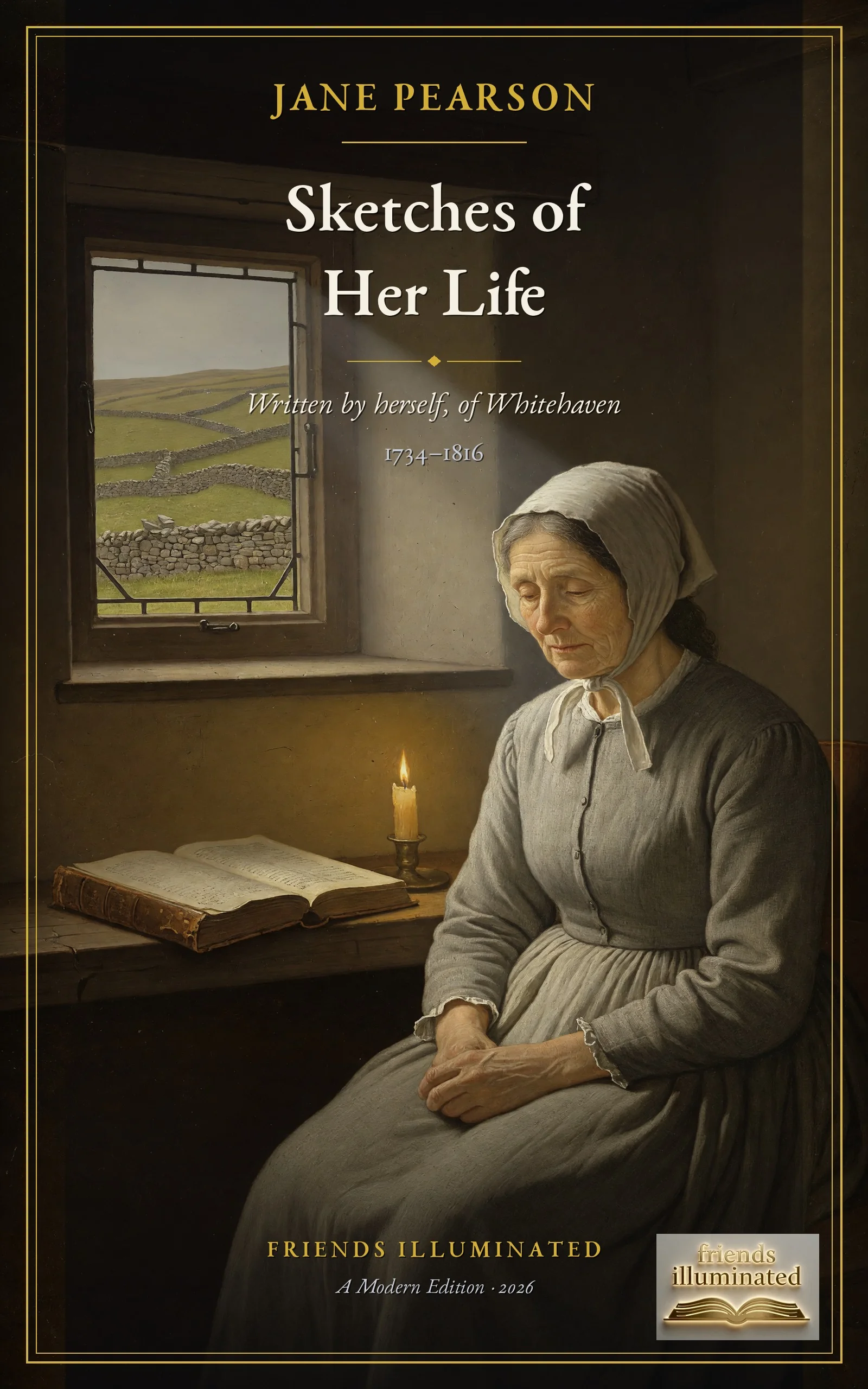
Sketches of the Life of Jane Pearson
The memoirs of Jane Pearson (1734–1816) of Whitehaven, written in her own hand and published the year after her death. Widowed in 1774 and left with a numerous family — every one of whom she outlived — she carried a gift in the ministry for forty-two years while recording, with rare honesty, the inward conflicts and searchings of heart that accompanied it. Her travels through Westmoreland, Lancashire, Yorkshire and the West Country are set down plainly, alongside the private reckonings she never intended for a public audience. With the Testimony of Pardshaw Monthly Meeting. A modern English edition with linked scripture and historical references.
- A Cumberland widow's private record of forty-two years in the ministry
- Unusually candid on inward conflict, doubt, and the fear of self-deception
- With the Testimony of Pardshaw Monthly Meeting appended
- EPUB format
This edition
Read itE-book · EPUB
- Time to read1.4 hours
- Length19,598 words
- Files1 EPUB, DRM-free
How we get 1.4 hours
This figure is here so you can compare one book against another. Every title on the site is timed from its own word count at the same reading speed — nothing is adjusted book by book — so if this edition says 1.4 hours and another says half that, the second one really is about half the reading. It is a measure of size, in the way a page count is. Your own pace is your own: at the speeds typical adult readers actually manage, this edition runs anywhere from 1.1 hours to 1.9 hours.
What is in this edition
| Modernized text | 18,316 words |
|---|---|
| Introduction, chapter summaries and notes written for this edition | 1,282 words |
| Total | 19,598 words |
The introduction, the chapter summaries and the notes on people, places and unfamiliar terms were written for this edition. They are 1,282 of the 19,598 words above, and they are part of what you are buying.
Counted from the text of the EPUB you receive. Navigation, the title page, the table of contents and the licence page are excluded — they are packaging, not reading.
The reading rate
238 words per minute, for adult silent reading of non-fiction, applied unchanged to every title on the site. We did not pick the number; it is the pooled result of a published meta-analysis. Nothing is adjusted book by book — that consistency is what makes two of these figures worth comparing.
Brysbaert, M. (2019). How many words do we read per minute? A review and meta-analysis of reading rate. Journal of Memory and Language, 109, 104047. doi:10.1016/j.jml.2019.104047
190 studies, 18,573 participants.
The same paper puts most adult readers between 175 and
300 words per minute, and those two speeds give the
1.1 hours and 1.9 hours above.
Because time is words divided by speed, an even range of speeds produces an
uneven range of times, so 1.4 hours sits nearer the fast end of that
range than the middle of it.
If it were a paperback
Roughly 56–78 pages.
Words per printed page is a typesetting convention, not a measurement — it moves with trim size, type size and leading. The range above assumes 250–350 words a page. Friends Illuminated publishes no print edition of this book; the figure is here only because pages are a more familiar size than words.
- Secure checkout by Stripe
- Instant download
- 7-day money-back guarantee
About This Edition
Jane Pearson was born Jane Sibson at Newtown, near Carlisle, in 1734 or 1735. Her father died while she was still very young, and her upbringing fell to her mother, who raised her carefully in the discipline of Friends. It did not take at first. By her own account she was drawn strongly to gaiety, and the memoirs that follow are in large part the record of what it cost her to be turned from it.
In 1757, at about twenty-two, she married John Pearson of Graysouthen, in Cumberland. Seventeen years later he was dead, and she was a widow with a house full of children. Some of them died young. The rest died grown. She outlived every one, and she wrote about it without ornament.
What makes these sketches unusual is not the outward story but the inward one. Jane Pearson first appeared in public testimony about 1773 and continued in the ministry for some forty-two years, yet the private papers she left behind are preoccupied less with her service than with her fear that she might be deceived in it. She writes of long stretches of spiritual darkness, of “inward conflicts” and “searchings of heart,” of speaking in meeting and then doubting whether she should have opened her mouth at all. She sought evidence of final acceptance under what her editor called accumulated discouragements, and did not pretend she had found it before she had.
She travelled less than many recorded ministers, and said plainly that she did not apprehend much travel to be required of her. What she did undertake she recorded: Westmoreland and Lancashire in 1777; Westmoreland, Lancashire and Yorkshire in 1779; and in 1787 a long southward journey through Lancashire, Cheshire, Shropshire, Worcestershire, Warwickshire, Somersetshire, Devonshire and Cornwall. Afterward she removed to Whitehaven, where she spent the rest of her life, diligent in the attendance of meetings and, by the account of those who sat with her, remarkably powerful in prayer.
She died on the morning of the twentieth of second month, 1816, about eighty-one years of age, and was buried in the Friends’ burial-ground at Whitehaven five days later. Her last letter had asked a friend to look over her papers when she was gone and dispose of them as he thought best. He published them in 1817, together with a specimen or two of her verses and the Testimony of Pardshaw Monthly Meeting, which is included here at the close of her own memoirs.
This is a book for the diffident and the dejected, and its editor said so. Jane Pearson was modest, doubtful of herself, and frequently in the dark; she was also faithful for four decades, and at the end she was given the assurance she had spent a lifetime looking for. That is the whole argument of the book, and she makes it by simply telling the truth about herself.
This Friends Illuminated edition presents the complete 1817 text in modern English, with archaic constructions resolved, scripture references linked, and the people, places and meetings of eighteenth-century Cumberland identified for the present-day reader.