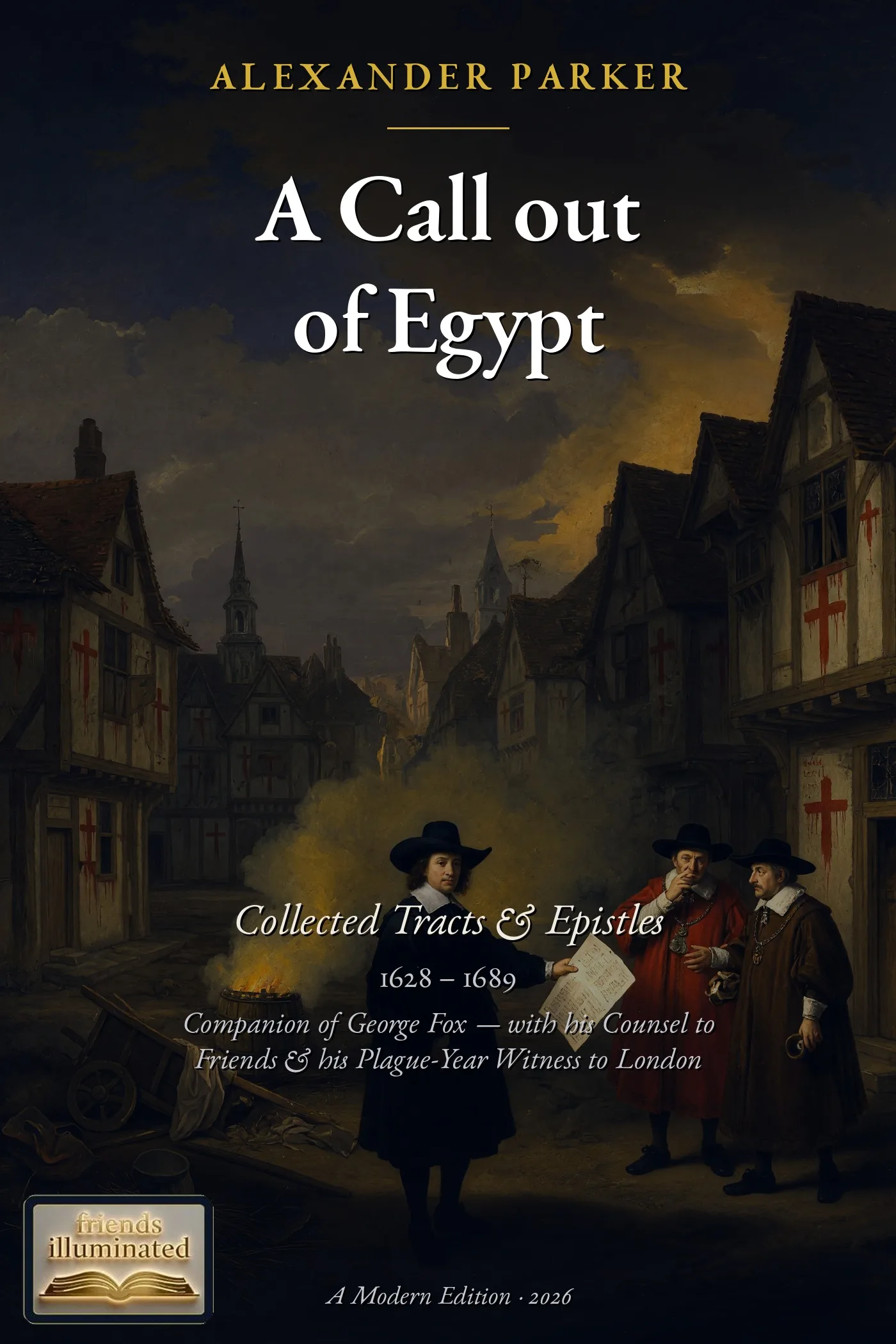
A Call out of Egypt: Collected Tracts & Epistles
Alexander Parker (1628–1689) — one of the Valiant Sixty and George Fox's most constant traveling companion — gathered here for the first time in a modern edition: his tracts on the soul's deliverance and Quaker worship, his celebrated counsel on silent meetings, his plague-year address to the Mayor of London, and his letters from the heart of the first Quaker generation. A modern English edition with linked scripture and historical references.
- Seven tracts (1654–1660) including A Call out of Egypt and the Declaration of Faith written with Edward Burrough
- The celebrated 1660 epistle on the conduct of silent meetings, the 1665 plague broadside, and eleven letters to Margaret Fell and George Fox
- EPUB format
This edition
Read itE-book · EPUB
- Time to read5.2 hours
- Length74,547 words
- Files1 EPUB, DRM-free
How we get 5.2 hours
This figure is here so you can compare one book against another. Every title on the site is timed from its own word count at the same reading speed — nothing is adjusted book by book — so if this edition says 5.2 hours and another says half that, the second one really is about half the reading. It is a measure of size, in the way a page count is. Your own pace is your own: at the speeds typical adult readers actually manage, this edition runs anywhere from 4.1 hours to 7.1 hours.
What is in this edition
| Modernized text | 72,347 words |
|---|---|
| Introduction, chapter summaries and notes written for this edition | 2,200 words |
| Total | 74,547 words |
The introduction, the chapter summaries and the notes on people, places and unfamiliar terms were written for this edition. They are 2,200 of the 74,547 words above, and they are part of what you are buying.
Counted from the text of the EPUB you receive. Navigation, the title page, the table of contents and the licence page are excluded — they are packaging, not reading.
The reading rate
238 words per minute, for adult silent reading of non-fiction, applied unchanged to every title on the site. We did not pick the number; it is the pooled result of a published meta-analysis. Nothing is adjusted book by book — that consistency is what makes two of these figures worth comparing.
Brysbaert, M. (2019). How many words do we read per minute? A review and meta-analysis of reading rate. Journal of Memory and Language, 109, 104047. doi:10.1016/j.jml.2019.104047
190 studies, 18,573 participants.
The same paper puts most adult readers between 175 and
300 words per minute, and those two speeds give the
4.1 hours and 7.1 hours above.
Because time is words divided by speed, an even range of speeds produces an
uneven range of times, so 5.2 hours sits nearer the fast end of that
range than the middle of it.
If it were a paperback
Roughly 213–298 pages.
Words per printed page is a typesetting convention, not a measurement — it moves with trim size, type size and leading. The range above assumes 250–350 words a page. Friends Illuminated publishes no print edition of this book; the figure is here only because pages are a more familiar size than words.
- Secure checkout by Stripe
- Instant download
- 7-day money-back guarantee
About This Edition
Alexander Parker (1628–1689) stands just past the central figure in almost every great scene of the first Quaker generation. When George Fox was seized at Swannington in 1655 and marched to London to face Oliver Cromwell, Parker rode with him rather than leave him alone among the soldiers. When the London meetings swelled in the late 1650s, his steady letters to Margaret Fell at Swarthmore carried the news. When the Restoration broke over the young movement, he wrote to Friends from a Chester prison cell; when the Conventicle Act filled the jails, he wrote from Newgate; and when plague emptied the streets of London in 1665, he stayed, and addressed the Lord Mayor and Aldermen of the dying city.
Part One of this volume presents his seven tracts in chronological order, from his first printed paper of 1654 to the Declaration to All the World of Our Faith issued with Edward Burrough in 1660. At their center is A Call out of Egypt (1656), which reads Israel’s bondage under Pharaoh as the map of the soul’s deliverance — Egypt the darkness, Moses the Light of Christ raised up within, the wilderness the long, tempted passage between conviction and rest. Part Two gathers the epistles and papers of a long faithfulness — the Newgate salutation of 1664, the plague broadside of 1665, the memorial testimony for Josiah Coale, the 1675 address to King and Parliament on the case of oaths — together with eleven of his letters to Margaret Fell and George Fox, and the celebrated general epistle of 1660 on the right conduct of silent meetings, quoted by Friends for three and a half centuries.
The tracts are modernized directly from hand-keyed transcriptions of the original seventeenth-century printings; the letters follow the 1841 collection Letters of Early Friends. As throughout the Friends Illuminated series, the modernization touches grammar and spelling, never substance — Parker’s scriptural saturation and steady, patient voice are exactly where he left them, with scripture and historical references linked throughout.