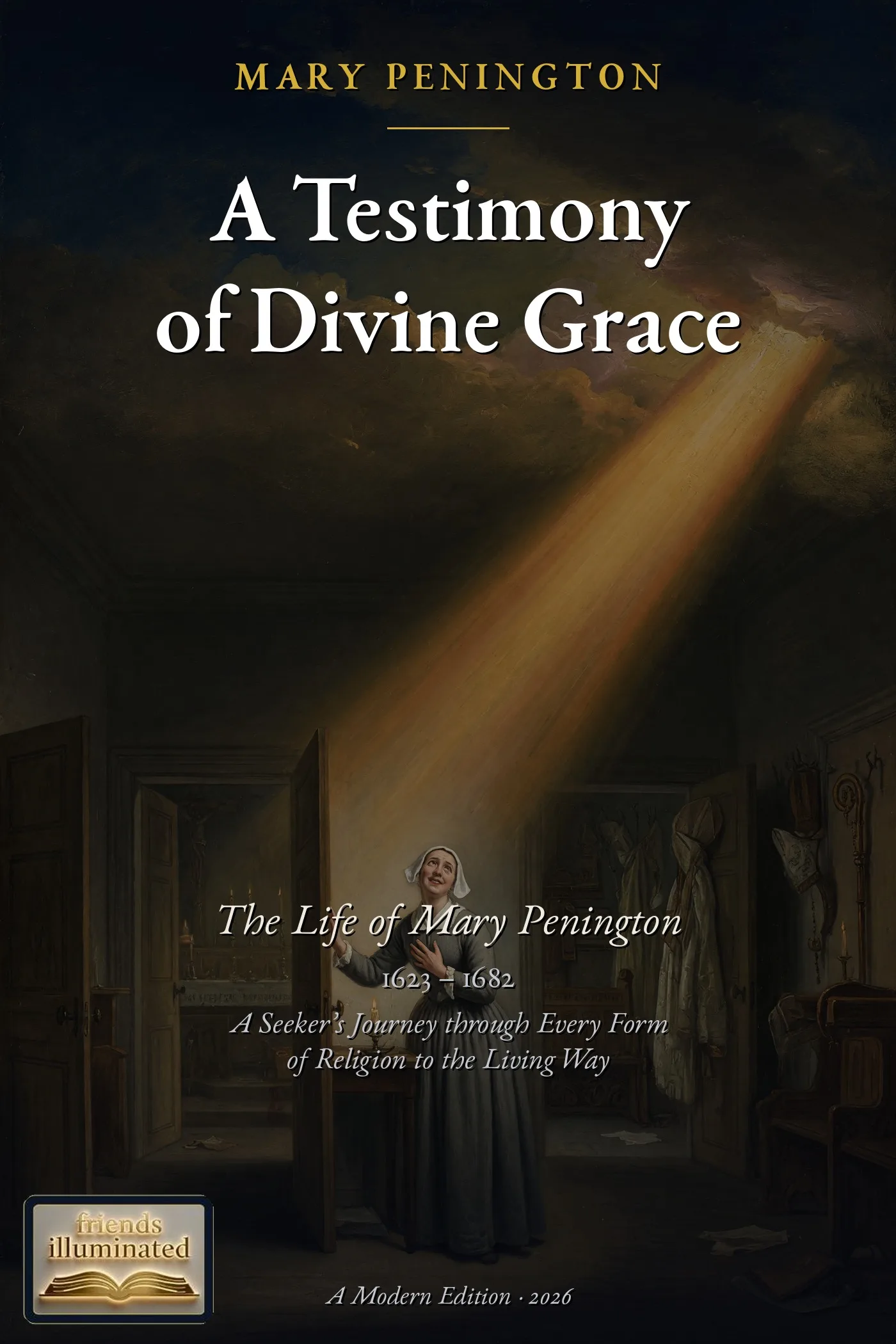
A Testimony of Divine Grace: The Life of Mary Penington
One of the finest first-person accounts of the long Puritan-to-Quaker spiritual journey — the autobiography of a woman who searched through every form of religion available to her before finding what she called 'the true and living way.'
- Complete & unabridged
- Modernized English
- EPUB format
This edition
Read itE-book · EPUB
- Time to read45 minutes
- Length10,682 words
- Files1 EPUB, DRM-free
How we get 45 minutes
This figure is here so you can compare one book against another. Every title on the site is timed from its own word count at the same reading speed — nothing is adjusted book by book — so if this edition says 45 minutes and another says half that, the second one really is about half the reading. It is a measure of size, in the way a page count is. Your own pace is your own: at the speeds typical adult readers actually manage, this edition runs anywhere from 36 minutes to 1 hour.
What is in this edition
| Modernized text | 10,497 words |
|---|---|
| Introduction, chapter summaries and notes written for this edition | 185 words |
| Total | 10,682 words |
The introduction, the chapter summaries and the notes on people, places and unfamiliar terms were written for this edition. They are 185 of the 10,682 words above, and they are part of what you are buying.
Counted from the text of the EPUB you receive. Navigation, the title page, the table of contents and the licence page are excluded — they are packaging, not reading.
The reading rate
238 words per minute, for adult silent reading of non-fiction, applied unchanged to every title on the site. We did not pick the number; it is the pooled result of a published meta-analysis. Nothing is adjusted book by book — that consistency is what makes two of these figures worth comparing.
Brysbaert, M. (2019). How many words do we read per minute? A review and meta-analysis of reading rate. Journal of Memory and Language, 109, 104047. doi:10.1016/j.jml.2019.104047
190 studies, 18,573 participants.
The same paper puts most adult readers between 175 and
300 words per minute, and those two speeds give the
36 minutes and 1 hour above.
Because time is words divided by speed, an even range of speeds produces an
uneven range of times, so 45 minutes sits nearer the fast end of that
range than the middle of it.
If it were a paperback
Roughly 31–43 pages.
Words per printed page is a typesetting convention, not a measurement — it moves with trim size, type size and leading. The range above assumes 250–350 words a page. Friends Illuminated publishes no print edition of this book; the figure is here only because pages are a more familiar size than words.
- Secure checkout by Stripe
- Instant download
- 7-day money-back guarantee
About This Edition
Mary Penington was born in 1623 into the Kent gentry, married first to a Parliamentary officer who died of fever in the Civil War, and then — after years as a widow and seeker — to Isaac Penington, the mystic theologian who would become one of the towering figures of early Quakerism. Her autobiography is the record of that long inner journey: from the formal religion of her upbringing, through Presbyterianism, Independency, and various other forms of dissent, to the moment when she finally heard George Fox preach and recognized, with something like shock, that she had at last found what she had spent her life looking for.
What makes Mary Penington’s account exceptional is her unflinching honesty about the spiritual search itself — its frustrations, its false stops, its periods of genuine despair. She had tried everything available to a devout Englishwoman of her era. She attended the best preachers. She examined her conscience with rigorous Puritan discipline. She sought conversion and found only more seeking. The Quaker meeting was her last resort, entered with considerable skepticism. What she experienced there — the gathered silence, the sense of a living presence — is described with a precision and simplicity that gives it the ring of genuine testimony.
The autobiography also gives us the other side of the Penington household that Isaac’s letters illuminate only obliquely: the management of Grange House and later Chalfont, the raising of children, the reception of traveling Friends at all hours, the repeated imprisonments of her husband and the toll they took. Mary Penington was not a passive figure in any of this. She negotiated with jailers, managed the estate during Isaac’s absences, and maintained the household as a center of Quaker life through years of persecution.
This Friends Illuminated edition is the complete text, carefully modernized for contemporary readers while preserving the authentic voice of one of the most gifted personal writers in early Quaker literature.