Life of Charles Marshall
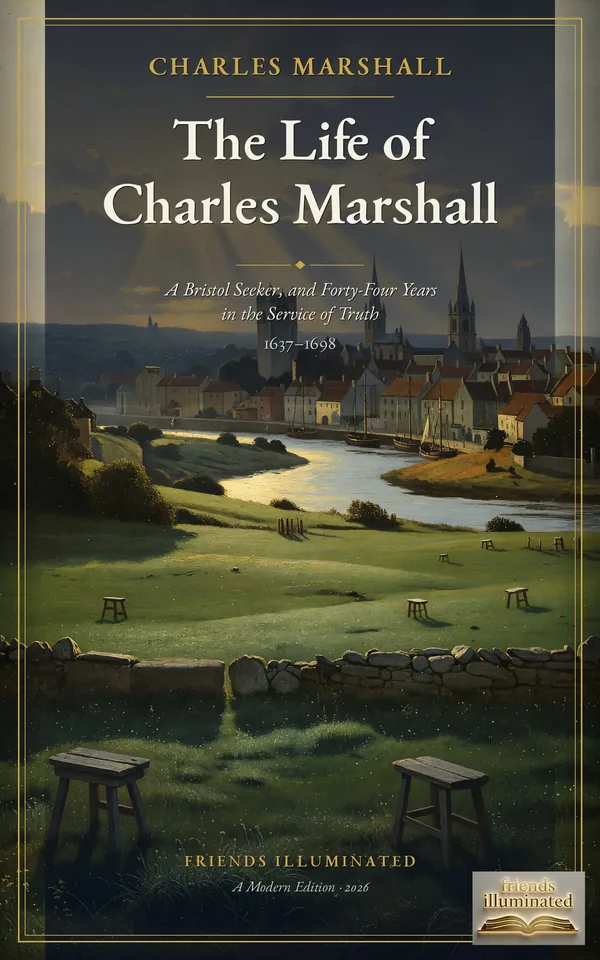
Charles Marshall was born in the city of Bristol in 1637 and brought up, as William Penn put it, among the most seeking and enlightened people of his time. In 1654 John Camm and John Audland came out of the North to Bristol, and the meetings they held in the field called Earlsmead drew thousands; Marshall was convinced there, and the rest of his life belonged to the ministry. For some twenty years he travelled England in that service, and he lay a prisoner in the Fleet in London through the winter of the great frost. This edition opens with the testimonies given at London in 1703 by William Penn, George Whitehead, John Freame, John Whiting and his widow Hannah Marshall. It then gathers his own account of his seeking years and of the Bristol visitation, which is one of the clearest first-hand records of what the early preaching actually did to the people who heard it; his epistles to the flock of Christ Jesus on households, marriage, servants, trade and the care of meetings; a second epistle written from Tytherton in Wiltshire in 1678; his treatise of 1673 on man's happy estate, his fall and the way of his restoration, with its sustained argument that Christ is the light that lights every man; his warning to England; two long addresses to the inhabitants of Wiltshire on the broad way and the narrow; and the last two epistles he wrote to Friends, in 1689 and 1691.
- Fully modernized English — every long sentence broken, every inversion untangled
- 2,239-word editorial introduction placing the Bristol ministry in context
- 18 chapters plus a full linked table of contents
- The 1703 testimonies of William Penn, George Whitehead and Hannah Marshall
- 205 linked Scripture and reference notes throughout
- EPUB format
This edition
Read itE-book · EPUB
- Time to read3.3 hours
- Length47,833 words
- Files1 EPUB, DRM-free
How we get 3.3 hours
This figure is here so you can compare one book against another. Every title on the site is timed from its own word count at the same reading speed — nothing is adjusted book by book — so if this edition says 3.3 hours and another says half that, the second one really is about half the reading. It is a measure of size, in the way a page count is. Your own pace is your own: at the speeds typical adult readers actually manage, this edition runs anywhere from 2.7 hours to 4.6 hours.
What is in this edition
| Modernized text | 45,628 words |
|---|---|
| Introduction, chapter summaries and notes written for this edition | 2,205 words |
| Total | 47,833 words |
The introduction, the chapter summaries and the notes on people, places and unfamiliar terms were written for this edition. They are 2,205 of the 47,833 words above, and they are part of what you are buying.
Counted from the text of the EPUB you receive. Navigation, the title page, the table of contents and the licence page are excluded — they are packaging, not reading.
The reading rate
238 words per minute, for adult silent reading of non-fiction, applied unchanged to every title on the site. We did not pick the number; it is the pooled result of a published meta-analysis. Nothing is adjusted book by book — that consistency is what makes two of these figures worth comparing.
Brysbaert, M. (2019). How many words do we read per minute? A review and meta-analysis of reading rate. Journal of Memory and Language, 109, 104047. doi:10.1016/j.jml.2019.104047
190 studies, 18,573 participants.
The same paper puts most adult readers between 175 and
300 words per minute, and those two speeds give the
2.7 hours and 4.6 hours above.
Because time is words divided by speed, an even range of speeds produces an
uneven range of times, so 3.3 hours sits nearer the fast end of that
range than the middle of it.
If it were a paperback
Roughly 137–191 pages.
Words per printed page is a typesetting convention, not a measurement — it moves with trim size, type size and leading. The range above assumes 250–350 words a page. Friends Illuminated publishes no print edition of this book; the figure is here only because pages are a more familiar size than words.
- Secure checkout by Stripe
- Instant download
- 7-day money-back guarantee
About This Edition
He was born in Bristol in the fourth month [June] of 1637, into a city William Penn described as holding the most seeking and enlightened people of its time. He died on the fifteenth of the ninth month [November], 1698, in the sixty-second year of his age, forty-four years after the meeting that decided his life.
The coming of Truth into Bristol
In 1654 John Camm and John Audland came out of the North with what Penn called the glad tidings, and the Bristol meetings they held drew crowds no building would hold — so they met in a field called Earlsmead, where people carried out stools from the streets to sit on. Marshall was a young man among them, and his account of those days is the part of this book that cannot be got anywhere else: not the doctrine of the visitation but the experience of it, written by someone who was standing in the field.
Twenty years in the ministry
He was not, Penn wrote, one who strove after fine words or leaned on memory or former openings; he waited for the feeling of God’s living power to carry him forth. That waiting took him the length of England for some twenty years. The cost is set down without self-pity: illness nearly to death more than once, the loss of a child, and a winter in the Fleet prison in London through the time of the great frost, put there by a man who spared no expense to get him jailed.
The epistles and the treatise
Most of this volume is what he wrote rather than what happened to him. The epistles to the flock of Christ Jesus turn to marriage and households, servants and masters, trade and plain dealing, and the care of meetings — practical counsel, closely argued. The treatise of 1673 works through man’s first estate, his fall and the way of his restoration, and then defends at length the claim the early Friends were most attacked for: that Christ is the light that lights every man coming into the world.
The two long addresses to the inhabitants of Wiltshire set the broad way against the narrow, and the book ends with the last two epistles he wrote to Friends, in 1689 and 1691.
About this edition
Every sentence has been rebuilt for a modern reader. His vocabulary of conviction — Truth, the Seed, First-day, the numbered months — is bracketed on first use and then left alone, because translating it would translate him out of the book. Two hundred and five Scripture and reference links are set into the text; every Scripture reference was checked against the King James text rather than recalled, and every person and place link was checked by hand, with any name that had no reliable page left unlinked rather than pointed somewhere wrong.