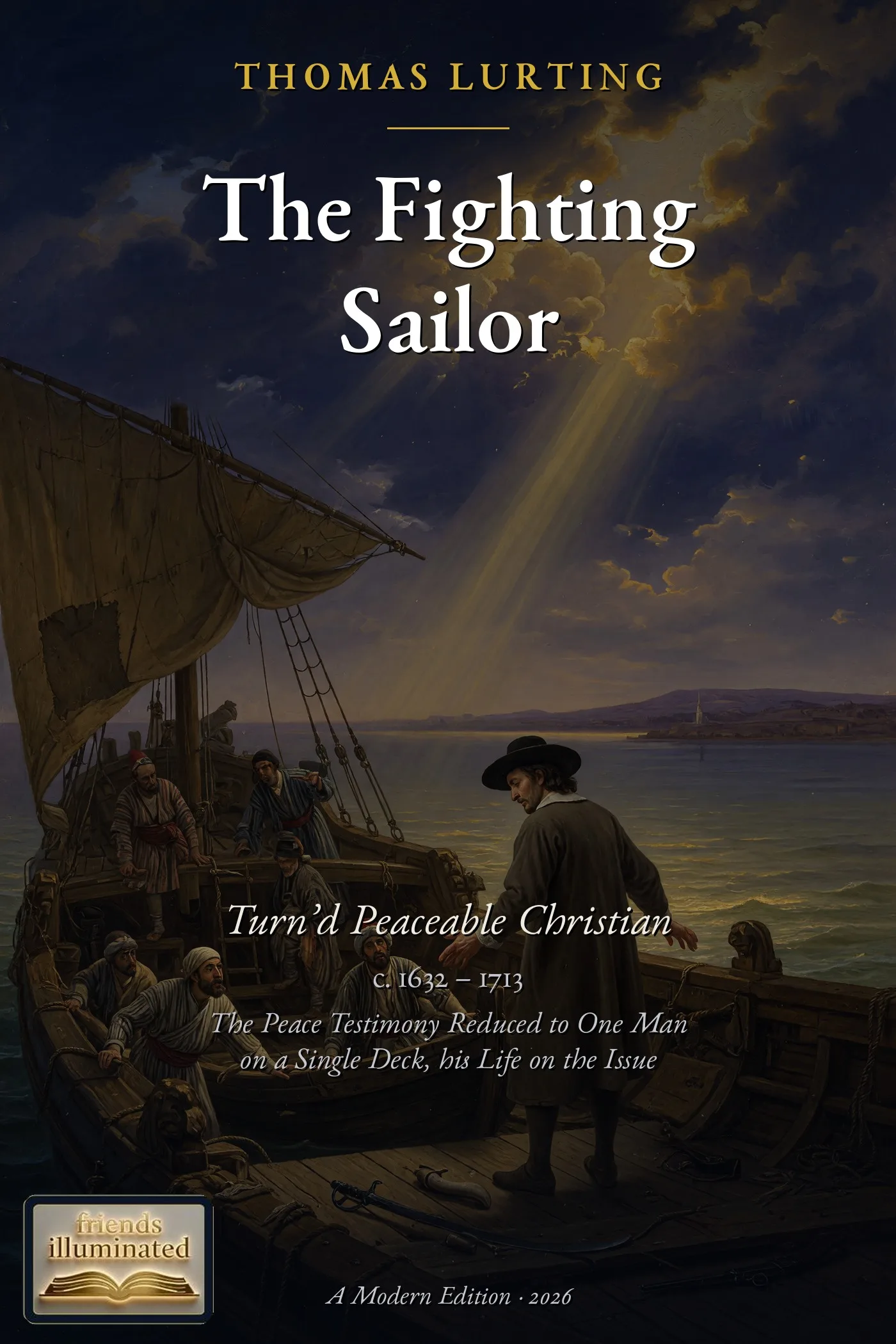
The Fighting Sailor Turn'd Peaceable Christian: The Life of Thomas Lurting
The narrative of Thomas Lurting (c. 1632–1713), the English seaman who fought through the naval wars of the 1650s, was convinced of the Quaker truth aboard a man-of-war, and laid down the sword — and who, in 1663, retook his ship from Barbary corsairs without bloodshed and carried his ten captives home to their own country. A modern English edition with linked scripture and historical references.
- The classic Quaker sea-narrative, in ten modern chapters
- From the guns of Santa Cruz to the famous freeing of the Turks
- EPUB format
Read it or hear it
Read itE-book · EPUB
- Time to read52 minutes
- Length12,482 words
- Files1 EPUB, DRM-free
Hear itAudiobook · MP3
- Runtime1h 19m
- Narrated byDaniel
- Files11 MP3s, one per chapter
How we get 52 minutes
This figure is here so you can compare one book against another. Every title on the site is timed from its own word count at the same reading speed — nothing is adjusted book by book — so if this edition says 52 minutes and another says half that, the second one really is about half the reading. It is a measure of size, in the way a page count is. Your own pace is your own: at the speeds typical adult readers actually manage, this edition runs anywhere from 42 minutes to 1.2 hours.
What is in this edition
| Modernized text | 11,295 words |
|---|---|
| Introduction, chapter summaries and notes written for this edition | 1,187 words |
| Total | 12,482 words |
The introduction, the chapter summaries and the notes on people, places and unfamiliar terms were written for this edition. They are 1,187 of the 12,482 words above, and they are part of what you are buying.
Counted from the text of the EPUB you receive. Navigation, the title page, the table of contents and the licence page are excluded — they are packaging, not reading.
The reading rate
238 words per minute, for adult silent reading of non-fiction, applied unchanged to every title on the site. We did not pick the number; it is the pooled result of a published meta-analysis. Nothing is adjusted book by book — that consistency is what makes two of these figures worth comparing.
Brysbaert, M. (2019). How many words do we read per minute? A review and meta-analysis of reading rate. Journal of Memory and Language, 109, 104047. doi:10.1016/j.jml.2019.104047
190 studies, 18,573 participants.
The same paper puts most adult readers between 175 and
300 words per minute, and those two speeds give the
42 minutes and 1.2 hours above.
Because time is words divided by speed, an even range of speeds produces an
uneven range of times, so 52 minutes sits nearer the fast end of that
range than the middle of it.
If it were a paperback
Roughly 36–50 pages.
Words per printed page is a typesetting convention, not a measurement — it moves with trim size, type size and leading. The range above assumes 250–350 words a page. Friends Illuminated publishes no print edition of this book; the figure is here only because pages are a more familiar size than words.
- Secure checkout by Stripe
- Instant download
- 7-day money-back guarantee
About This Edition
Among the autobiographies of the first Quaker generation, Thomas Lurting’s little book stands almost alone. It does not begin in a meetinghouse or on a country road, but on the gun-deck of a man-of-war, with a boy of fourteen pressed into the wars and a cannon-ball passing close enough to feel. Lurting (c. 1632–1713) was a fighting seaman before he was anything else. He had served through some of the hardest sea-battles of his age, risen to be a boatswain’s mate with two hundred men under his command, and stood at the guns when the shot was flying and the decks ran with blood. The wonder of his story is that it tells how such a man came to lay down his sword and never take it up again.
First printed at London in the early eighteenth century under a title that says everything in a phrase — The Fighting Sailor Turn’d Peaceable Christian — the narrative carries the reader from Lurting’s impressment as a boy, through the wars against the Dutch and the Spaniard, to the four deliverances he counted in a single afternoon at the battle of Santa Cruz under General Robert Blake. Then comes the slow, costly turning: convinced of the Quaker truth in the unlikeliest of congregations, a handful of plain men aboard a warship, Lurting found at last that he could no longer serve the gun. His account of the standoff that followed — the captain’s drawn sword, the seaman who would not lift a hand to defend himself — is the peace testimony of the Quakers reduced to a single man on a single deck, with his life on the issue.
The book closes with the episode that made Lurting’s name. In 1663, sailing in a small merchant vessel, he and his shipmates were taken by Barbary corsairs out of Algiers. By seamanship and nerve they retook their own ship without killing a single man — and then, instead of selling their captives or holding them for ransom, they sailed to the Barbary coast and quietly set the ten Turks ashore, free men, in their own country. When the story reached England, King Charles II and the Duke of York sent for Lurting and asked him plainly why he had let his enemies go free. His answer is the moral of the whole book, lived out where kings could see it. This Friends Illuminated edition presents his narrative in lightly modernized English, with the plain speech of Friends preserved where he used it, and scripture and historical references linked throughout.