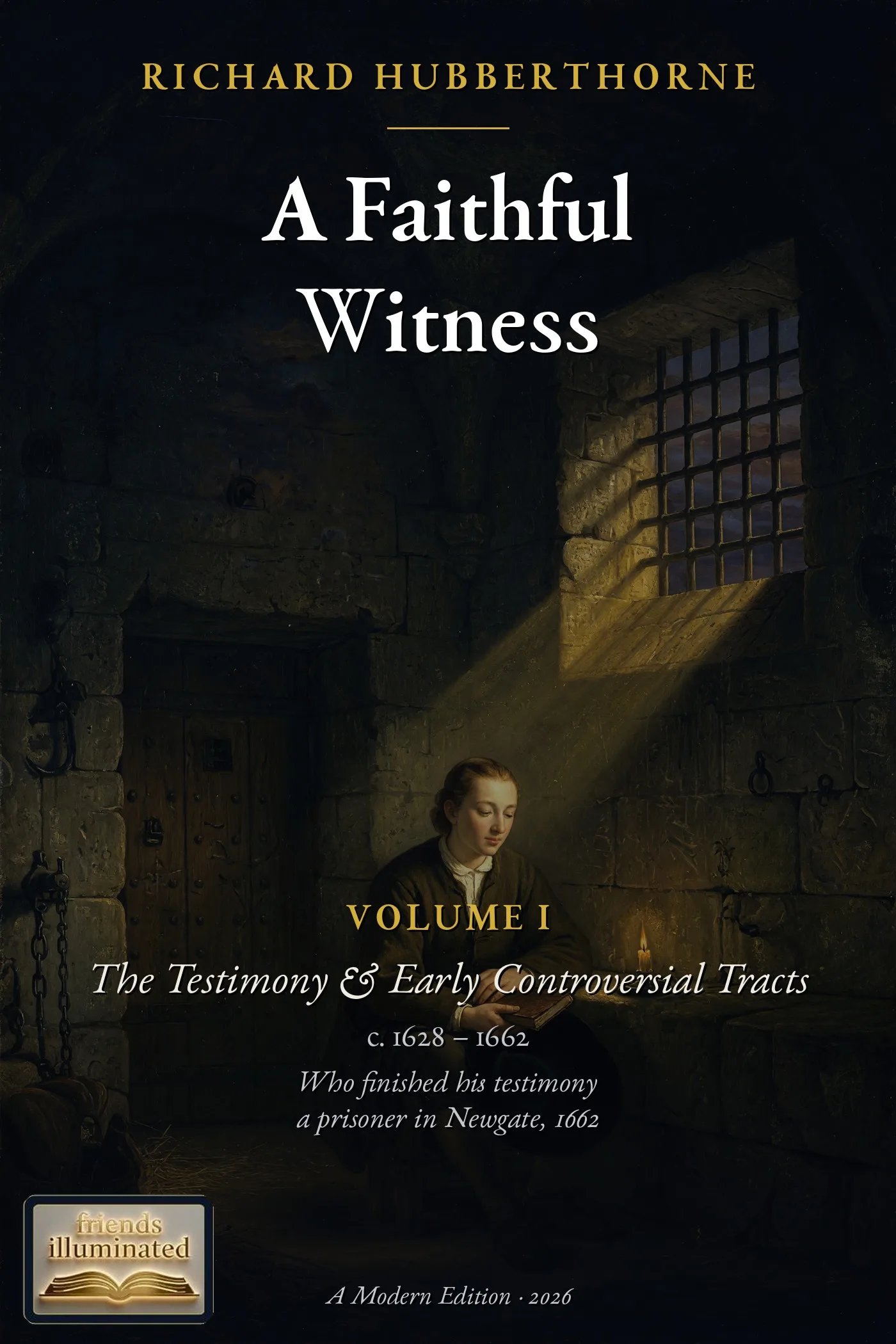
A Collection of the Several Books and Writings of Richard Hubberthorne, Volume I: The Testimony & Early Controversial Tracts
The controversial and testimonial writings of Richard Hubberthorne (c. 1628–1662), one of the first generation of Quaker ministers, who finished his life a prisoner in Newgate. Volume I gathers his autobiographical Testimony of Obedience, his replies to Priest Sherlock, the Mittimus Answered, and the great tracts on Truth, Innocency, and the sufficiency of the Light Within — a modern English edition with linked scripture and historical references.
- Thirteen tracts and testimonies in one volume
- The writings of a Friend who died a prisoner in Newgate
- EPUB format
This edition
Read itE-book · EPUB
- Time to read3.9 hours
- Length55,501 words
- Files1 EPUB, DRM-free
How we get 3.9 hours
This figure is here so you can compare one book against another. Every title on the site is timed from its own word count at the same reading speed — nothing is adjusted book by book — so if this edition says 3.9 hours and another says half that, the second one really is about half the reading. It is a measure of size, in the way a page count is. Your own pace is your own: at the speeds typical adult readers actually manage, this edition runs anywhere from 3.1 hours to 5.3 hours.
What is in this edition
| Modernized text | 52,748 words |
|---|---|
| Introduction, chapter summaries and notes written for this edition | 2,753 words |
| Total | 55,501 words |
The introduction, the chapter summaries and the notes on people, places and unfamiliar terms were written for this edition. They are 2,753 of the 55,501 words above, and they are part of what you are buying.
Counted from the text of the EPUB you receive. Navigation, the title page, the table of contents and the licence page are excluded — they are packaging, not reading.
The reading rate
238 words per minute, for adult silent reading of non-fiction, applied unchanged to every title on the site. We did not pick the number; it is the pooled result of a published meta-analysis. Nothing is adjusted book by book — that consistency is what makes two of these figures worth comparing.
Brysbaert, M. (2019). How many words do we read per minute? A review and meta-analysis of reading rate. Journal of Memory and Language, 109, 104047. doi:10.1016/j.jml.2019.104047
190 studies, 18,573 participants.
The same paper puts most adult readers between 175 and
300 words per minute, and those two speeds give the
3.1 hours and 5.3 hours above.
Because time is words divided by speed, an even range of speeds produces an
uneven range of times, so 3.9 hours sits nearer the fast end of that
range than the middle of it.
If it were a paperback
Roughly 159–222 pages.
Words per printed page is a typesetting convention, not a measurement — it moves with trim size, type size and leading. The range above assumes 250–350 words a page. Friends Illuminated publishes no print edition of this book; the figure is here only because pages are a more familiar size than words.
- Secure checkout by Stripe
- Instant download
- 7-day money-back guarantee
About This Edition
Richard Hubberthorne (c. 1628–1662) was a Lancashire farmer’s son who became one of the boldest and clearest voices of the first generation of Quaker ministers — the company later remembered as the Valiant Sixty. Convinced under the preaching of George Fox in the early 1650s, he laid down a soldier’s commission and took up a harder warfare, traveling the length of England to declare the inward Light of Christ, disputing with priests and magistrates, suffering imprisonment again and again, and at last finishing his testimony in Newgate prison in 1662, dead at about thirty-four. This first volume of his collected writings gathers the testimonial and controversial tracts of those crowded years.
The volume opens with his Testimony of Obedience to the Heavenly Call, a brief spiritual autobiography in which Hubberthorne traces his own turning from the forms of religion to the voice of God within. From there the collection moves through the great controversies of the 1650s: his threefold Reply to Priest Sherlock, the Mittimus Answered in which he meets the legal warrant of his jailers with the higher law of conscience, The Zeal of the Oxford-Professors Tried, and his tracts on the Innocency of the Righteous Seed and the Distance between the Flesh and the Spirit. The book closes with the sustained and searching Word from the Lord and the long defense of Truth and Innocency, in which Hubberthorne sets out, with characteristic plainness, the Quaker conviction that the Light which shows a man his sin is the same Light that can lead him out of it.
These are documents of a movement under fire. Hubberthorne wrote not for the study but for the street and the prison, answering specific adversaries by name and defending Friends against the charges of blasphemy and disorder that filled the pamphlet wars of the Interregnum and the early Restoration. Yet beneath the controversy runs a steady devotional current — the same confidence in the sufficiency of the inward Christ that carried him, unbroken, to a felon’s death in London.
This edition gently modernizes Hubberthorne’s seventeenth-century prose for present-day readers: archaic spellings and the longest run-on sentences eased for clarity, while his voice, his arguments, and his imagery are kept intact. The plain speech of thee and thou has been preserved where it carries weight, for it was a testimony the first Friends suffered for. Scripture references have been added and linked to the King James text, and the people and places behind the controversies linked to encyclopedic articles, so that any reader may turn at once from Hubberthorne’s pages to the Scripture and history beneath them.