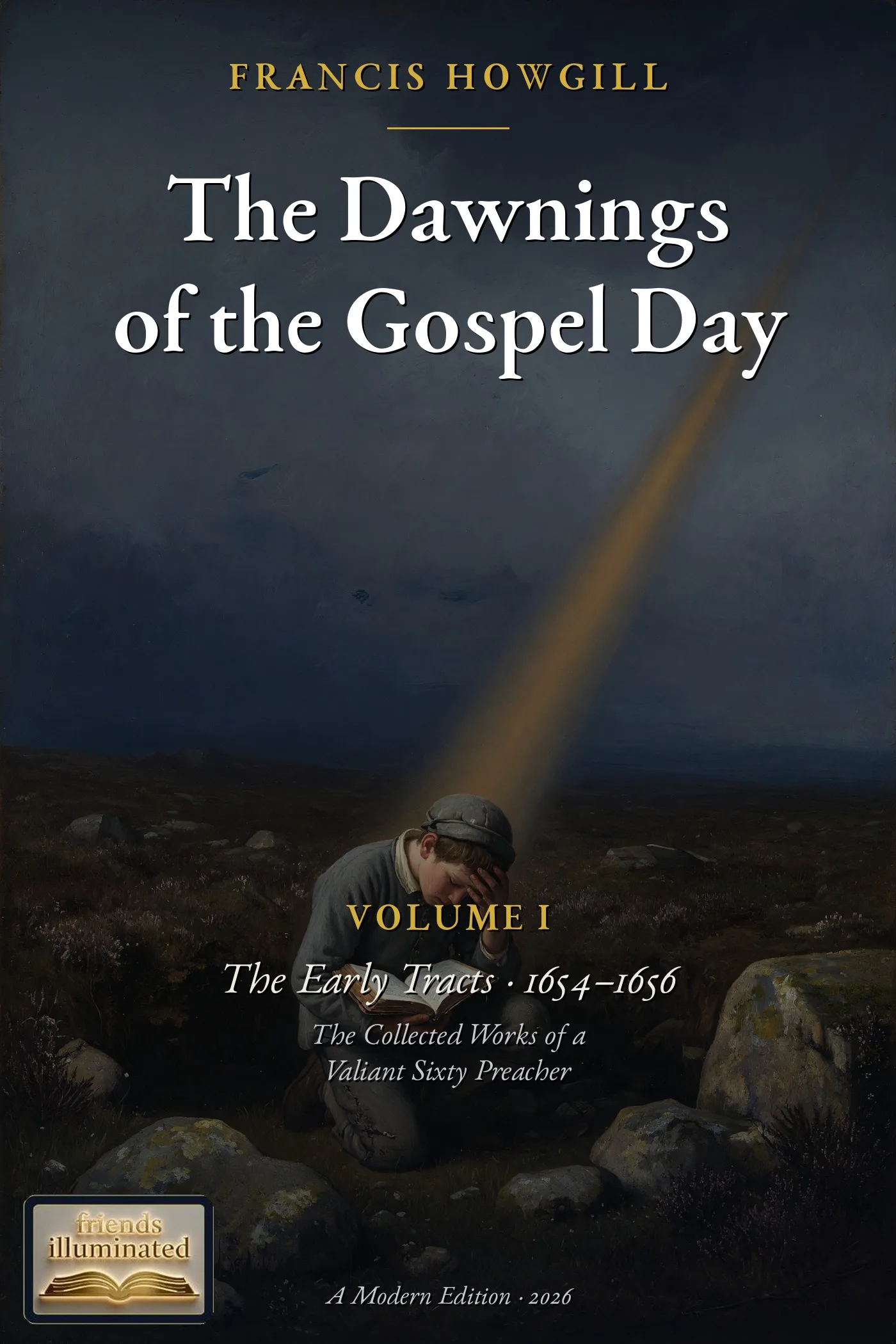
The Dawnings of the Gospel Day, Volume I: The Early Tracts
The collected early writings of Francis Howgill (1618–1668), one of the Valiant Sixty and a great pillar of the first generation of Friends. Gathered from the 1676 folio, this first volume brings together his tracts and epistles of 1654–1656 — warnings to magistrates and priests, epistles of love to the gathered Friends, and the great declaration The Inheritance of Jacob Discovered, with its searching account of his own pilgrimage out of the sects into the inward Light of Christ. A modern English edition with linked scripture and references.
- The earliest tracts and epistles, 1654–1656
- Including the spiritual autobiography in The Inheritance of Jacob Discovered
- EPUB format
This edition
Read itE-book · EPUB
- Time to read4.7 hours
- Length66,445 words
- Files1 EPUB, DRM-free
How we get 4.7 hours
This figure is here so you can compare one book against another. Every title on the site is timed from its own word count at the same reading speed — nothing is adjusted book by book — so if this edition says 4.7 hours and another says half that, the second one really is about half the reading. It is a measure of size, in the way a page count is. Your own pace is your own: at the speeds typical adult readers actually manage, this edition runs anywhere from 3.7 hours to 6.3 hours.
What is in this edition
| Modernized text | 61,303 words |
|---|---|
| Introduction, chapter summaries and notes written for this edition | 5,142 words |
| Total | 66,445 words |
The introduction, the chapter summaries and the notes on people, places and unfamiliar terms were written for this edition. They are 5,142 of the 66,445 words above, and they are part of what you are buying.
Counted from the text of the EPUB you receive. Navigation, the title page, the table of contents and the licence page are excluded — they are packaging, not reading.
The reading rate
238 words per minute, for adult silent reading of non-fiction, applied unchanged to every title on the site. We did not pick the number; it is the pooled result of a published meta-analysis. Nothing is adjusted book by book — that consistency is what makes two of these figures worth comparing.
Brysbaert, M. (2019). How many words do we read per minute? A review and meta-analysis of reading rate. Journal of Memory and Language, 109, 104047. doi:10.1016/j.jml.2019.104047
190 studies, 18,573 participants.
The same paper puts most adult readers between 175 and
300 words per minute, and those two speeds give the
3.7 hours and 6.3 hours above.
Because time is words divided by speed, an even range of speeds produces an
uneven range of times, so 4.7 hours sits nearer the fast end of that
range than the middle of it.
If it were a paperback
Roughly 190–266 pages.
Words per printed page is a typesetting convention, not a measurement — it moves with trim size, type size and leading. The range above assumes 250–350 words a page. Friends Illuminated publishes no print edition of this book; the figure is here only because pages are a more familiar size than words.
- Secure checkout by Stripe
- Instant download
- 7-day money-back guarantee
About This Edition
Among the first generation of the people called Quakers, few burned with a brighter or steadier flame than Francis Howgill (1618–1668). Born at Todthorne, near Grayrigg in Westmorland, he was a man of learning and conscience long before he was a Friend — a preacher among the Independents and then among the Seekers, restless and unsatisfied, searching the Scriptures and his own heart for a faith that was more than words. In 1652, when George Fox came preaching through the northern dales, Howgill heard him and was convinced. What he had sought through years of study broke upon him at last not as a new doctrine but as a present and inward power — the Light of Christ shining in the conscience. From that hour he gave the rest of his life, and at last his liberty and his body, to the proclaiming of it.
The Dawnings of the Gospel Day is the great folio of Howgill’s collected writings, gathered and printed in 1676, eight years after his death in Appleby Gaol, where he died a prisoner for refusing to swear an oath that his conscience forbade. The whole collection runs to nearly five hundred thousand words and spans the entire arc of his ministry. This first volume gathers his earliest tracts and epistles, written between 1654 and 1656 — the white heat of the movement’s first years, when a handful of northern farmers, weavers, and former soldiers went out two by two to turn the world upside down.
Howgill belonged to that band of itinerant preachers later remembered as the Valiant Sixty — the men and women who carried the Quaker message out of its northern cradle into every corner of England and beyond. His most constant companion was Edward Burrough, a younger man of equal fire, and the two are often named together in the chronicles of those years, “the two great pillars,” as one early Friend called them. Together they preached through the north, then carried the message south to London in 1654, where their plain and searching ministry drew great crowds and greater opposition. Howgill traveled also into Ireland, where the tract that gives this volume its spiritual center, The Inheritance of Jacob Discovered, was written and sent forth.
This edition gently modernizes Howgill’s seventeenth-century prose for present-day readers: spelling and punctuation brought into present usage, the archaic verb forms (hath, doth, saith) lightened to their modern equivalents, the older second-person forms (thee, thou, thy) rendered as you and your, and the longest run-on sentences divided for clarity — while the cadences of the Authorized Version, the great Quaker watchwords, and the prophetic intensity of his appeals all remain his own. Scripture references have been added and linked to the King James text, and the persons, places, and events behind the writings linked to encyclopedic articles, so that any reader may turn at once from Howgill’s witness to the Scripture and history beneath it.