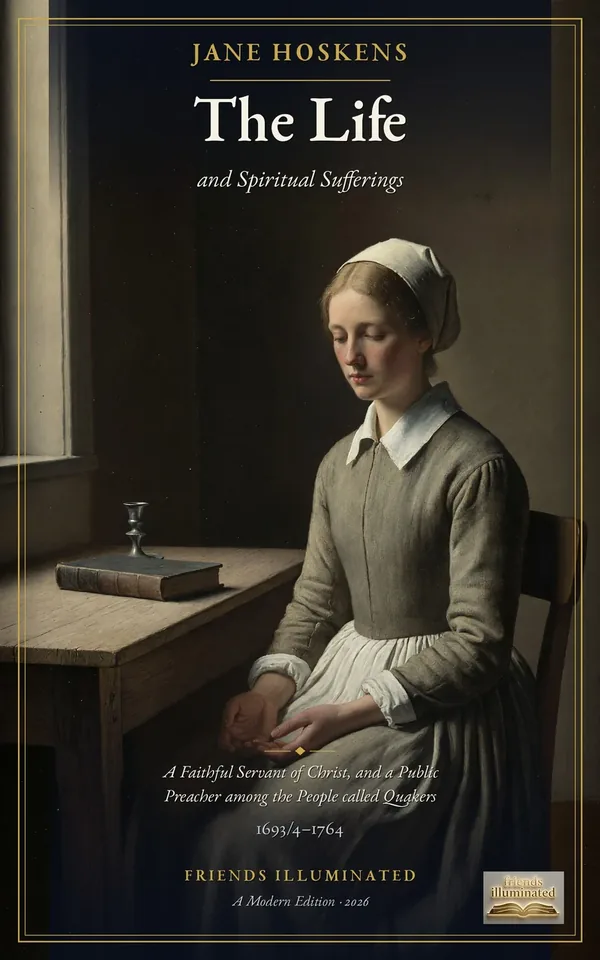
The Life of Jane Hoskens
The memoir of Jane Hoskens (1694–1764), a London girl with no knowledge of Friends who, lying near death in her sixteenth year, believed she had been told to go to Pennsylvania. She crossed in 1712 on the word of a Welshman who then tried to bind her by indenture for his own profit; she refused to sign, and was confined by legal process until the matter was settled. She taught school at Plymouth and Haverford, was convinced among Friends, and then spent years refusing a call to speak in meeting — the long refining this short book is most honest about. She became one of the first women to travel in the ministry out of Pennsylvania, lived twenty years in the household of David and Grace Lloyd at Chester, and journeyed from Nantucket to Carolina, to Barbadoes, and through Britain and Ireland. A modern English edition with linked scripture and historical references.
- The memoir of one of the first women to travel in the ministry from Pennsylvania
- A servant girl's refusal to sign indentures, and what it cost her
- Her years in the household of David and Grace Lloyd at Chester
- Journeys from Nantucket to Carolina, and a voyage to Barbadoes
- EPUB format
This edition
Read itE-book · EPUB
- Time to read1 hour
- Length14,371 words
- Files1 EPUB, DRM-free
How we get 1 hour
This figure is here so you can compare one book against another. Every title on the site is timed from its own word count at the same reading speed — nothing is adjusted book by book — so if this edition says 1 hour and another says half that, the second one really is about half the reading. It is a measure of size, in the way a page count is. Your own pace is your own: at the speeds typical adult readers actually manage, this edition runs anywhere from 48 minutes to 1.4 hours.
What is in this edition
| Modernized text | 12,985 words |
|---|---|
| Introduction, chapter summaries and notes written for this edition | 1,386 words |
| Total | 14,371 words |
The introduction, the chapter summaries and the notes on people, places and unfamiliar terms were written for this edition. They are 1,386 of the 14,371 words above, and they are part of what you are buying.
Counted from the text of the EPUB you receive. Navigation, the title page, the table of contents and the licence page are excluded — they are packaging, not reading.
The reading rate
238 words per minute, for adult silent reading of non-fiction, applied unchanged to every title on the site. We did not pick the number; it is the pooled result of a published meta-analysis. Nothing is adjusted book by book — that consistency is what makes two of these figures worth comparing.
Brysbaert, M. (2019). How many words do we read per minute? A review and meta-analysis of reading rate. Journal of Memory and Language, 109, 104047. doi:10.1016/j.jml.2019.104047
190 studies, 18,573 participants.
The same paper puts most adult readers between 175 and
300 words per minute, and those two speeds give the
48 minutes and 1.4 hours above.
Because time is words divided by speed, an even range of speeds produces an
uneven range of times, so 1 hour sits nearer the fast end of that
range than the middle of it.
If it were a paperback
Roughly 41–57 pages.
Words per printed page is a typesetting convention, not a measurement — it moves with trim size, type size and leading. The range above assumes 250–350 words a page. Friends Illuminated publishes no print edition of this book; the figure is here only because pages are a more familiar size than words.
- Secure checkout by Stripe
- Instant download
- 7-day money-back guarantee
About This Edition
Jane Hoskens was born in London in the first month of 1693/4 — March, by the reckoning then in use — and brought up strictly in the Church of England. She was cheerful, musical, fond of singing and of company, and by her own account not much troubled about her soul until, in her sixteenth year, a sickness brought her close to death. Lying in that extremity she made a covenant: if she were spared, the rest of her days would be given to God’s service. Something answered it. If I restore you, go to Pennsylvania. She recovered, and promptly forgot.
She did not stay forgotten. The opening came back, and came back again, until she told her parents she meant to go to America. Her father’s response has survived because she wrote it down: The girl has a mind to turn Quaker. She had at that point never met a Friend and knew nothing of their principles. He forbade it. She obeyed him, and was miserable, and in the end went anyway.
What follows is one of the most precise accounts we have of what it meant to be a poor young woman in a world of passage money and indentures. She crossed in 1712 on the credit of a Welshman named Robert Davis, who agreed to pay her fare and wait for repayment on her word alone, without note or bond. Once they reached Philadelphia he changed his mind and pressed her to sign indentures binding her four years to a stranger, at a profit to himself. She refused. He had her confined by legal process. Friends offered to pay him off and she declined that too, being unwilling to be bought out of one obligation into another, and convinced that Philadelphia was not where she was meant to settle. The matter resolved itself when four families at Plymouth wanted a sober young woman to teach their children and paid her passage money themselves.
She taught school, first at Plymouth and then at Haverford, and among Friends she was convinced. Then comes the part of the book that is hardest and best. She believed she was called to speak in meeting, and for a long time she would not. She had herself spoken a great deal against women appearing in that way. She pleaded unfitness. She stopped going to meetings altogether rather than face what she expected to be required of her there, and went through what she calls a time of refining — days and nights of godly sorrow she said were beyond her ability to set down. Her neighbours treated her with great tenderness and had no idea what was wrong. When she finally stood up she spoke, she says, like a child, a few words only, and sat down in the enjoyment of heavenly life.
From about 1710 she lived in the household of David and Grace Lloyd at Chester — David Lloyd being the Welsh-born lawyer who served as Pennsylvania’s first Attorney General and fourteen years as Chief Justice of its Supreme Court. It is one of the warmest passages in the book. They gave her liberty to travel in the ministry, and when he died she wrote simply that in him she had lost a father and a sure friend. Her account of her own years of service contains a sentence worth sitting with: she never was more easy and contented in mind, with regard to outward things, in any station of life, than when she was a servant.
The later chapters are travel. With Elizabeth Levis and others she went through the colonies — New Castle, Kent and Sussex on Delaware, the Eastern Shore of Maryland, Virginia, North Carolina, the Jersies, Long Island, Nantucket, Rhode Island, New England as far east as Salem — and then by sea to Barbadoes, and later to Britain and Ireland. She was shipwrecked, becalmed, lamed at Nantucket and laid up at Boston for nine weeks, and seized on Long Island with a clouding of her sight. She records the storms in the language of the ninety-third Psalm, which was evidently in her head at sea: the Lord is stronger than the noise of many waters.
This is a short book, and it does not try to be a great one. It is the plain account of a woman who was given something to do that she did not want, argued with it for years, and then did it for the rest of her life.
This Friends Illuminated edition presents the complete text in modern English, with the long inverted sentences of the 1771 Philadelphia printing resolved, scripture references linked, and the people, places and meetings of Hoskens’s Pennsylvania identified for the present-day reader.