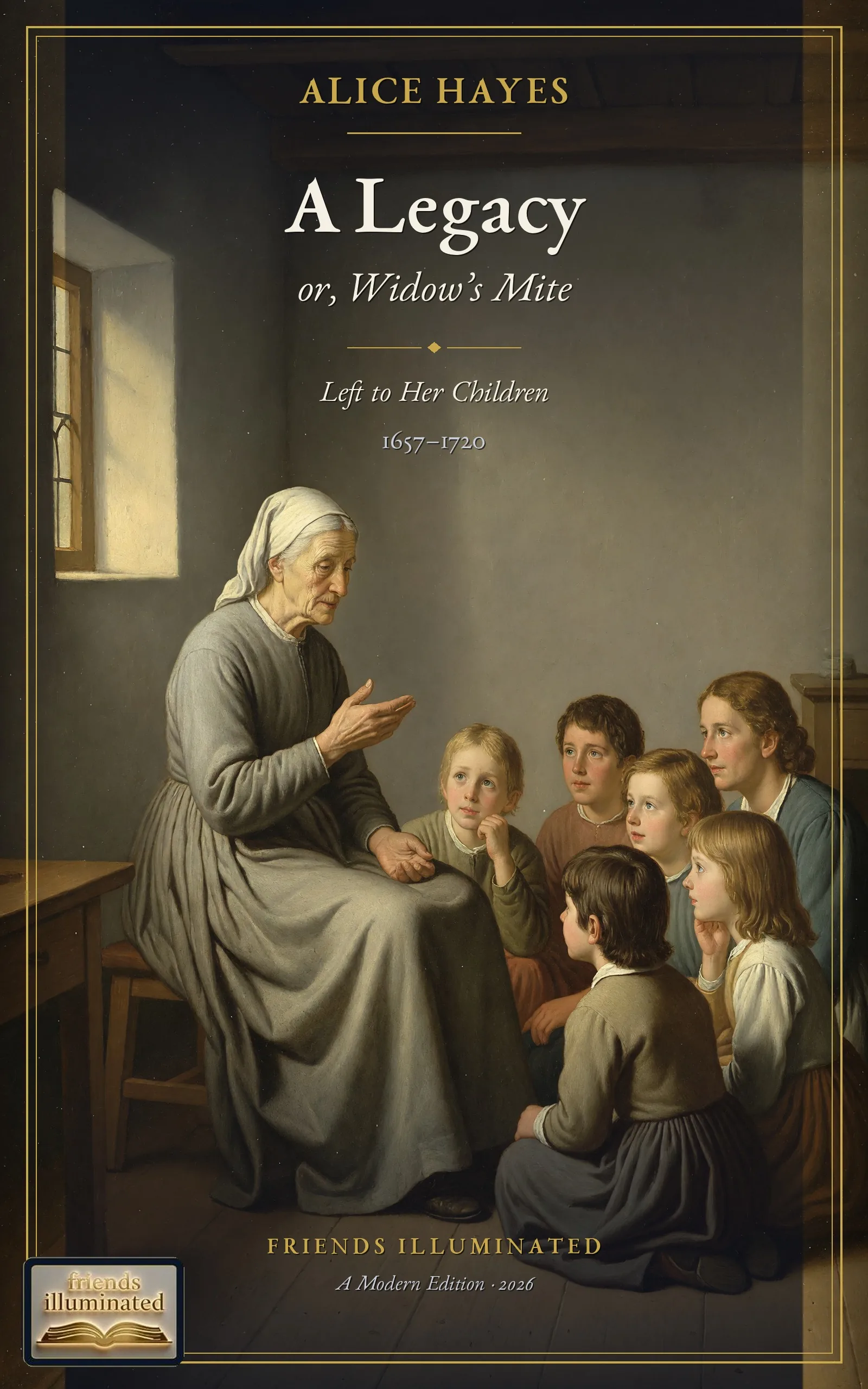
A Legacy, or Widow's Mite
The devotional autobiography of Alice Hayes (1657–1720) — born at Rickmansworth, raised in the Church of England, and brought through a long spiritual seeking to convincement among Friends about 1680. Written near the end of her life as a legacy for her children, it records an ordinary Quaker woman's inward journey: a husband's opposition, a call to the ministry, sufferings for tithes, and the settled peace of her last days. The closing testimony of Tottenham Meeting preserves her tender dying sayings. A modern English edition with linked scripture and historical references.
- A tender spiritual autobiography written as a legacy for her children
- Closes with the Tottenham Meeting testimony and her luminous dying sayings
- EPUB format
This edition
Read itE-book · EPUB
- Time to read1.3 hours
- Length19,072 words
- Files1 EPUB, DRM-free
How we get 1.3 hours
This figure is here so you can compare one book against another. Every title on the site is timed from its own word count at the same reading speed — nothing is adjusted book by book — so if this edition says 1.3 hours and another says half that, the second one really is about half the reading. It is a measure of size, in the way a page count is. Your own pace is your own: at the speeds typical adult readers actually manage, this edition runs anywhere from 1.1 hours to 1.8 hours.
What is in this edition
| Modernized text | 15,285 words |
|---|---|
| Introduction, chapter summaries and notes written for this edition | 3,787 words |
| Total | 19,072 words |
The introduction, the chapter summaries and the notes on people, places and unfamiliar terms were written for this edition. They are 3,787 of the 19,072 words above, and they are part of what you are buying.
Counted from the text of the EPUB you receive. Navigation, the title page, the table of contents and the licence page are excluded — they are packaging, not reading.
The reading rate
238 words per minute, for adult silent reading of non-fiction, applied unchanged to every title on the site. We did not pick the number; it is the pooled result of a published meta-analysis. Nothing is adjusted book by book — that consistency is what makes two of these figures worth comparing.
Brysbaert, M. (2019). How many words do we read per minute? A review and meta-analysis of reading rate. Journal of Memory and Language, 109, 104047. doi:10.1016/j.jml.2019.104047
190 studies, 18,573 participants.
The same paper puts most adult readers between 175 and
300 words per minute, and those two speeds give the
1.1 hours and 1.8 hours above.
Because time is words divided by speed, an even range of speeds produces an
uneven range of times, so 1.3 hours sits nearer the fast end of that
range than the middle of it.
If it were a paperback
Roughly 54–76 pages.
Words per printed page is a typesetting convention, not a measurement — it moves with trim size, type size and leading. The range above assumes 250–350 words a page. Friends Illuminated publishes no print edition of this book; the figure is here only because pages are a more familiar size than words.
- Secure checkout by Stripe
- Instant download
- 7-day money-back guarantee
About This Edition
Alice Hayes was born in 1657 at Rickmansworth in Hertfordshire and raised in the profession of the Church of England. Her autobiography — written near the end of her life and first published in 1723 — is one of the gentlest and most intimate of the early Quaker spiritual narratives, composed, as its old title says, as “a legacy, or widow’s mite, left to her children and others.”
The book follows the long arc of a seeking soul. From childhood awakening and a first Quaker meeting, through lameness and marriage and a second awakening, Hayes passes into what she calls the refiner’s fire — a season of seeking the living Christ among dead forms until, plainly directed, she goes to the Quakers and is convinced. Then come the costly years: a husband’s opposition and the great trial of love, the reproof of a priest, her own call into the ministry about 1680 under Elizabeth Stamper, and sufferings for tithes. She travelled in the ministry through Holland into Germany as far as Friedrichstadt, and settled at last at Tottenham.
The final chapter is not by Hayes but about her — the memorial testimony of Tottenham Monthly Meeting, gathering the facts her modesty left out and preserving the luminous sayings she spoke as she quietly died in 1720. “I am going home,” she said over and over. “All will be well.”
This edition gently modernizes Hayes’s prose for present-day readers: spelling and punctuation brought into present usage, the archaic verb forms lightened, and the longest run-on sentences divided for clarity — while the tenderness and devotional depth of her voice remain her own. Scripture references have been added and linked to the King James text, and the persons, places, and events behind the narrative linked to encyclopedic articles.