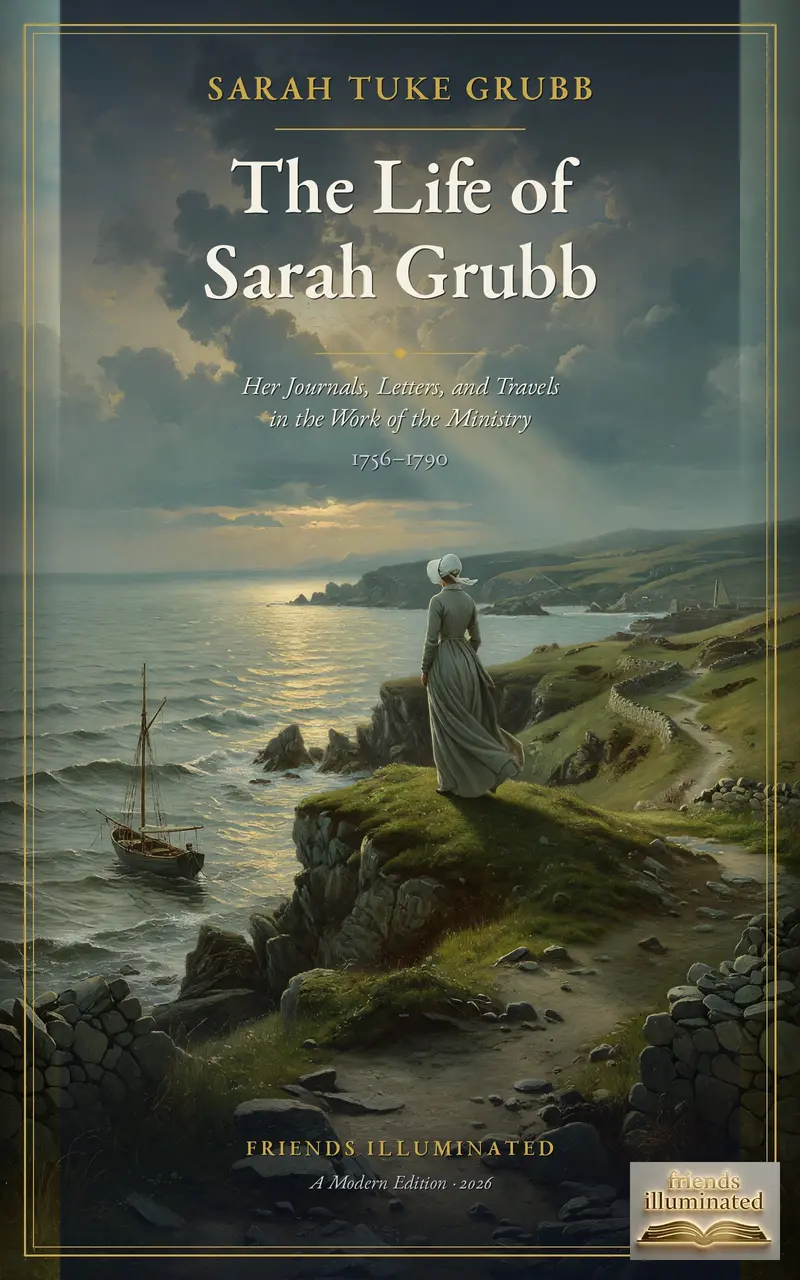
The Life of Sarah Grubb
Sarah Tuke Grubb was one of the most travelled Quaker ministers of the eighteenth century, and she was dead at thirty-four. Born at York in 1756 to William and Elizabeth Tuke, she first spoke in meeting in her twenty-third year, and from that point until her death she was rarely at rest. She crossed Scotland to Aberdeen, made two full circuits of Ireland, worked the western counties and Wales, and in 1788 sailed for the Continent — Amsterdam, the Rhine, Pyrmont, Westphalia, and a long journey south to the French dissenters of Congénies who had reached Quaker convictions on their own. She wrote to the Emperor Leopold the Second on his accession. She founded a boarding school at Clonmel. She died at Cork in the twelfth month of 1790, ten days after being taken ill at the close of a quarterly meeting. This edition presents her journals, her letters, and the testimonies concerning her in clear modern English, with nothing of her voice sanded away.
- Fully modernized English — every long sentence broken, every inversion untangled
- 1,500-word editorial introduction placing her life and travels in context
- 24 chapters with argument summaries, plus a full linked table of contents
- Journals, letters, and the testimonies of Friends who knew her
- EPUB format
This edition
Read itE-book · EPUB
- Time to read7.9 hours
- Length112,435 words
- Files1 EPUB, DRM-free
How we get 7.9 hours
This figure is here so you can compare one book against another. Every title on the site is timed from its own word count at the same reading speed — nothing is adjusted book by book — so if this edition says 7.9 hours and another says half that, the second one really is about half the reading. It is a measure of size, in the way a page count is. Your own pace is your own: at the speeds typical adult readers actually manage, this edition runs anywhere from 6.2 hours to 10.7 hours.
What is in this edition
| Modernized text | 110,881 words |
|---|---|
| Introduction, chapter summaries and notes written for this edition | 1,554 words |
| Total | 112,435 words |
The introduction, the chapter summaries and the notes on people, places and unfamiliar terms were written for this edition. They are 1,554 of the 112,435 words above, and they are part of what you are buying.
Counted from the text of the EPUB you receive. Navigation, the title page, the table of contents and the licence page are excluded — they are packaging, not reading.
The reading rate
238 words per minute, for adult silent reading of non-fiction, applied unchanged to every title on the site. We did not pick the number; it is the pooled result of a published meta-analysis. Nothing is adjusted book by book — that consistency is what makes two of these figures worth comparing.
Brysbaert, M. (2019). How many words do we read per minute? A review and meta-analysis of reading rate. Journal of Memory and Language, 109, 104047. doi:10.1016/j.jml.2019.104047
190 studies, 18,573 participants.
The same paper puts most adult readers between 175 and
300 words per minute, and those two speeds give the
6.2 hours and 10.7 hours above.
Because time is words divided by speed, an even range of speeds produces an
uneven range of times, so 7.9 hours sits nearer the fast end of that
range than the middle of it.
If it were a paperback
Roughly 321–450 pages.
Words per printed page is a typesetting convention, not a measurement — it moves with trim size, type size and leading. The range above assumes 250–350 words a page. Friends Illuminated publishes no print edition of this book; the figure is here only because pages are a more familiar size than words.
- Secure checkout by Stripe
- Instant download
- 7-day money-back guarantee
About This Edition
She was born Sarah Tuke at York on the twentieth of the sixth month, 1756, into a household that would go on to change the way England treated the insane. Her father was William Tuke; her brother’s family would found the York Retreat. But Sarah’s work went outward rather than inward. In her twenty-third year she stood up in a Friends’ meeting and spoke, and for the eleven years that remained to her she was almost never at home.
A life measured in roads
The arithmetic of her travel is difficult to take in. Scotland to Old Meldrum and Ury. Two complete circuits of Ireland. Norfolk, Cheshire, Westmoreland, Cumberland, the western counties, Wales. Then in 1788, with her husband Robert Grubb, the crossing to Amsterdam and up the Rhine — Krefeld, Düsseldorf, Mülheim, Pyrmont, Minden, Osnabrück, Bielefeld — and the long southern journey to Congénies in Languedoc, where a body of French dissenters had arrived at Quaker convictions with no Quaker to teach them.
She travelled by trekschuit and packet boat and open cart, through weather that would keep a modern traveller indoors, in a state of health that was never good and was frequently alarming. The illness at Sheffield in 1785 nearly ended her. She went back out.
The letter to a king
In 1790 she wrote to Leopold the Second on his accession to the imperial throne — a Quaker woman from York addressing the Holy Roman Emperor on the subject of religious liberty and the treatment of conscience. The letter is here in full. It is characteristic of her: direct, unhurried, entirely without deference to rank, and entirely without insolence either.
Clonmel
She married Robert Grubb of Clonmel in the fourth month of 1782 and settled in Tipperary. There she took up the work that outlasted her personally — a boarding school for Friends’ children, established and governed on principles she had thought hard about. Her letters on education are among the most practical writing in the book.
The end
She set off from Clonmel on the twenty-fourth of the eleventh month, 1790, for the quarterly meeting at Cork. She was taken ill at its close. Ten days later she was dead, in the thirty-fifth year of her age, and on the twelfth her remains were attended to the burying ground by a very large concourse of people. The testimony of the Monthly Meeting for the county of Tipperary, given three months afterward, closes this edition.
About this edition
Every sentence in this volume has been rebuilt for a modern reader. Eighteenth-century Quaker prose runs to sentences of sixty and eighty words, wound through with inversions and nested qualifications; those are gone. What is not gone is her vocabulary of conviction — Truth, the Seed, convincement, First-day, the numbered months — which is bracketed on first use and then left alone, because translating it would translate her out of the book. The result reads at roughly nineteen words to the sentence, with none of the original’s meaning traded away for the clarity.