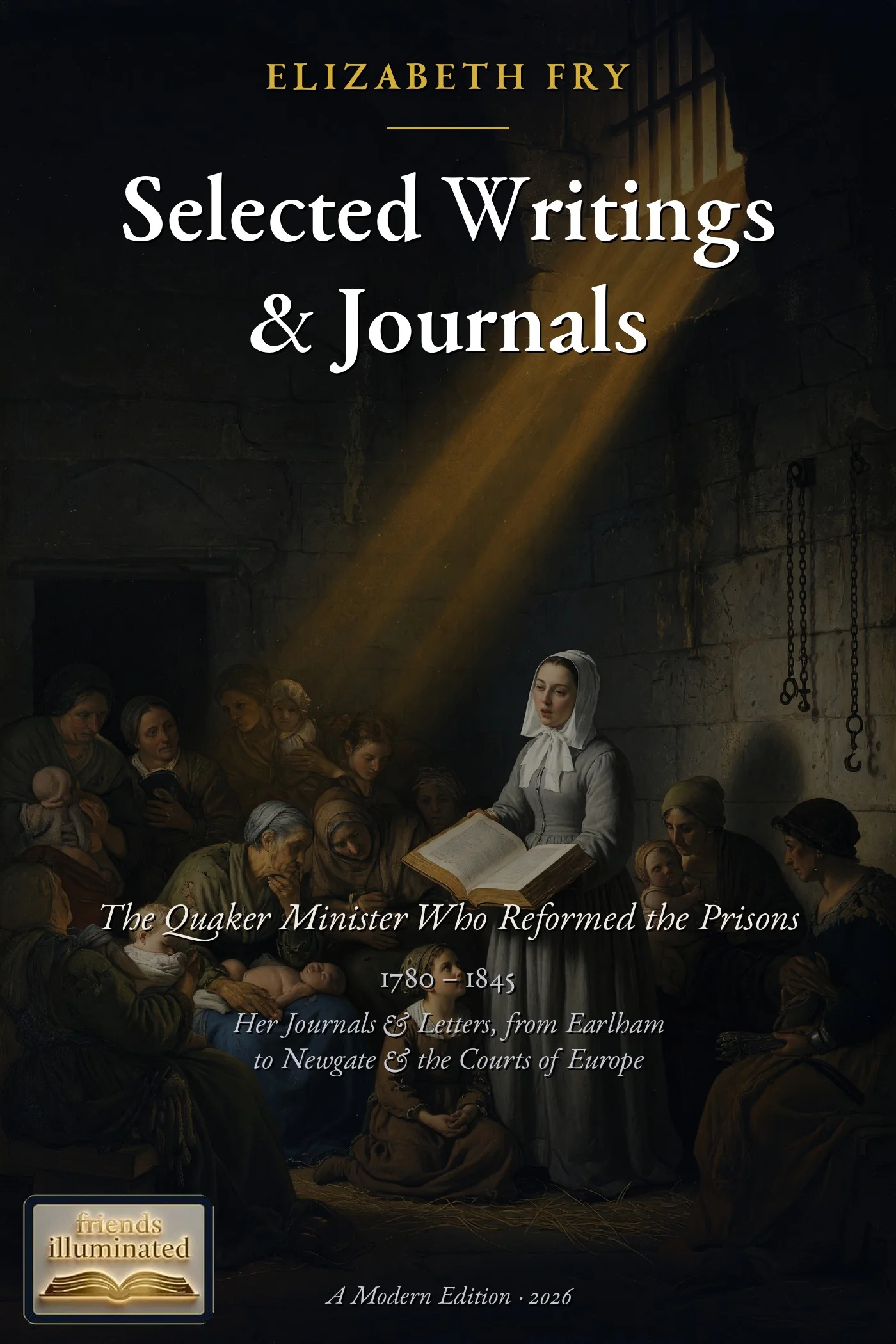
Selected Writings & Journals
Elizabeth Fry (1780–1845), the Quaker minister who walked into Newgate in 1813 and came out the mother of modern prison reform, in her own journals and letters — from the awakening under William Savery at Norwich to the last mission to the courts of Europe. A modern English edition with linked scripture and historical references.
- The Quaker minister who reformed the prisons of Europe, in her own words
- Ten chronological chapters drawn from her journals and letters (1798–1845)
- EPUB format
This edition
Read itE-book · EPUB
- Time to read1.8 hours
- Length25,836 words
- Files1 EPUB, DRM-free
How we get 1.8 hours
This figure is here so you can compare one book against another. Every title on the site is timed from its own word count at the same reading speed — nothing is adjusted book by book — so if this edition says 1.8 hours and another says half that, the second one really is about half the reading. It is a measure of size, in the way a page count is. Your own pace is your own: at the speeds typical adult readers actually manage, this edition runs anywhere from 1.4 hours to 2.5 hours.
What is in this edition
| Modernized text | 24,792 words |
|---|---|
| Introduction, chapter summaries and notes written for this edition | 1,044 words |
| Total | 25,836 words |
The introduction, the chapter summaries and the notes on people, places and unfamiliar terms were written for this edition. They are 1,044 of the 25,836 words above, and they are part of what you are buying.
Counted from the text of the EPUB you receive. Navigation, the title page, the table of contents and the licence page are excluded — they are packaging, not reading.
The reading rate
238 words per minute, for adult silent reading of non-fiction, applied unchanged to every title on the site. We did not pick the number; it is the pooled result of a published meta-analysis. Nothing is adjusted book by book — that consistency is what makes two of these figures worth comparing.
Brysbaert, M. (2019). How many words do we read per minute? A review and meta-analysis of reading rate. Journal of Memory and Language, 109, 104047. doi:10.1016/j.jml.2019.104047
190 studies, 18,573 participants.
The same paper puts most adult readers between 175 and
300 words per minute, and those two speeds give the
1.4 hours and 2.5 hours above.
Because time is words divided by speed, an even range of speeds produces an
uneven range of times, so 1.8 hours sits nearer the fast end of that
range than the middle of it.
If it were a paperback
Roughly 74–103 pages.
Words per printed page is a typesetting convention, not a measurement — it moves with trim size, type size and leading. The range above assumes 250–350 words a page. Friends Illuminated publishes no print edition of this book; the figure is here only because pages are a more familiar size than words.
- Secure checkout by Stripe
- Instant download
- 7-day money-back guarantee
About This Edition
Elizabeth Fry (1780–1845) is remembered as the Angel of the Prisons — the Norwich banker’s daughter who, in 1813, walked into the women’s side of Newgate and would not turn back. What she found there — hundreds of women and their children packed together in filth, drinking, fighting, and waiting to be hanged or shipped to the far side of the world — shaped the rest of her life. What she did there — asking the prisoners themselves what they wanted, opening a school for their children, giving them work and order and a measure of dignity — began the long labor of prison reform that carried her before committees of the House of Commons, aboard the female convict ships that sailed for Australia, and at last into the courts of France, Prussia, and Denmark, where kings and queens sent for her to plead the cause of the people they had locked away.
Fry was, first and last, a Quaker minister. Her authority in the world grew out of her authority in the meeting — a gift the Society of Friends acknowledged in 1811 and that only deepened through the crowded years of her marriage to the London merchant Joseph Fry, the raising of eleven children, and the failure of the family bank in 1828 that stripped the Frys of fortune and reputation but not of faith. This Friends Illuminated edition gathers her own account of that life, drawn from the journals she kept for nearly fifty years and from the letters she wrote to her family, her fellow workers, and the great figures of her age. It is not a biography written about her. It is, as far as possible, her own record — the awakening at Norwich under William Savery, the marriage and the crowded years of motherhood, the descent into the horror of Newgate, the founding of the Ladies’ Association and the Newgate school, the missions to the convict ships and to the Continent, the bereavements and the final illness — arranged into ten chronological chapters that follow the shape of her days from Earlham to Ramsgate.
The heart of the book is Newgate; around it run the private threads of her journal — her prayers, her doubts, her grief at the graves of her children, her constant fear that she was not doing enough. This inward record is what makes her more than a reformer. She measured every day against a standard she could never quite reach, and she wrote it all down. Her plain speech is preserved where she used it, her dates given by “First Month” and “First-day” as she wrote them, and her constant reaching for the language of Scripture linked throughout to the passages she loved. The aim has been to clear the glass without repainting the picture.