Memoir of George Fox
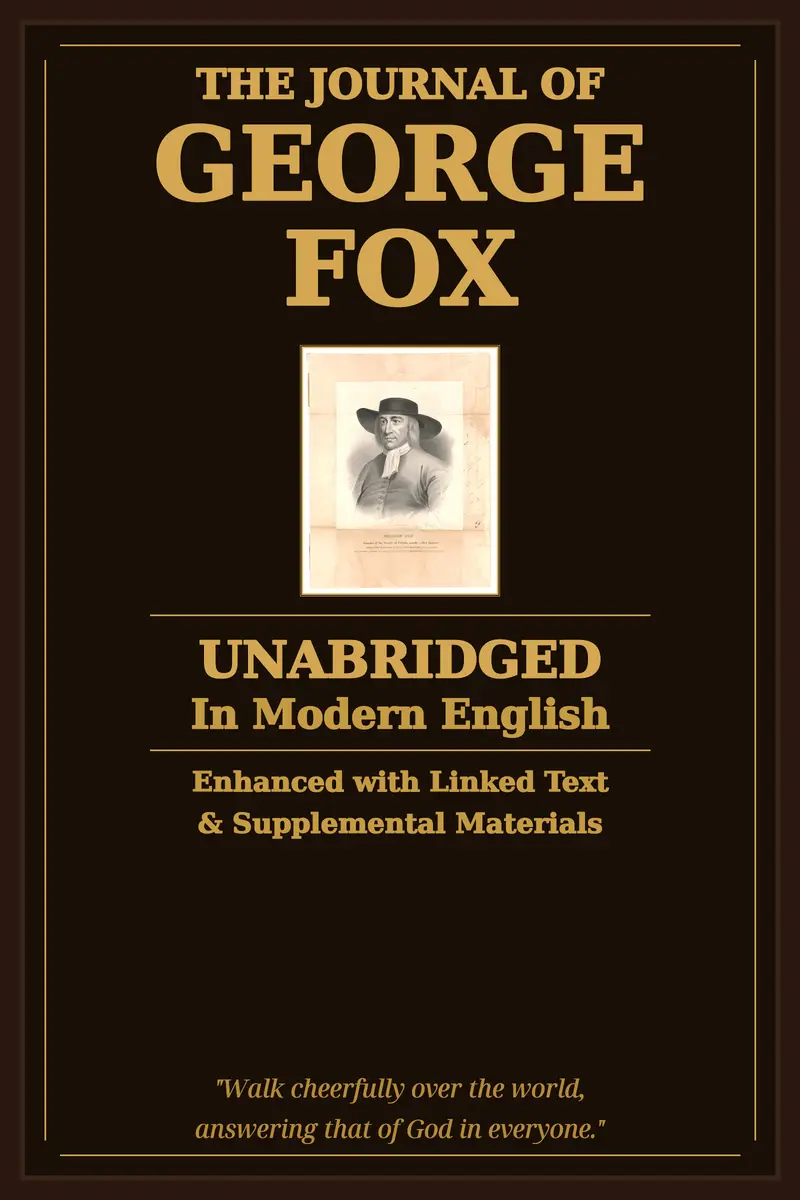
George Fox was a weaver's apprentice from Drayton-in-the-Clay who walked out of his trade at nineteen because no priest and no professor could speak to his condition. What he found instead — that there is one, even Christ Jesus, that can speak to thy condition — became the seed of the Religious Society of Friends. This memoir follows him from that first opening to the end: the vision on Pendle Hill of a great people to be gathered, the convincement of Swarthmoor and the whole north country, and then the price. Eight imprisonments. Derby, where the justice called him a Quaker and the name stuck. Launceston, and the pit at Doomsdale that no man would clean. Lancaster and Scarborough Castle. Worcester, and the long fight over the oath he would not swear. He carried the peace testimony to Charles the Second's officers in 1660 and never moved from it. He crossed to Barbadoes, Jamaica, Maryland, New England and the Carolinas, travelling by open boat and Indian guide. He went into Holland and Germany. He built the meeting structure that outlived him — monthly, quarterly and yearly meetings, records, marriages, poor relief — and he held it together through the separations that tried to pull it apart. He died at Gracechurch Street in London on the thirteenth of the eleventh month, 1690, two days after preaching. This edition presents the memoir in clear modern English, with the testimonies of William Penn and Thomas Ellwood concerning him.
- Fully modernized English — every long sentence broken, every inversion untangled
- 1,670-word editorial introduction placing his life against the English Civil War and the Restoration
- 30 chapters with argument summaries, plus a full linked table of contents
- Pendle Hill, Swarthmoor, Derby, Launceston, Lancaster, Worcester — the whole arc of convincement and suffering
- The 1660 peace testimony, the American voyage, and the building of the meeting structure
- 401 linked Scripture and reference notes throughout
- EPUB format
This edition
Read itE-book · EPUB
- Time to read5.5 hours
- Length78,681 words
- Files1 EPUB, DRM-free
How we get 5.5 hours
This figure is here so you can compare one book against another. Every title on the site is timed from its own word count at the same reading speed — nothing is adjusted book by book — so if this edition says 5.5 hours and another says half that, the second one really is about half the reading. It is a measure of size, in the way a page count is. Your own pace is your own: at the speeds typical adult readers actually manage, this edition runs anywhere from 4.4 hours to 7.5 hours.
What is in this edition
| Modernized text | 77,044 words |
|---|---|
| Introduction, chapter summaries and notes written for this edition | 1,637 words |
| Total | 78,681 words |
The introduction, the chapter summaries and the notes on people, places and unfamiliar terms were written for this edition. They are 1,637 of the 78,681 words above, and they are part of what you are buying.
Counted from the text of the EPUB you receive. Navigation, the title page, the table of contents and the licence page are excluded — they are packaging, not reading.
The reading rate
238 words per minute, for adult silent reading of non-fiction, applied unchanged to every title on the site. We did not pick the number; it is the pooled result of a published meta-analysis. Nothing is adjusted book by book — that consistency is what makes two of these figures worth comparing.
Brysbaert, M. (2019). How many words do we read per minute? A review and meta-analysis of reading rate. Journal of Memory and Language, 109, 104047. doi:10.1016/j.jml.2019.104047
190 studies, 18,573 participants.
The same paper puts most adult readers between 175 and
300 words per minute, and those two speeds give the
4.4 hours and 7.5 hours above.
Because time is words divided by speed, an even range of speeds produces an
uneven range of times, so 5.5 hours sits nearer the fast end of that
range than the middle of it.
If it were a paperback
Roughly 225–315 pages.
Words per printed page is a typesetting convention, not a measurement — it moves with trim size, type size and leading. The range above assumes 250–350 words a page. Friends Illuminated publishes no print edition of this book; the figure is here only because pages are a more familiar size than words.
- Secure checkout by Stripe
- Instant download
- 7-day money-back guarantee
About This Edition
George Fox was born at Drayton-in-the-Clay in Leicestershire in July 1624, the son of a weaver the neighbours called Righteous Christer. He was apprenticed to a shoemaker who also kept sheep, and he was good at it. At nineteen he walked away.
The seeking years
What drove him out was not doubt but disgust — two professing men at a fair pressing him to drink healths with them, and the ordinary distance between what people said they believed and how they lived. He went to the priests. He went to the separate preachers. One told him to take tobacco and sing psalms; another set him to bleed. None of them could speak to his condition. Then, when all his hopes in men were gone, he heard a voice which said, There is one, even Christ Jesus, that can speak to thy condition — and his heart leapt for joy.
Pendle Hill and the gathering
In 1652 he was moved to go up Pendle Hill, and from the top he saw in vision a great people to be gathered. Within weeks he was at Firbank Chapel preaching to a thousand Seekers, and then at Swarthmoor, where Margaret Fell was convinced and Judge Fell let the meeting be held in his house. The north country came in by whole meetings.
Eight imprisonments
The price is set out plainly here. Derby, 1650, where Justice Bennet called him a Quaker because he bade the bench tremble at the word of the Lord, and the name stuck. Carlisle, in a filthy dungeon among the moss-troopers. Launceston, and the pit called Doomsdale that had not been cleaned in years. Lancaster and Scarborough Castle, held on the oath of allegiance he would not swear — not from disloyalty, but because Christ had said swear not at all. Worcester, and the years of legal fight that followed.
The peace testimony, and the wider world
In 1660 he and eleven other Friends gave the declaration to Charles the Second that Friends would not take up carnal weapons for any end whatever, and he never moved from it. He crossed the Atlantic and travelled Barbadoes, Jamaica, Maryland, New England and the Carolinas, much of it by open boat and Indian guide through country with no roads. He went into Holland and Germany. He wrote and he kept writing.
What he built
The lasting work was structural and unglamorous: monthly, quarterly and yearly meetings; records of births, marriages and burials; oversight, poor relief, and care for the families of prisoners. He held that structure together through the separations that John Perrot and later John Wilkinson and John Story raised against it. He died at Gracechurch Street in London on the thirteenth of the eleventh month, 1690, two days after preaching, and was buried at Bunhill Fields.
About this edition
Every sentence has been rebuilt for a modern reader. His vocabulary of conviction — Truth, the Seed, Convincement, First-day, the numbered months — is bracketed on first use and then left alone, because translating it would translate him out of the book. Four hundred and one Scripture and reference links are set into the text; every Scripture reference was checked against the King James text rather than recalled, and every person and place link was checked by hand, with doubtful ones dropped rather than guessed. The testimonies of William Penn and Thomas Ellwood close the volume.