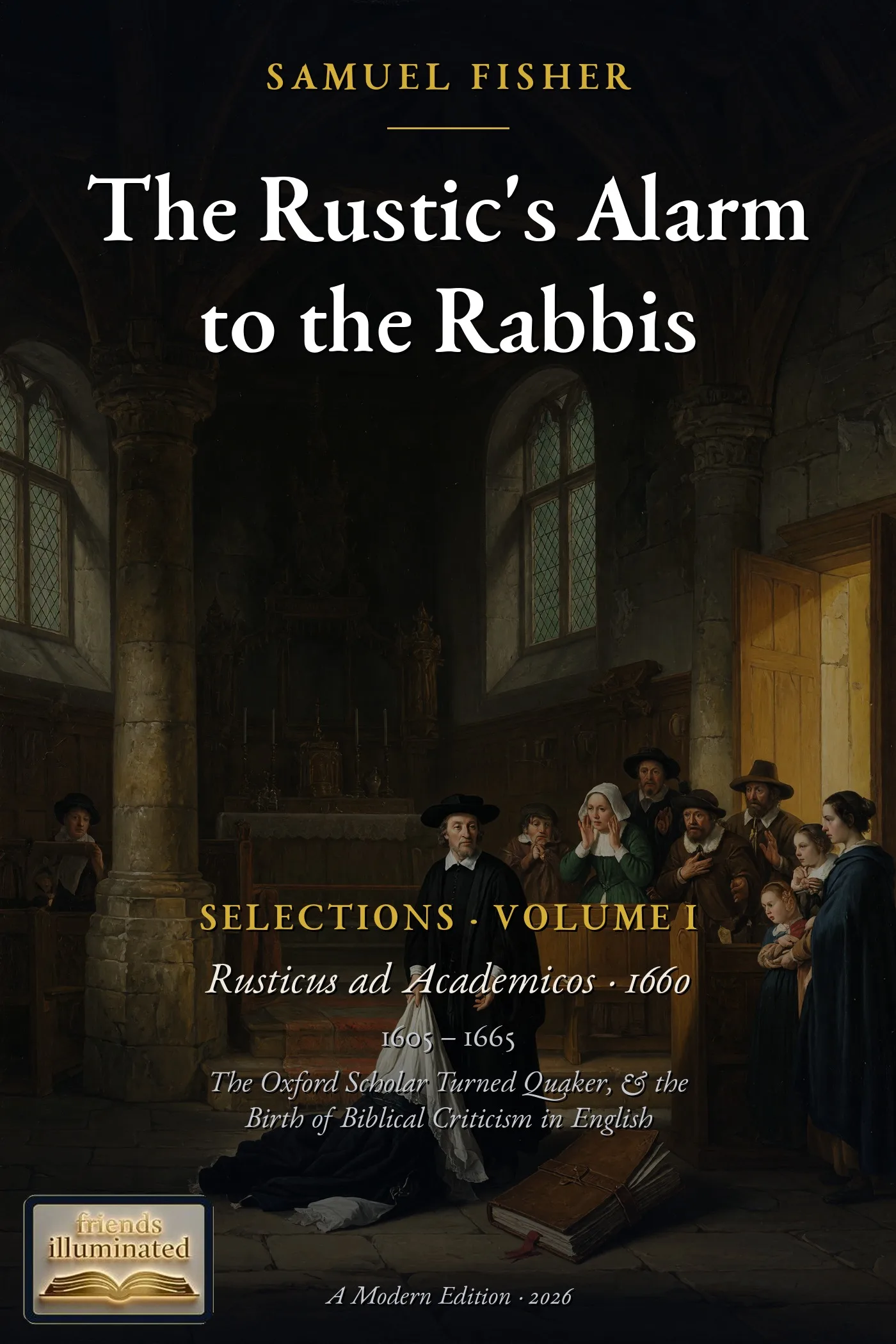
Rusticus ad Academicos: The Rustic's Alarm to the Rabbis (Selections)
Samuel Fisher (1605–1665) — the Oxford-educated vicar who laid down one of the richest livings in Kent for conscience's sake and became the scholar of the first Quaker generation — answers the academic divines in the wittiest, most learned polemic of the age. Selections from Rusticus ad Academicos in modern English, with linked scripture and historical references.
- Selections from the massive 1660 folio — the movement's one Oxford-trained scholar answers John Owen, Danson, Tombes & Baxter
- The celebrated pioneering biblical criticism: the canon, the vowel points, the various readings — a decade before Spinoza
- EPUB format
This edition
Read itE-book · EPUB
- Time to read5.8 hours
- Length82,983 words
- Files1 EPUB, DRM-free
How we get 5.8 hours
This figure is here so you can compare one book against another. Every title on the site is timed from its own word count at the same reading speed — nothing is adjusted book by book — so if this edition says 5.8 hours and another says half that, the second one really is about half the reading. It is a measure of size, in the way a page count is. Your own pace is your own: at the speeds typical adult readers actually manage, this edition runs anywhere from 4.6 hours to 7.9 hours.
What is in this edition
| Modernized text | 75,300 words |
|---|---|
| Introduction, chapter summaries and notes written for this edition | 7,683 words |
| Total | 82,983 words |
The introduction, the chapter summaries and the notes on people, places and unfamiliar terms were written for this edition. They are 7,683 of the 82,983 words above, and they are part of what you are buying.
Counted from the text of the EPUB you receive. Navigation, the title page, the table of contents and the licence page are excluded — they are packaging, not reading.
The reading rate
238 words per minute, for adult silent reading of non-fiction, applied unchanged to every title on the site. We did not pick the number; it is the pooled result of a published meta-analysis. Nothing is adjusted book by book — that consistency is what makes two of these figures worth comparing.
Brysbaert, M. (2019). How many words do we read per minute? A review and meta-analysis of reading rate. Journal of Memory and Language, 109, 104047. doi:10.1016/j.jml.2019.104047
190 studies, 18,573 participants.
The same paper puts most adult readers between 175 and
300 words per minute, and those two speeds give the
4.6 hours and 7.9 hours above.
Because time is words divided by speed, an even range of speeds produces an
uneven range of times, so 5.8 hours sits nearer the fast end of that
range than the middle of it.
If it were a paperback
Roughly 237–332 pages.
Words per printed page is a typesetting convention, not a measurement — it moves with trim size, type size and leading. The range above assumes 250–350 words a page. Friends Illuminated publishes no print edition of this book; the figure is here only because pages are a more familiar size than words.
- Secure checkout by Stripe
- Instant download
- 7-day money-back guarantee
About This Edition
Samuel Fisher was the anomaly of early Quakerism: an Oxford Master of Arts in a movement of shepherds and shoemakers. Vicar of Lydd in Kent, holder of a benefice worth some two hundred pounds a year, he stunned his parishioners by resigning it all — convinced that a ministry maintained by compulsory tithes could not be the ministry of Christ. He grazed sheep for his bread, preached among the Baptists, and in 1655 was convinced by the Quaker message that the light of Christ is given to every man. When the ablest divines in England — John Owen, late Dean of Christ Church, Thomas Danson, John Tombes, and Richard Baxter — published against the Friends, Fisher answered them all at once, in the enormous, riotous folio of 1660: Rusticus ad Academicos, “The Rustic’s Alarm to the Rabbis; or, The Country Correcting the University and Clergy.”
At the heart of the book stands the argument that made it famous, and that has led modern scholars to call Fisher a pioneer of biblical criticism a full decade before Spinoza. Against Owen’s claim that the Scripture text had been preserved “entire to a tittle,” Fisher — who knew the manuscripts and the scholarship — showed that the Hebrew vowel points were a late invention of the Masoretes; that the copies vary in thousands of readings; that the originals are lost; that the canon was bounded by fallible human councils; and that no translation the common reader touches can rise above the texts beneath it. His conclusion was not to cast Scripture away, but to ground faith where the Scriptures themselves ground it: in the Spirit that gave them forth, the light of Christ within.
This Friends Illuminated edition presents curated selections — about one-seventh of the 554,000-word folio — carrying the complete arc of the work: the great opening address to the reader, the confrontation with Owen and Danson, the celebrated text-critical chapters, the defense of the universal light, the catalogue of his opponents’ self-contradictions, and the radiant closing manifesto, Christ’s Light Springing. Fisher’s deliriously punning prose — no one else in the seventeenth century sounds like him — is preserved in lightly modernized English, with scripture and historical references linked throughout.