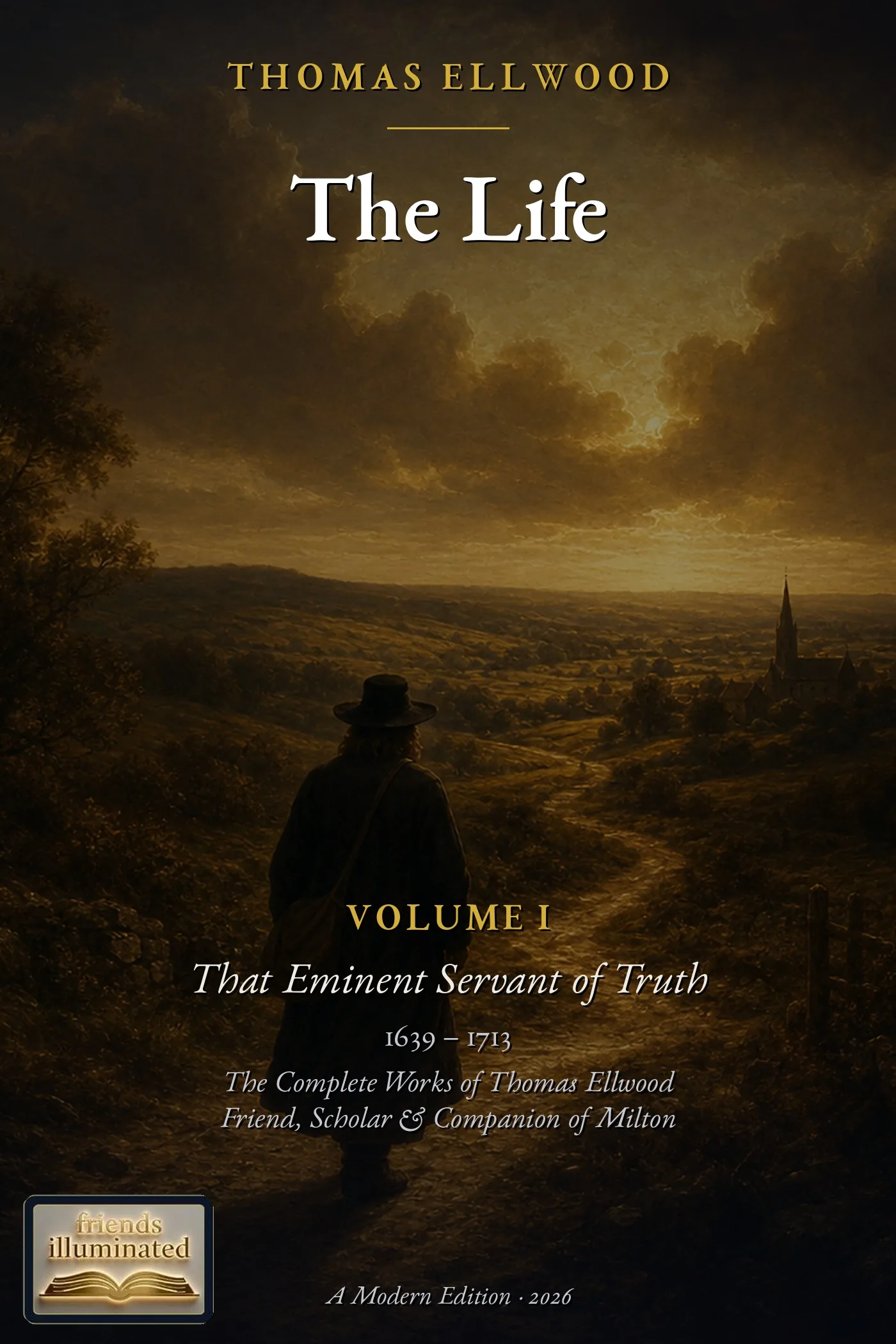
The Life of Thomas Ellwood, Volume 1
The autobiography of Milton's Quaker friend — one of the most charming personal narratives in English Quaker literature, following Ellwood's turbulent conversion, his imprisonment, his years as secretary to the blind John Milton, and the story of how he inspired Paradise Regained.
- Complete autobiography
- Volume 1
- EPUB format
This edition
Read itE-book · EPUB
- Time to read5.4 hours
- Length76,453 words
- Files1 EPUB, DRM-free
How we get 5.4 hours
This figure is here so you can compare one book against another. Every title on the site is timed from its own word count at the same reading speed — nothing is adjusted book by book — so if this edition says 5.4 hours and another says half that, the second one really is about half the reading. It is a measure of size, in the way a page count is. Your own pace is your own: at the speeds typical adult readers actually manage, this edition runs anywhere from 4.2 hours to 7.3 hours.
What is in this edition
| Modernized text | 69,475 words |
|---|---|
| Introduction, chapter summaries and notes written for this edition | 6,978 words |
| Total | 76,453 words |
The introduction, the chapter summaries and the notes on people, places and unfamiliar terms were written for this edition. They are 6,978 of the 76,453 words above, and they are part of what you are buying.
Counted from the text of the EPUB you receive. Navigation, the title page, the table of contents and the licence page are excluded — they are packaging, not reading.
The reading rate
238 words per minute, for adult silent reading of non-fiction, applied unchanged to every title on the site. We did not pick the number; it is the pooled result of a published meta-analysis. Nothing is adjusted book by book — that consistency is what makes two of these figures worth comparing.
Brysbaert, M. (2019). How many words do we read per minute? A review and meta-analysis of reading rate. Journal of Memory and Language, 109, 104047. doi:10.1016/j.jml.2019.104047
190 studies, 18,573 participants.
The same paper puts most adult readers between 175 and
300 words per minute, and those two speeds give the
4.2 hours and 7.3 hours above.
Because time is words divided by speed, an even range of speeds produces an
uneven range of times, so 5.4 hours sits nearer the fast end of that
range than the middle of it.
If it were a paperback
Roughly 218–306 pages.
Words per printed page is a typesetting convention, not a measurement — it moves with trim size, type size and leading. The range above assumes 250–350 words a page. Friends Illuminated publishes no print edition of this book; the figure is here only because pages are a more familiar size than words.
- Secure checkout by Stripe
- Instant download
- 7-day money-back guarantee
About This Edition
Thomas Ellwood’s autobiography is one of the great personal narratives of the seventeenth century — disarmingly honest, often funny, and quietly profound. Ellwood was the son of a country gentleman, educated for a respectable life, who encountered the Quaker movement in his early twenties and found his world turned upside down. His father, appalled, threw him out of the house. His social circle abandoned him. His own inner life was convulsed. What followed was a series of imprisonments, conflicts, and eventually a settled life of Quaker service that brought him into contact with some of the most remarkable figures of his age.
The most famous episode in Ellwood’s life is his service as reader and amanuensis to John Milton after the great poet lost his sight. It was Ellwood who, having read the manuscript of Paradise Lost, asked Milton: “Thou hast said much of Paradise Lost, but what hast thou to say of Paradise Found?” Milton’s answer was Paradise Regained. But Ellwood’s relationship with Milton is only one strand of an autobiography that ranges widely across Quaker history: his close friendship with Isaac Penington and his wife Mary, his role in editing George Fox’s Journal after Fox’s death, and his own sustained writing career. This edition of the autobiography presents Ellwood’s complete text in clear modern English, with notes to help readers follow the dense web of historical reference.