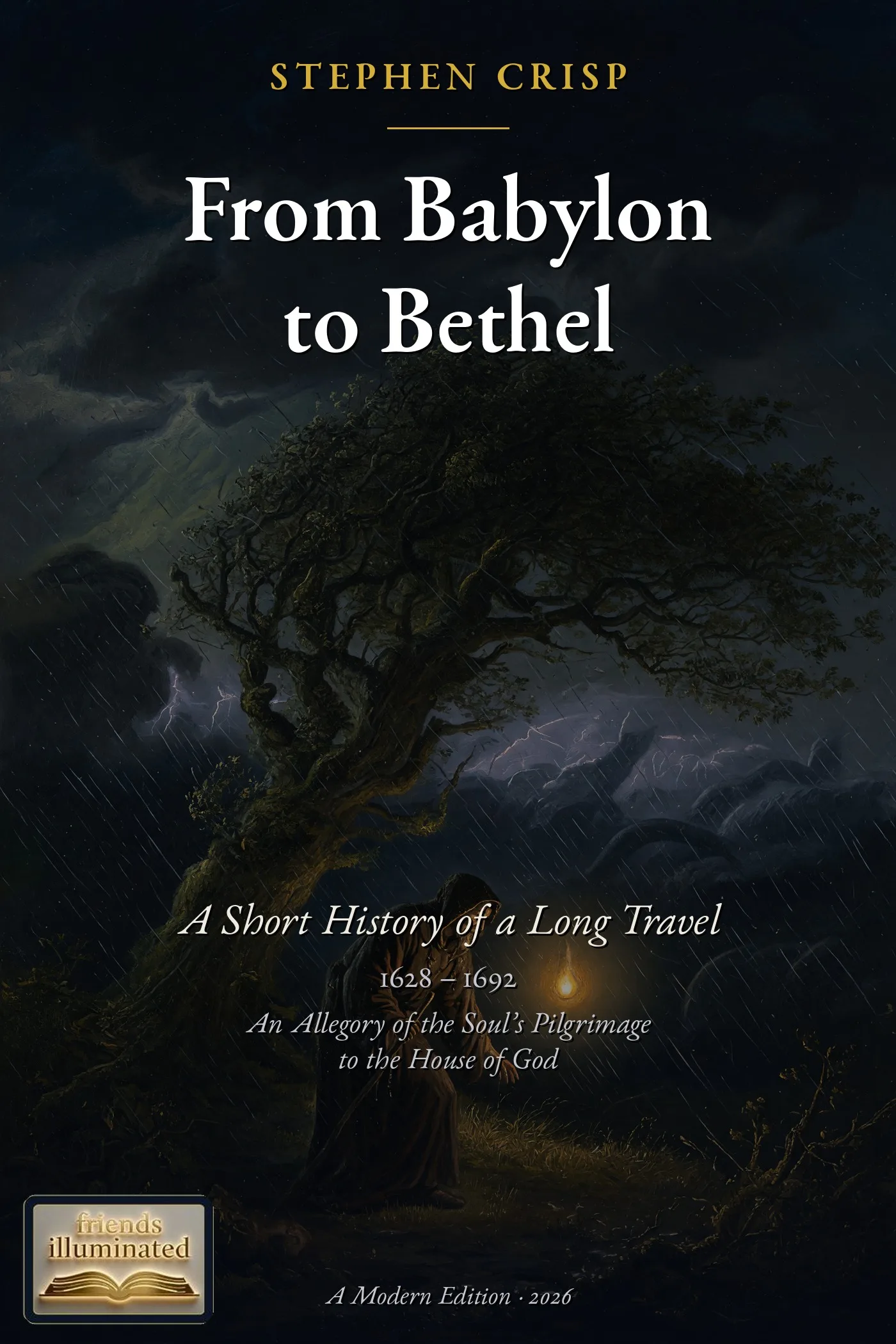
A Short History of a Long Travel from Babylon to Bethel
Stephen Crisp's beloved allegory of the soul's pilgrimage — a seeker leaves his father's house in search of the house of God, is misled by a hired guide into a painted house full of contention, wanders lost in a howling wilderness, and is led home at last by a small inward Light. First printed in 1691 and treasured by Friends for two centuries, here in a modern English edition with linked scripture references.
- A complete spiritual allegory in seven chapters
- The soul's pilgrimage from the world to the house of God
- EPUB format
This edition
Read itE-book · EPUB
- Time to read36 minutes
- Length8,522 words
- Files1 EPUB, DRM-free
How we get 36 minutes
This figure is here so you can compare one book against another. Every title on the site is timed from its own word count at the same reading speed — nothing is adjusted book by book — so if this edition says 36 minutes and another says half that, the second one really is about half the reading. It is a measure of size, in the way a page count is. Your own pace is your own: at the speeds typical adult readers actually manage, this edition runs anywhere from 28 minutes to 49 minutes.
What is in this edition
| Modernized text | 6,384 words |
|---|---|
| Introduction, chapter summaries and notes written for this edition | 2,138 words |
| Total | 8,522 words |
The introduction, the chapter summaries and the notes on people, places and unfamiliar terms were written for this edition. They are 2,138 of the 8,522 words above, and they are part of what you are buying.
Counted from the text of the EPUB you receive. Navigation, the title page, the table of contents and the licence page are excluded — they are packaging, not reading.
The reading rate
238 words per minute, for adult silent reading of non-fiction, applied unchanged to every title on the site. We did not pick the number; it is the pooled result of a published meta-analysis. Nothing is adjusted book by book — that consistency is what makes two of these figures worth comparing.
Brysbaert, M. (2019). How many words do we read per minute? A review and meta-analysis of reading rate. Journal of Memory and Language, 109, 104047. doi:10.1016/j.jml.2019.104047
190 studies, 18,573 participants.
The same paper puts most adult readers between 175 and
300 words per minute, and those two speeds give the
28 minutes and 49 minutes above.
Because time is words divided by speed, an even range of speeds produces an
uneven range of times, so 36 minutes sits nearer the fast end of that
range than the middle of it.
If it were a paperback
Roughly 24–34 pages.
Words per printed page is a typesetting convention, not a measurement — it moves with trim size, type size and leading. The range above assumes 250–350 words a page. Friends Illuminated publishes no print edition of this book; the figure is here only because pages are a more familiar size than words.
- Secure checkout by Stripe
- Instant download
- 7-day money-back guarantee
About This Edition
Among the small classics of early Quaker devotion, few have been loved so long or so widely as Stephen Crisp’s A Short History of a Long Travel from Babylon to Bethel. Crisp (1628–1692), a Colchester man who became one of the most weighty and well-traveled ministers of the first generation of Friends, wrote it near the end of his life, and it was first printed in 1691, the year before he died. It is a brief thing — a single sitting will see it through — yet generations of readers returned to it again and again, because under its plain story it carries the whole inward journey of the soul.
The allegory tells of a young man who, in his father’s house, hears others speak of a great happiness called the house of God, and is seized with a longing to find it. He hires a guide who is paid to lead seekers there, only to discover that the man knows the road no better than he does, and reads it out of a little book. Abandoning that guide, he is taken up by another who leads him cheerfully to a splendid painted house across a bridgeless river — but within, the house is foul, dirty, and full of cobwebs, and its people wrangle over money and office like a fish market. He leaves it too, and wanders into a howling wilderness, where at last, beneath a storm-bent tree in the dark, a small light appears beside him and waits. This Light becomes his only true guide, leading him through serpents and mire to the house of God at last — a house transparent and clean, where the washed and the willing are clothed in white and given a new name.
The meaning would have been plain to Crisp’s first readers, and remains so now. The hired guides are the paid ministers of the day; the painted house is the outward, contentious church that promises glory and gives only frailty; the wilderness is the seeking soul stripped of every borrowed comfort; and the small, patient Light is the inward light of Christ, which the early Friends held to be God’s own teacher in every heart. Babylon is the confusion of the world’s religion, and Bethel — “the house of God” — is the soul brought home to dwell with him.
This edition gently modernizes Crisp’s seventeenth-century prose for present-day readers: archaic spellings and the longest run-on sentences eased for clarity, while his voice and imagery are kept intact. The plain speech of thee and thou has been preserved in the dialogue, where it belongs, for it was a testimony the first Friends suffered for. Scripture references have been added and linked to the King James text, and the places and ideas behind the allegory linked to encyclopedic articles, so that any reader may turn at once from Crisp’s story to the Scripture and history beneath it.