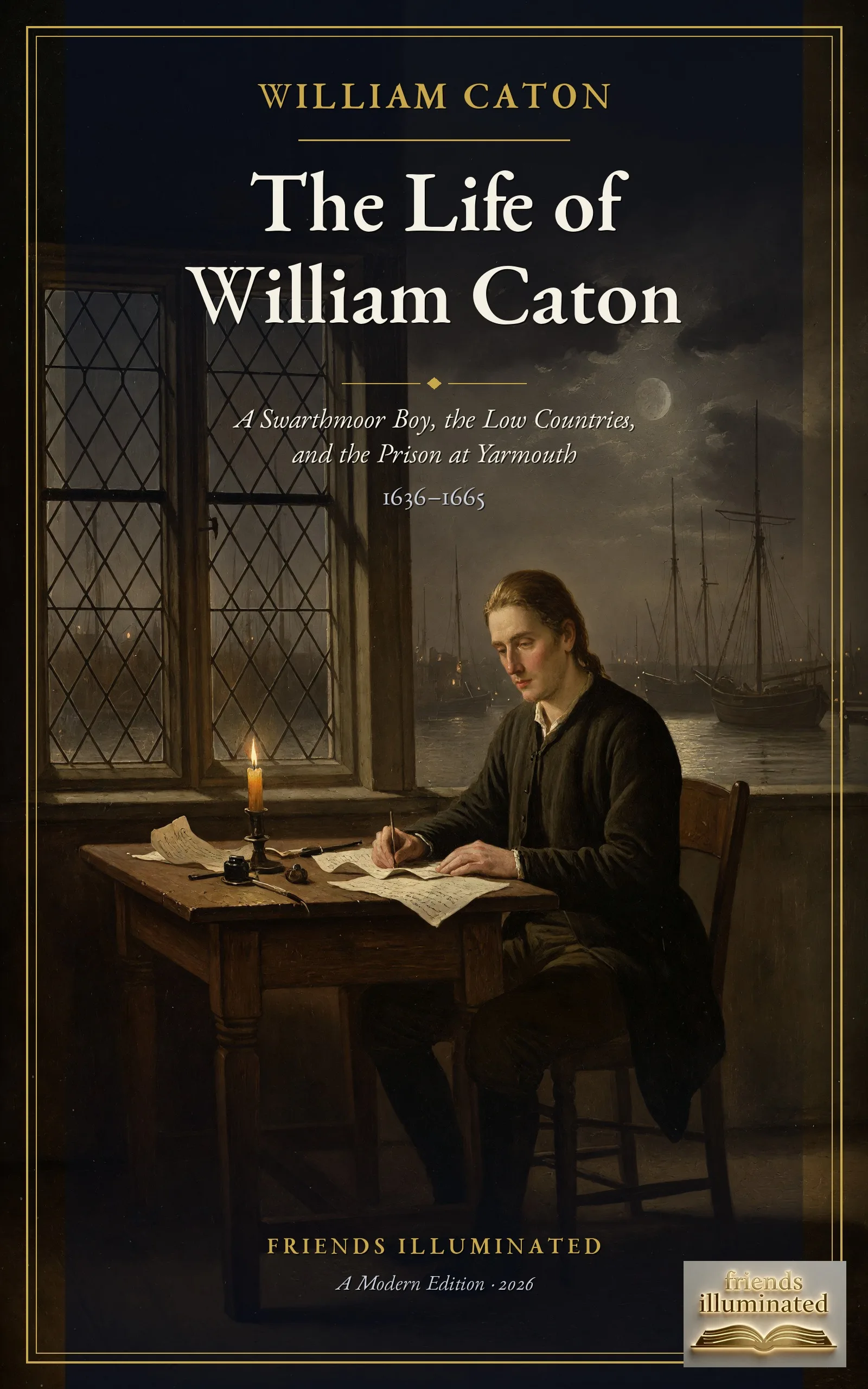
The Life of William Caton
William Caton came to Swarthmoor Hall as a boy, to be schooled alongside Judge Fell's son, and was there in 1652 when George Fox walked in. He was sixteen. What follows is the record of the thirteen years that were left to him. He went out into Kent and was mobbed at Maidstone; into Scotland twice, the second time to Aberdeen and the tolbooth; into Sussex, where he was taken up and sent home under guard. Then Holland, which became his real work — Amsterdam, Rotterdam, Middelburg, the Palatinate and the Rhine, years of translating and printing and arguing with Dutch ministers in Latin because he had no Dutch. He was imprisoned at Great Yarmouth on the way back. He married Annekin Dirricks at Amsterdam and died there in 1665, not yet thirty. Margaret Fell kept his letters; George Fox wrote the testimony that opens this book. This is his own account, in clear modern English, with his last letters appended.
- The boyhood at Swarthmoor Hall, and George Fox's arrival there in 1652
- Kent, Scotland and Sussex — mobbed at Maidstone, gaoled at Aberdeen
- Nine years in the Low Countries: Amsterdam, Rotterdam, the Palatinate, the Rhine
- With George Fox's testimony concerning him, and Caton's last letters
- Fully modernized English — long sentences broken, inversions untangled
- 175 linked Scripture and reference notes; full linked table of contents
- EPUB format
This edition
Read itE-book · EPUB
- Time to read3 hours
- Length42,588 words
- Files1 EPUB, DRM-free
How we get 3 hours
This figure is here so you can compare one book against another. Every title on the site is timed from its own word count at the same reading speed — nothing is adjusted book by book — so if this edition says 3 hours and another says half that, the second one really is about half the reading. It is a measure of size, in the way a page count is. Your own pace is your own: at the speeds typical adult readers actually manage, this edition runs anywhere from 2.4 hours to 4.1 hours.
What is in this edition
| Modernized text | 40,789 words |
|---|---|
| Introduction, chapter summaries and notes written for this edition | 1,799 words |
| Total | 42,588 words |
The introduction, the chapter summaries and the notes on people, places and unfamiliar terms were written for this edition. They are 1,799 of the 42,588 words above, and they are part of what you are buying.
Counted from the text of the EPUB you receive. Navigation, the title page, the table of contents and the licence page are excluded — they are packaging, not reading.
The reading rate
238 words per minute, for adult silent reading of non-fiction, applied unchanged to every title on the site. We did not pick the number; it is the pooled result of a published meta-analysis. Nothing is adjusted book by book — that consistency is what makes two of these figures worth comparing.
Brysbaert, M. (2019). How many words do we read per minute? A review and meta-analysis of reading rate. Journal of Memory and Language, 109, 104047. doi:10.1016/j.jml.2019.104047
190 studies, 18,573 participants.
The same paper puts most adult readers between 175 and
300 words per minute, and those two speeds give the
2.4 hours and 4.1 hours above.
Because time is words divided by speed, an even range of speeds produces an
uneven range of times, so 3 hours sits nearer the fast end of that
range than the middle of it.
If it were a paperback
Roughly 122–170 pages.
Words per printed page is a typesetting convention, not a measurement — it moves with trim size, type size and leading. The range above assumes 250–350 words a page. Friends Illuminated publishes no print edition of this book; the figure is here only because pages are a more familiar size than words.
- Secure checkout by Stripe
- Instant download
- 7-day money-back guarantee
About This Edition
William Caton was born at Kirkby, in the north of Lancashire, in 1636. His mother died while he was small. At about eleven he was taken into Swarthmoor Hall to be brought up and schooled with George Fell, the son of Judge Thomas Fell and Margaret Fell, and he stayed there through the years that made the house what it became.
Swarthmoor, 1652
He was sixteen when George Fox came to Swarthmoor. Caton’s account of it is one of the plainest first-hand records we have of that summer — not the preaching so much as what happened afterwards in the household: the reading, the silence at meals, the arguments, the servants and the schoolboy convinced along with the mistress of the house. He does not dramatize it. He simply says what changed.
Kent, Scotland, Sussex
He went out young. Kent first, with John Stubbs, where the two of them were beaten and stoned at Maidstone and put in the cage. Then Scotland twice — the second journey as far as Aberdeen, and a spell in the tolbooth for it. Then Sussex, where he was taken up and passed home from constable to constable as a vagrant. He was barely twenty through most of this.
Holland
The Low Countries became his real work, and he gave nine years to them: Amsterdam, Rotterdam, Middelburg, and inland to the Palatinate and up the Rhine. He learned Dutch late and badly, and in the meantime disputed with Dutch and German ministers in Latin, which both sides had. He translated, he printed, he answered books, he kept the correspondence with Swarthmoor moving. Coming back through Norfolk he was taken and held in Great Yarmouth gaol.
He married Annekin Dirricks at Amsterdam, and died there in the twelfth month of 1665, not yet thirty years of age.
About this edition
Margaret Fell kept his letters; George Fox wrote the testimony that stands at the front of this book. The text is his own, published at London in 1689. Every sentence has been rebuilt for a modern reader, while his vocabulary of conviction — Truth, the Seed, First-day, the numbered months — is bracketed on first use and then left to stand. One hundred and seventy-five Scripture and reference links are set into the text; every Scripture reference was checked against the King James text rather than recalled, and every person and place link was checked by hand.