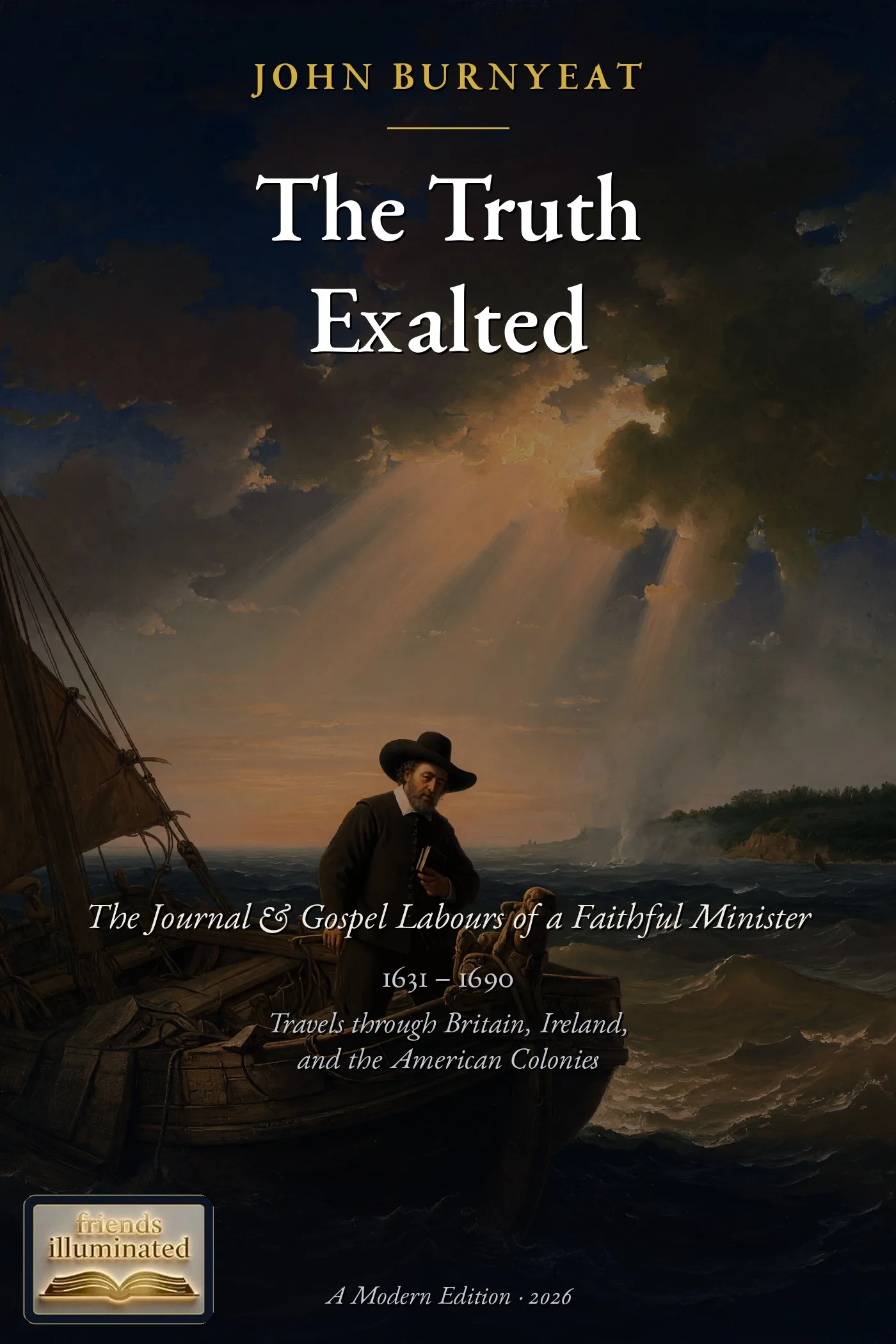
The Truth Exalted: The Journal of John Burnyeat
The journal of John Burnyeat (1631–1690), the Cumberland farmer who became the chief builder of Irish Quakerism. Convinced in 1653, he crossed the Atlantic twice, helped answer Roger Williams in the famous 1672 Rhode Island disputation, and organized the meetings of Friends in Ireland. Here is his complete journal, with his letters to his brother and his pastoral epistles, in a modern English edition with linked scripture and historical references.
- Complete journal, letters, and epistles in twelve sections
- A firsthand witness to early Quakerism in Britain, Ireland, and colonial America
- EPUB format
This edition
Read itE-book · EPUB
- Time to read3.2 hours
- Length45,544 words
- Files1 EPUB, DRM-free
How we get 3.2 hours
This figure is here so you can compare one book against another. Every title on the site is timed from its own word count at the same reading speed — nothing is adjusted book by book — so if this edition says 3.2 hours and another says half that, the second one really is about half the reading. It is a measure of size, in the way a page count is. Your own pace is your own: at the speeds typical adult readers actually manage, this edition runs anywhere from 2.5 hours to 4.3 hours.
What is in this edition
| Modernized text | 41,669 words |
|---|---|
| Introduction, chapter summaries and notes written for this edition | 3,875 words |
| Total | 45,544 words |
The introduction, the chapter summaries and the notes on people, places and unfamiliar terms were written for this edition. They are 3,875 of the 45,544 words above, and they are part of what you are buying.
Counted from the text of the EPUB you receive. Navigation, the title page, the table of contents and the licence page are excluded — they are packaging, not reading.
The reading rate
238 words per minute, for adult silent reading of non-fiction, applied unchanged to every title on the site. We did not pick the number; it is the pooled result of a published meta-analysis. Nothing is adjusted book by book — that consistency is what makes two of these figures worth comparing.
Brysbaert, M. (2019). How many words do we read per minute? A review and meta-analysis of reading rate. Journal of Memory and Language, 109, 104047. doi:10.1016/j.jml.2019.104047
190 studies, 18,573 participants.
The same paper puts most adult readers between 175 and
300 words per minute, and those two speeds give the
2.5 hours and 4.3 hours above.
Because time is words divided by speed, an even range of speeds produces an
uneven range of times, so 3.2 hours sits nearer the fast end of that
range than the middle of it.
If it were a paperback
Roughly 130–182 pages.
Words per printed page is a typesetting convention, not a measurement — it moves with trim size, type size and leading. The range above assumes 250–350 words a page. Friends Illuminated publishes no print edition of this book; the figure is here only because pages are a more familiar size than words.
- Secure checkout by Stripe
- Instant download
- 7-day money-back guarantee
About This Edition
Among the traveling ministers of the first Quaker generation, few left a record as steady and trustworthy as John Burnyeat. Born in 1631 on a farm in the parish of Loweswater, among the fells of Cumberland, he searched for years among the Puritan groups of the day and found rest in none of them. Then, in 1653, the first Quaker preachers swept through the north country, and Burnyeat was “convinced” — the word Friends used for that decisive turning. The experience marked him for life, and the journal gathered here begins at exactly that point.
What followed was nearly forty years on the road. Burnyeat became a “Public Friend,” one of the traveling ministers who carried the Quaker message from county to county and country to country. He rode the length of England and Scotland, crossed repeatedly to Ireland, and was imprisoned more than once under the persecutions of the restored monarchy. He records these sufferings without self-pity, treating jail as simply one of the places the work led him. But the journeys that made his name carried him much farther — twice across the Atlantic to the young English settlements of America, through Barbados, Virginia, Maryland, and New England.
His second American journey placed him at the center of a defining episode. In 1672 the aging Roger Williams of Rhode Island challenged the Quakers to a public debate. George Fox had already left the colony, so the burden of answering fell on Burnyeat and his fellow minister William Edmundson. The result was the famous three-day disputation at Newport, and Burnyeat’s firsthand account is one of the clearest windows we have into colonial religion a generation before William Penn founded Pennsylvania.
In his later years Burnyeat turned to Ireland, and there he did the work for which Friends remembered him longest: building the system of monthly, quarterly, and national meetings that gave Irish Quakerism its lasting structure. He died at Dublin in 1690, worn out at fifty-nine by a life of constant motion. This Friends Illuminated edition presents his complete journal, his tender letters to his brother, and his pastoral epistles to Friends, with a testimony by George Fox at the front, as in the original 1691 collection. The text is gently modernized for present-day readers, with the plain speech of thee and thou preserved where Burnyeat used it, and scripture and historical references linked throughout.