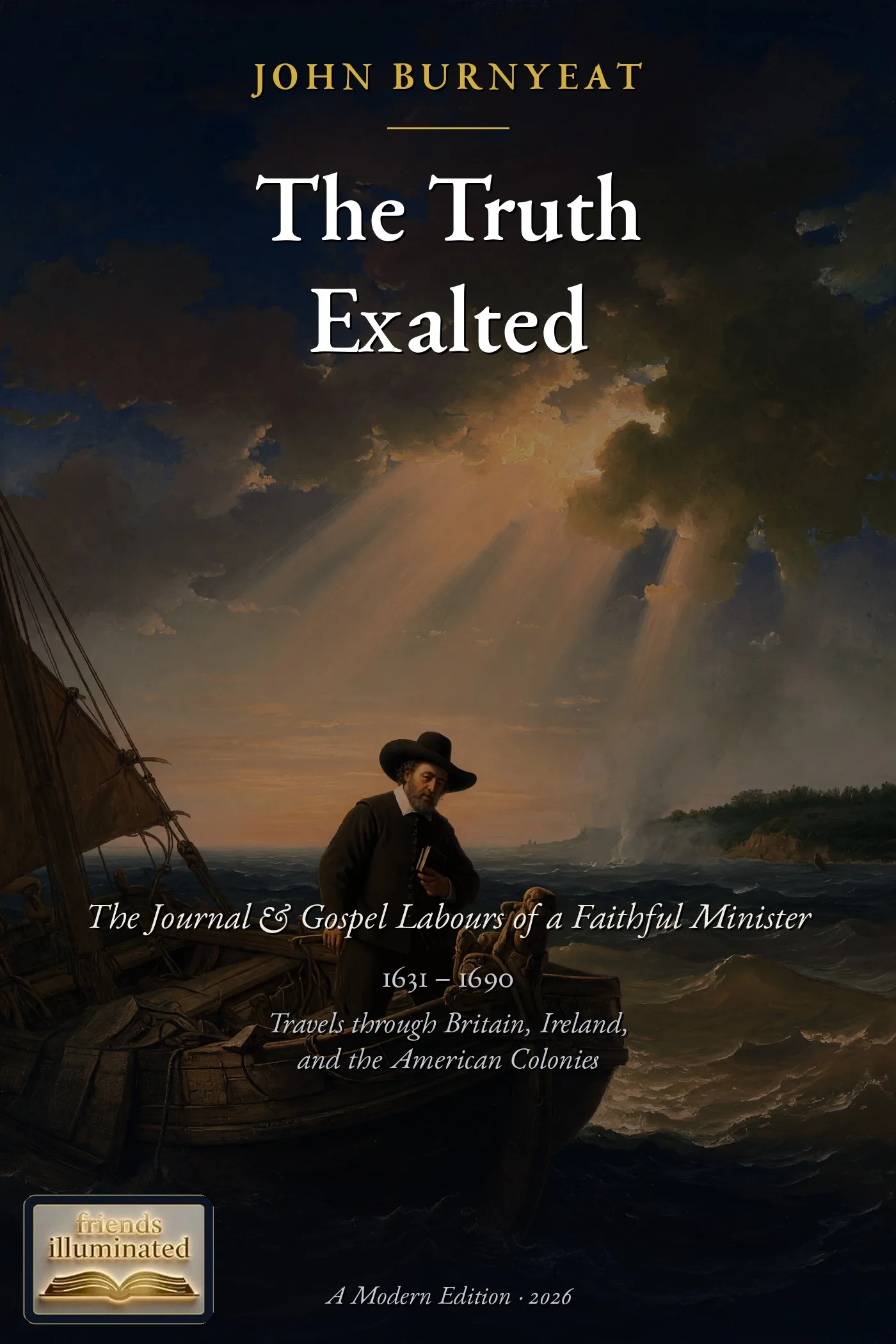
The Life of John Burnyeat
John Burnyeat was a Cumberland farmer's son who heard George Fox in 1653 and spent the next thirty-seven years on the road. The north of England and Scotland first, through the worst of the Restoration persecution — Carlisle gaol, Ripon gaol, meetings broken up and Friends carried off. Then three crossings of the Atlantic, which is what makes this book unusual: Barbadoes, Virginia, Maryland, Long Island, New England, the Carolinas, travelling by open boat and Indian guide through country that had no roads. In Rhode Island he stood up against Roger Williams before the governor and the assembly. He helped settle the order and discipline of meetings on both sides of the ocean, and he stood against the separation John Wilkinson and John Story raised in Westmorland. At the last he gave himself to Ireland and stayed there, through the Marshalsea in Dublin and through a country at war. He came home from the monthly meeting at New Garden with a fever, lay twelve days, and died on the eleventh of the seventh month, 1690. This edition gathers his journal, his epistles, and the testimonies of Friends in Cumberland and in Ireland concerning him, in clear modern English.
- Fully modernized English — every long sentence broken, every inversion untangled
- 1,933-word editorial introduction placing his three Atlantic voyages in context
- 24 chapters with argument summaries, plus a full linked table of contents
- Barbadoes, Virginia, Maryland, New England and the Carolinas — an eyewitness of the American colonies before Penn
- The public dispute with Roger Williams, and the stand against the Wilkinson–Story separation
- 501 linked Scripture and reference notes throughout
- EPUB format
This edition
Read itE-book · EPUB
- Time to read4.9 hours
- Length70,338 words
- Files1 EPUB, DRM-free
How we get 4.9 hours
This figure is here so you can compare one book against another. Every title on the site is timed from its own word count at the same reading speed — nothing is adjusted book by book — so if this edition says 4.9 hours and another says half that, the second one really is about half the reading. It is a measure of size, in the way a page count is. Your own pace is your own: at the speeds typical adult readers actually manage, this edition runs anywhere from 3.9 hours to 6.7 hours.
What is in this edition
| Modernized text | 68,445 words |
|---|---|
| Introduction, chapter summaries and notes written for this edition | 1,893 words |
| Total | 70,338 words |
The introduction, the chapter summaries and the notes on people, places and unfamiliar terms were written for this edition. They are 1,893 of the 70,338 words above, and they are part of what you are buying.
Counted from the text of the EPUB you receive. Navigation, the title page, the table of contents and the licence page are excluded — they are packaging, not reading.
The reading rate
238 words per minute, for adult silent reading of non-fiction, applied unchanged to every title on the site. We did not pick the number; it is the pooled result of a published meta-analysis. Nothing is adjusted book by book — that consistency is what makes two of these figures worth comparing.
Brysbaert, M. (2019). How many words do we read per minute? A review and meta-analysis of reading rate. Journal of Memory and Language, 109, 104047. doi:10.1016/j.jml.2019.104047
190 studies, 18,573 participants.
The same paper puts most adult readers between 175 and
300 words per minute, and those two speeds give the
3.9 hours and 6.7 hours above.
Because time is words divided by speed, an even range of speeds produces an
uneven range of times, so 4.9 hours sits nearer the fast end of that
range than the middle of it.
If it were a paperback
Roughly 201–281 pages.
Words per printed page is a typesetting convention, not a measurement — it moves with trim size, type size and leading. The range above assumes 250–350 words a page. Friends Illuminated publishes no print edition of this book; the figure is here only because pages are a more familiar size than words.
- Secure checkout by Stripe
- Instant download
- 7-day money-back guarantee
About This Edition
John Burnyeat was born at Crabtreebeck, in Loweswater in Cumberland, in about 1631. He was a farmer’s son in a corner of England that had no reason to matter, and he was twenty-two when George Fox came north. He was convinced in 1653. He was travelling in the ministry within three years, and he did not stop for thirty-seven.
The north, and the gaols
The first journeys were the ones close to home — Cumberland, Westmorland, Northumberland, the Bishoprick, and twice into Scotland. This was the Restoration, and the price was fixed: Carlisle gaol, Ripon gaol, meetings broken up by soldiers, Friends carried off from their own houses. He records it plainly and without self-pity, which is what makes it readable three and a half centuries later.
Three times across the Atlantic
What sets this journal apart from most of its generation is the sea. Burnyeat crossed three times, and he went far. Barbadoes, and the great sugar plantations where he wrote to the rulers of the island about the people they held. Virginia and Maryland, where the meetings were scattered along the rivers and he travelled by open boat. Long Island and New England. The Carolinas, through country with no roads and no bridges, guided by Indians and sleeping in the woods.
In Rhode Island in 1672 he stood up in public against Roger Williams before the governor and the assembly, in the debate Williams later printed as George Fox Digg’d out of his Burrowes. Burnyeat’s own account of that week is here.
Ireland
He gave the last part of his life to Ireland and settled there. He was in the Marshalsea in Dublin. He was there through the war between James and William, when Friends’ houses were plundered by both armies and the meetings kept on anyway. He worked at the order and discipline of meetings — the unglamorous business of records, marriages, poor relief and oversight — on both sides of the ocean, and he stood against the separation John Wilkinson and John Story raised in Westmorland.
The close
He was at the province meeting at Rosenallis, then at Mountrath, then Ballinakill, then the monthly meeting at New Garden. After the meeting he went home with John Watson to his house, felt unwell, took to his bed with a fever, and lay twelve days. He died on the eleventh of the seventh month, 1690, about two o’clock in the afternoon, in about the fifty-ninth year of his age, and was buried at New Garden on the fourteenth. The testimonies of Friends in Cumberland and in Ireland concerning him close this edition.
About this edition
Every sentence has been rebuilt for a modern reader. His vocabulary of conviction — Truth, the Seed, First-day, the numbered months — is bracketed on first use and then left alone, because translating it would translate him out of the book. Five hundred and one Scripture and reference links are set into the text; every Scripture reference was checked against the King James text rather than recalled, and every person and place link was checked by hand, with doubtful ones dropped rather than guessed.