Born in Kent
Both her parents died before she was three. Her first husband, Sir William Springett, died on Civil War service at Arundel. The 1821 printing of her manuscript gives her birth year as 1616; later reference works give 1623.
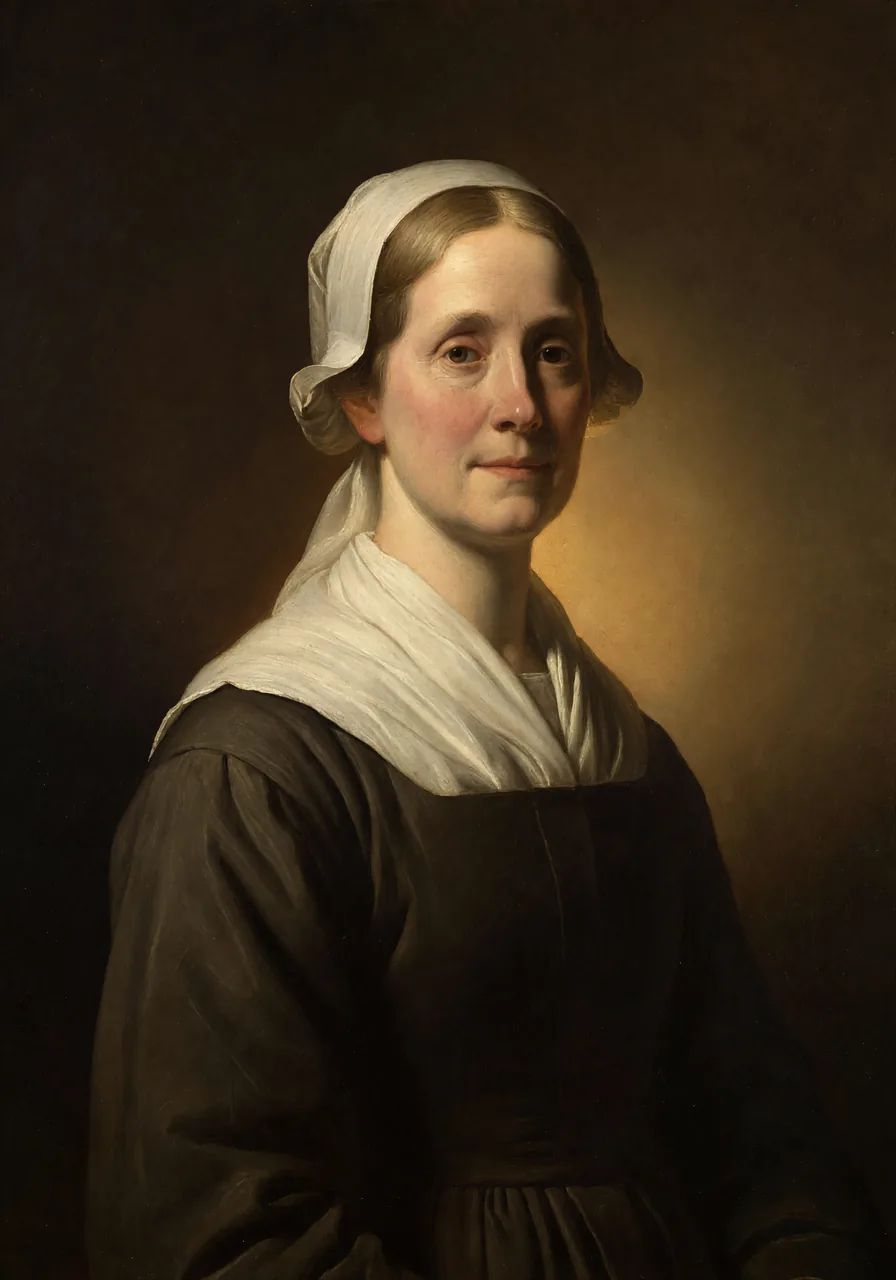
Pilgrim Soul, Author of a Striking Spiritual Autobiography
“I was wearied in seeking and not finding.” — Mary Penington
Mary Penington was born in Kent, and both her parents died — in her own words — when she was “not above three years of age”. She was raised by guardians, and her account of that childhood is largely an account of religion done badly: she was left, she says, “under the care of people who were a kind of loose Protestants, that minded no more about religion than to go to their worship-house on first days”. She was about eight when a verse of scripture first caught hold of her — “Blessed are they that hunger and thirst after righteousness, for they shall be filled” — and she spent the next thirty years hungry.
She married into the Springett family while still very young. Her husband, Sir William Springett, was about twenty, and had already stopped attending the parish worship. Both were uneasy with conventional religious forms, and they married without a ring, with — at his wish — many of what she called “the usual, dark, formal words” left out of the ceremony. They lived together, in her exact reckoning, “about two years and a month”. Springett fought for Parliament in the Civil War; the last service he saw was at Arundel in Sussex, where he fell ill and died. Mary travelled down with a doctor and reached him at the end, and her account of sitting with him is one of the most physically immediate passages in seventeenth-century Quaker writing — his breath so scorching that it chapped his lips, and cool relief only where hers touched them.
She was carrying their daughter when he died. The child was born after his death, named Gulielma Maria Springett, and it is to her — by then “my dear daughter, Gulielma Maria Penn” — that Mary addressed the account of her life. Against heavy pressure Mary refused to have her sprinkled, “which brought great reproach upon me; so I became a by-word and a hissing among the people of my own rank in the world”. It was her first public act of dissent, and she was barely into her twenties.
The years of her widowhood were the years of her searching, and she is unsparing about how bad they were. She and her first husband had already worked their way out of set prayers, out of psalm-singing as “the inventions of vain poets”, out of bread and wine and water baptism; they looked into the Independent way and “saw death there”. Alone afterwards, she went further and stopped altogether. She gave over all religious exercise, in her family and in private, and did it with grief rather than indifference — she had loved being occupied about religion. For years she did not dare kneel to pray at all, “because I could not in truth call God father, and dared not mock or be formal in the thing”. When tenderness did break over her she distrusted it, and wondered whether it was “some influence from the planets that governed the body”.
It was in exactly that condition — “in the situation I mentioned, of being wearied in seeking and not finding” — that she married Isaac Penington in 1654, the mystical writer and son of a Lord Mayor of London. She was drawn to him, she wrote, because he too “saw the deceit of all notions” and refused to be comforted by any appearance of religion. Four years later, in 1658, they came among Friends. She describes it less as conversion than as arrival, and her memory of it stayed physical: “the joy that filled my soul in the first meeting ever held in our house at Chalfont. To this day I have a fresh remembrance of it.”
She also turned her mind to practical work, and wrote about it with obvious pleasure. She planted, made provision for building, argued with surveyors who wanted to raise a whole new range from the ground, and watched part of the old house come down unexpectedly, narrowly missing her. “The building was wholly managed by me,” she records, “with great ease and cheerfulness” — an occupation almost unheard of for a woman of her rank.
Convincement cost the Peningtons a great deal. The family lost property, and Isaac was imprisoned repeatedly for refusing oaths and for attending meetings the law had made illegal — he wrote to Friends in 1661 from Aylesbury gaol in Buckinghamshire, signing himself from the prison “where my life breathes for the consolation and redemption of God’s Israel”. It was Mary’s competence with money and building that held the household together through those absences, and the Penington home became one of the fixed points of Quaker life in the Chilterns. Her daughter Gulielma married William Penn, making Mary Penington the mother-in-law of the founder of Pennsylvania; she was staying at Penn’s house at Worminghurst in 1670 when she had the second of the two dreams she chose to record.
She was in no hurry to be read. In 1668 she thought of leaving the manuscript with a Friend, Elizabeth Walmsby, to be shown after her death “to such as had a love for me”, and then forgot about it; she found it again among other writings some four years later. Isaac died in 1679, and Mary, having survived him nearly three years, died in 1682. The account she had written for her children was not printed until 1821, and it has been valued ever since as one of the clearest first-person records of the Puritan-to-Quaker journey — unusual for its candour about the false starts, the frustration, and the long stretches of genuine despair that preceded the finding. Friends Illuminated publishes it in clear modern English as A Testimony of Divine Grace: The Life of Mary Penington.
Sources: Mary Penington’s own manuscript, printed as “Some Account of Circumstances in the Life of Mary Pennington, from her Manuscript, left for her Family” (London: Harvey and Darton, 1821) — the source of every quotation above and of the events of her life. The dates for her marriage to Isaac (1654), his death (1679) and hers (1682) are from that volume’s preface; the Aylesbury prison letter is from Isaac Penington’s collected works. Note that the 1821 preface gives her year of birth as 1616, where later reference works give 1623; Friends Illuminated has not been able to resolve the discrepancy from a primary source, and gives neither as settled.
Both her parents died before she was three. Her first husband, Sir William Springett, died on Civil War service at Arundel. The 1821 printing of her manuscript gives her birth year as 1616; later reference works give 1623.
After years as a widow and spiritual seeker, married Isaac Penington. Together they found the Quakers.
Together with Isaac, convinced of Quaker truth after years of searching among Puritans and Independents.
Died having survived Isaac by nearly three years. The manuscript she left for her family was not printed until 1821.
One of the finest first-person accounts of the long Puritan-to-Quaker spiritual journey — the autobiography of a woman who searched through every form of religion available to her, gave up religious practice entirely, and described herself in those years as 'wearied in seeking and not finding.'