Born
Barbara Blaugdone was born into a time of religious turmoil in England.
Early woman missionary whose vivid account of travels and persecutions opened new paths for Quaker witness
“The Lord was pleased to make use of me, a weak instrument, to bring many to the knowledge of the Truth.” — Barbara Blaugdone
Barbara Blaugdone stands as one of the early Quaker women who chose to step beyond traditional roles to become a traveling missionary, carrying the Quaker message across England and into Ireland at a time when such public ministry by women was both radical and dangerous. Born in 1609, she lived through the tumultuous decades of the English Civil War, the Interregnum, and the Restoration—a period when religious boundaries were fiercely contested and when those who chose unconventional paths faced severe consequences.
Her convincement to Quakerism came during the movement’s early years, when the spiritual power of the first generation was transforming lives across England. Unlike many of her contemporaries who remained within their local meetings, Blaugdone felt called to travel extensively, bringing the message of the Inward Light to those who had not yet heard it. Her travels took her through England and across the Irish Sea, where she faced the particular dangers that awaited Quaker missionaries in unfamiliar territory.
The challenges Blaugdone encountered were formidable. As a woman traveling alone in the seventeenth century, she already faced significant social obstacles. As a Quaker woman minister, her challenges multiplied. The established church saw no legitimacy in her calling; local authorities viewed her as a disruptive influence; and the penalties for her ministry included imprisonment and physical abuse. Yet her Account describes these sufferings with a matter-of-fact determination that testifies to the depth of her commitment.
Her autobiography, published in 1691, is particularly valuable as one of the earliest extended accounts by a Quaker woman of missionary travels and persecution. While shorter and less famous than the works of some of her contemporaries, it provides crucial documentation of what Quaker women faced when they chose to answer the call to ministry. Her descriptions of imprisonment, of confrontations with hostile crowds, and of the spiritual support that sustained her through these trials offer modern readers a window into the costs of early Quaker witness.
Blaugdone’s account also captures something of the movement’s early evangelistic urgency. She described her sense of being “a weak instrument” used by God to bring others “to the knowledge of the Truth”—a characteristic Quaker expression of humility coupled with recognition of divine empowerment. Like Margaret Fell and other women ministers of the period, she defended her right to speak publicly by appealing to direct divine calling, a claim that carried transformative implications for religious authority and gender roles.
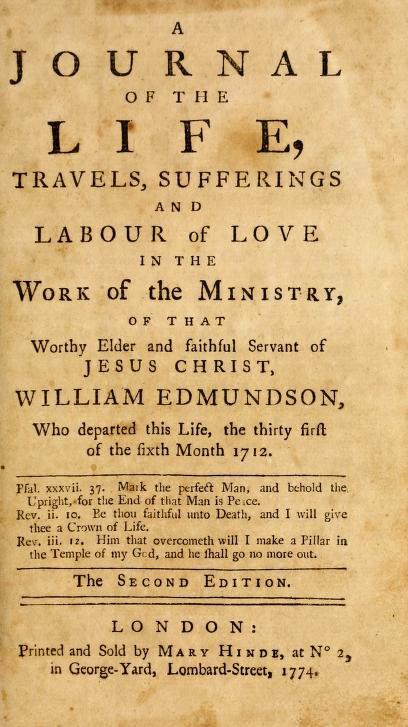
Her work connects to the broader story of Quaker expansion into Ireland, complementing William Edmundson’s more famous Journal. Where Edmundson provides the perspective of Irish Quakerism’s principal founder, Blaugdone offers the view of a traveling English missionary who brought the message to Irish soil. Together, their accounts paint a fuller picture of how the Quaker movement crossed the Irish Sea and took root in a neighboring but distinct culture.
Blaugdone lived to be ninety-five, dying in 1704. Her longevity meant that she witnessed the transformation of Quakerism from a persecuted sect to a more established religious community, though she remained among those “worthy lesser voices” whose contributions were remembered primarily by fellow Quakers and later historians. Her Account continues to be of interest to scholars of early Quakerism, women’s religious history, and seventeenth-century English religious radicalism, providing valuable primary source material for understanding how women navigated religious activism in a period of intense persecution and social constraint.
Barbara Blaugdone was born into a time of religious turmoil in England.
Converted to Quakerism and became a dedicated traveling minister, moved by the spiritual power of the early movement.
Traveled extensively as a missionary, carrying the Quaker message to various regions, including difficult journeys to Ireland.
Like many early Quaker women, Blaugdone suffered imprisonment for her ministry and refusal to conform to religious establishment requirements.
Her autobiographical account was published, providing one of the earliest and most detailed records of a Quaker woman missionary's travels and sufferings.
Published in 1691, this work provides a vivid record of an early woman missionary, including travels to Ireland and accounts of persecution faced by Quaker women.